
By Bhakti Raghava Swami – August 1-2, 2009
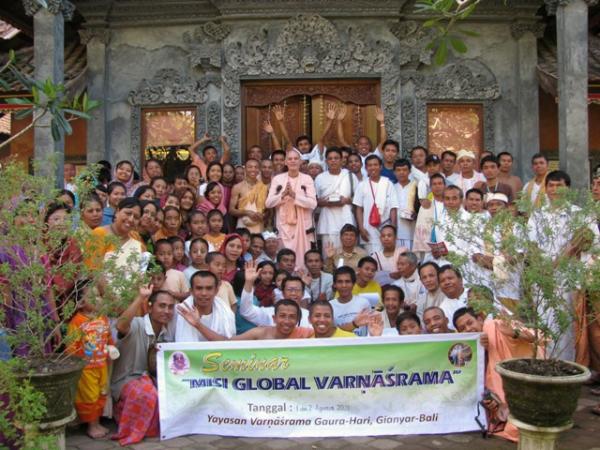
The Varnasrama Global Mission seminar ended today, August 2nd, 2009, at the Gaura Hari Asrama in Bali, Indonesia. Approximately 75 delegates from different temples in Bali attended the two day seminar with speakers coming from different parts of Indonesia such as Yogyakarta in Java and Lampung in Sumatra.
The opening day was particularly auspicious being the first day of Jhulan Yatra according to the Vaisnava calendar. This year, August 1 also commemorated the Festival of Sarasvati according to the Balinese tradition when all the educational institutions in Bali hold special functions in glorification of mother Sarasvati, the Goddess of Learning.
On the occasion of this first international varnasrama seminar, the first ever to be conducted in Indonesia, the organizers inaugurated the Gaura Hari Varnasrama College which will be a forerunner to the proposed Markendaya Rishi Gurukula. The Gaura Hari Varnasrama College will be headed by Sriman Bhagiratha prabhu who graduated last year from the Srimad Bhagavatam Vidyapitham in Govardhan where he obtained his Bhagavat Sastri degree.
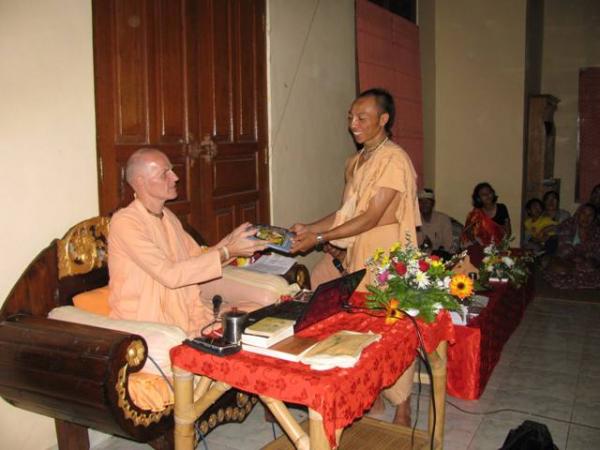
During the first day of the seminar, the book entitled Varnasrama Education, written by H. H. Bhakti Raghava Swami, was also officially launched in the local language, Bahasa Indonesia, and offered to the Temple President, Sriman Kisora Krishna who will add it to the proposed Bhaktivedanta Library at the Gaura Hari Varnasrama College.
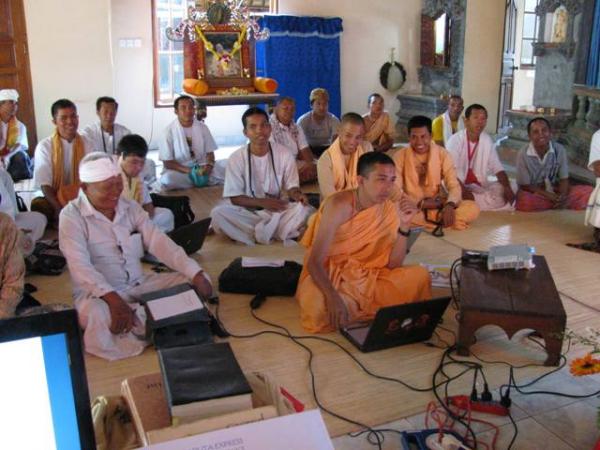
The modules presented during the two day seminar covered the following topics: (1) Overview of Varnasrama Global Mission, the Four Waves of ISKCON and Varnasrama Social Structure presented by His Holiness Bhakti Raghava Swami (Canada), (2) Bali Tradition in Relation to Varnasrama by His Grace Mahesvasa prabhu (Bali), (3) National Education in Indonesia by His Grace Visvambhara prabhu (Bali), (4) Comparison of Traditional Education Pondok Pesantren (Islam) and Gurukula (Hindu) by His Grace Surya Locana prabhu
(Yogyakarta), (5) Gita Nagari Baru project in Sumatra by His Grace Sadbhuja Gauranga prabhu (Lampung), (6) Varnasrama Projects in Indonesia by His Grace Kisora Krishna prabhu (Bali) and (7) Gurukula Traditional Education by His Grace Bhagiratha prabhu (Bali).
Each presentation was followed by a period of question and answers where participants could get clarifications on the topics presented. The response from both the speakers and participants was extremely positive and enlivening to all those who took part. Both the organizers and the participants expressed a desire to hold an annual seminar on the important topic of varnasrama education.
All those who attended the two day seminar received a Certificate of Attendance and each speaker was also presented with a book on varnasrama as well as prasadam as a small token of appreciation of their participation.
Anyone wishing more information on the seminar may contact Sriman Bhagiratha prabhu at bhagiratha@varnasrama.org.
IMPORTANT POINTS OF SEMINAR
1) ISKCON FOUR WAVES
Both Srila Prabhupada’s essay on Gita Nagari, entitled “Conception of Gita Nagari” published in BTG, 1956 and his letter to Deputy Prime Minister Dr. Patel, written earlier in 1949, spell out the four “movements” or “divisions” which later on Srila Prabhupada integrated within his ISKCON society. It is essential for every single devotee of our society to clearly understand these four divisions and to see them as a complete whole meant to compliment and support one another. These four “waves” of ISKCON are known as: 1. Sankirtan Movement (The Holy Names & Books) 2. Temple Worship Movement (Installing Deities) 3. Spiritual Initiation Movement
(Congregations) 4. Classless Society Movement (Daivi Varnasrama).
2) FROM OUR VAISNAVA ACARYAS
FROM SRILA BHAKTIVINODA THAKURA “But a devotee who desires to properly pass his life still accepts his duties according to varnasrama, as those duties are favorable to devotional service and counted as part of devotional service. All these activities are no longer called karma.” [Sri Bhaktyaloka, Six Faults that destroy bhakti]
“With the assistance of varnasrama dharma, a person should cultivate bhakti. It is also necessary to follow the rules of varnasrama in the cultivation of bhakti.” [Chapter 3] “Though all humans have a right to practice bhakti, those who follow the regulations of varnasrama have a much easier time.” [From “Sri Chaitanya Siksamrta, Chapter 3]
FROM SRILA PRABHUPADA
“The classless society so often demanded by the people in general is made possible by the process of ‘yajna” or sacrifice for the Supremei Spiritual existence of devotional activities and classless society are two identical terms. The one without the other has no meaning”. [BTG, Vol. III, Part IV,
1956, ‘Yajna’ or Sacrifice for the Supreme (Classless Society)]
“Unless in the human society the varnasrama system is introduced, no scheme or social order, health order or any order, political order, will be successful”. [Room Conversation, October 18, 1977, Vrndavana]
It is interesting that the true “classless society” or the real (spiritual) communism recognizes the divisions of society into four social classes and four spiritual orders.
One might ask, “Then how is it classless?”
It is classless in the sense that it is a society based on the recognition of the spiritual oneness of all people and even all sentient beings, as children of the Supreme Spirit, Krishna. “Panditah sama-darsinah.”
The classes are merely means of organizing society based on the external natures of different members, which make them suitable to contribute to the great yajna in different ways, with different kinds of work. Otherwise, the overriding principle is that society must cooperate to please Krishna, each contributing according to his or her particular abilities, and each accepting his or her own quota for peaceful, healthy life.
One might then ask, “But why is this so essential for performance of devotional service?”
The answer seems to be that real devotional service involves not only love for God but proper recognition of the spiritual nature of all beings as His creatures. The essential Christian formula comes to mind: “Love God with all your heart, and love your neighbor as you do yourself.”
If someone thinks they are devoted to Krishna but does not properly and respectfully treat His children, the other living beings, then that devotion is not very mature. A neophyte devotee may worship Krishna in the temple but not know how to worship Him through his or her daily interaction with other living beings.
It is sometimes recommended for an aspiring transcendentalist or yogi to go off to a solitary place to avoid the distractions of materialistic society, but the devotees generally accept the mood of Prahlada Maharaja: they do not want to be saved all by themselves, and leave the rest of the world suffering in ignorance. They show kindness to innocent people by encouraging them toward spiritual knowledge.
Therefore, devotional service is a social enterprise, and the spiritual organization of society into the four natural classes and four natural spiritual stages of life is an integral part of how devotional service is properly performed.
The great yajna for this age is sankirtan, or congregational chanting of the maha mantra and reciting of Srimad Bhagavatam and Bhagavad-Gita (and large scale distribution of these holy books to society at large). The classless society movement is an essential part of this yajna.