
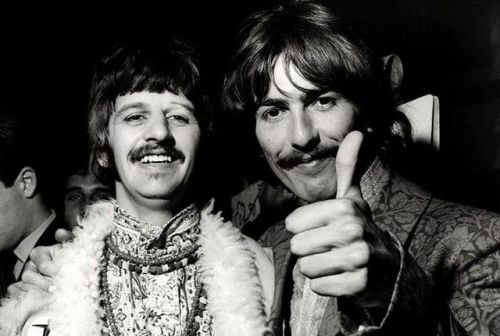
George Harrison: For all I know, Ringo might be a yogi disguised as a drummer!
Perhaps George Harrison’s greatest influence on popular culture was in the field of spirituality – in particular his promotion of the Hare Krishna movement. Richard Williams introduces an extraordinary conversation between the late musician and one of the movement’s leaders, Mukunda Goswami.
—-
George Harrison left the world, in his family’s words, “as he had lived in it, conscious of God, fearless of death, and at peace”. Thirty-five years of devotion to Krishna consciousness had prepared him for what he viewed as the translation to the next stage of his journey between the material and the spiritual worlds.
It was George who turned the Beatles and their worldwide army of followers on to the idea of the quest for enlightenment. In the process he created the material for a series of glorious parodies, from Private Eye’s long-running saga of Spiggy Topes and the Turds through Eric Idle’s Rutles (in which Harrison participated) to This Is Spinal Tap. In most of them, the joke was based on the shallowness and short attention span that, reasonably enough, characterized the average rock star.
Harrison, however, was in it for the long haul, which in his case meant a journey that would continue beyond this life. His sincerity was confirmed by his occasional shows of impatience and irritability – signs that he remained a sentient human being and not someone whose faculties had been narcoticised by the embrace of a cult. In this remarkable interview with Mukunda Goswami, recorded in 1982, he described his involvement with the Hare Krishna movement.
Mukunda Goswami: George, you were a member of the Beatles, you had material success. You’d been everywhere, done everything, yet at the same time you were on a spiritual quest. What was it that really got you started on your journey?
George Harrison: It wasn’t until the experience of the 60s really hit. You know, having been successful and meeting everybody we thought worth meeting and finding out they weren’t worth meeting, and having had more hit records than everybody else and having done it bigger than everybody else. It was like reaching the top of a wall and then looking over and seeing that there’s so much more on the other side. So I felt it was part of my duty to say, “Oh, OK, maybe you are thinking this is all you need – to be rich and famous – but actually it isn’t.”
MG: In your recently published autobiography, I, Me, Mine, you said your song Awaiting on You All is about japa-yoga, or chanting mantras on beads. How do you feel after chanting for a long time?
GH: I find that I sometimes have opportunities when I can really get going at it, and the more I do it, I find the harder it is to stop, and I don’t want to lose the feeling it gives me. For example, once I chanted the Hare Krishna mantra all the way from France to Portugal, nonstop. I drove for about 23 hours and chanted all the way. It gets you feeling a bit invincible. The funny thing was that I didn’t even know where I was going. I mean I had bought a map, and I knew basically which way I was aiming, but I couldn’t speak French, Spanish, or Portuguese. But none of that seemed to matter. You know, once you get chanting, then things start to happen transcendentally.
MG: Can you think of any incident where you felt God’s presence very strongly through chanting?
Harrison: Once I was on an aeroplane that was in an electric storm. It was hit by lightning three times, and a Boeing 707 went over the top of us, missing by inches.
I thought the back end of the plane had blown off. I was on my way from Los Angeles to New York to organise the Bangladesh concert. As soon as the plane began bouncing around, I started chanting Hare Krishna, Hare Krishna, Krishna Krishna Hare Hare/ Hare Rama, Hare Rama, Rama Rama, Hare Hare. The whole thing went on for about an hour and a half or two hours, the plane dropping hundreds of feet and bouncing all over in the storm, all the lights out and all these explosions, and everybody terrified.
I ended up with my feet pressed against the seat in front, my seat belt as tight as it could be, gripping on the thing, and yelling Hare Krishna, Hare Krishna, Krishna Krishna Hare Hare at the top of my voice. I know for me, the difference between making it and not making it was actually chanting the mantra. Peter Sellers also swore that chanting Hare Krishna saved him from a plane crash once.
MG: Did any of the other Beatles chant?
Harrison: Before meeting Prabhupada [the founder of the Kare Krishna movement] and all of you, I had bought that album Prabhupada did in New York, and John and I listened to it. I remember we sang it for days, John and I, with ukulele banjos, sailing through the Greek islands chanting Hare Krishna. Like six hours we sang, because we couldn’t stop once we got going. As soon as we stopped, it was like the lights went out. It went on to the point where our jaws were aching, singing the mantra over and over and over and over and over. We felt exalted; it was a very happy time for us.
MG: In 1969 you produced a single called The Hare Krishna Mantra, which eventually became a hit in many countries. That tune later became a cut on the Radha-Krishna Temple album, which you also produced. A lot of people were surprised by this, your producing songs for and singing with the Hare Krishnas. Why did you do it?
Harrison: Well, it’s just all a part of service, isn’t it? Spiritual service, in order to try to spread the mantra all over the world. Also, to try and give the devotees a wider base and a bigger foothold.
MG: How did the success of this record of Hare Krishna devotees chanting compare with some of the rock musicians you were producing at the time, like Jackie Lomax, Splinter, and Billy Preston?
Harrison: There was less commercial potential in it, but it was much more satisfying to do, knowing the possibilities that it was going to create, just by doing a three-and-a-half-minute mantra. That was more fun really than trying to make a pop hit record.
MG: What effect do you think that tune, The Hare Krishna Mantra, having reached millions of people, has had on the cosmic consciousness of the world?
Harrison: I’d like to think it had some effect. After all, the sound is God.
MG: When Apple called a press conference to promote the record, the media seemed to be shocked to hear you speak about the soul and God being so important.
Harrison: I felt it was important…to come out of the closet and really tell them. Because once you realise something, then you can’t pretend you don’t know it any more. So the idea was to try to spiritually infiltrate society, so to speak. One of the greatest thrills of my life, actually, was seeing you all on BBC’s Top of the Pops [with the Hare Krishna single]. I couldn’t believe it. My strategy was to keep it to a three-and-a-half-minute version of the mantra so they’d play it on the radio, and it worked.
MG: Shortly after its release, John Lennon told me that they played it at the intermission right before Bob Dylan did the Isle of Wight concert with Jimi Hendrix, the Moody Blues, and Joe Cocker in the summer of ‘69.
Harrison: They played it while they were getting the stage set up for Bob. It was great. Besides, it was a catchy tune, and the people didn’t have to know what it meant to enjoy it.
MG: What about the other Beatles? What did they think about your taking up Krishna consciousness? What was their reaction? You’d all been to India by then and were pretty much searching for something spiritual.
Harrison: Oh, yeah, well, if the Fab Four couldn’t deal with shaven-headed Hare Krishnas, then there would have been no hope! And the devotees just came to be associated with me, so people stopped thinking, “Hey, what’s this?” you know, if somebody in orange, with a shaved head, would appear. They’d say, “Oh, yeah, they’re with Harrison.”
MG: You know, the Tudor mansion and estate that you gave us outside London has become one of our largest international centres. How do you feel about the Bhaktivedanta Manor’s success in spreading Krishna consciousness?
Harrison: Oh, it’s great. And it also relates to making the Hare Krishna record. It gives me pleasure, the idea that I was fortunate enough to be able to help at that time. All those songs with spiritual themes were like little plugs – My Sweet Lord and the others.
MG: In The Ballad of John and Yoko, John and Yoko rapped the media for the way it can foster a false image of you and perpetuate it. It’s taken a lot of time and effort to get them to understand that we are a genuine religion, with scriptures that predate the New Testament by 3,000 years. Gradually, though, more people have come around, and today they have a great deal of respect.
Harrison: The media is to blame for everything, for all the misconceptions about the movement, but in a sense it didn’t really matter if they said something good or bad, because Krishna consciousness always seemed to transcend that barrier anyway. The fact that the media was letting people know about Krishna was good in itself.
MG: You write in your autobiography that “No matter how good you are, you still need grace to get out of the material world. You can be a yogi or a monk or a nun, but without God’s grace you still can’t make it.” And at the end of the song Living in the Material World, the lyrics say, “Got to get out of this place by the Lord Sri Krishna’s grace, my salvation from the material world.” If we’re dependent on the grace of God, what does the expression “God helps those who help themselves” mean?
Harrison : It’s flexible, I think. In one way, I’m never going to get out of here unless it’s by His grace but then again, His grace is relative to the amount of desire I can manifest in myself. The amount of grace I would expect from God should be equal to the amount of grace I can gather or earn. I get out what I put in. Like in the song I wrote about Prabhupada:
The Lord loves the one that loves the Lord
And the law says if you don’t give,
then you don’t get loving
Now the Lord helps those that help themselves
And the law says whatever you do
It comes right back on you
MG: Did any of the other Beatles believe in reincarnation?
Harrison: I’m sure John does! And I wouldn’t want to underestimate Paul and Ringo. I wouldn’t be surprised if they’re hoping it’s true, you know what I mean? For all I know, Ringo might be a yogi disguised as a drummer!
MG: Where do you think John’s soul is now?
Harrison: I should hope that he’s in a good place. He had the understanding, though, that each soul reincarnates until it becomes completely pure, and that each soul finds its own level, designated by reactions to its actions in this and previous lives.
MG: Dylan did a lot of chanting at one time. He used to come to the Los Angeles temple and came to the Denver and Chicago temples as well. In fact he drove across the US with two devotees once and wrote several songs about Krishna. They spent a lot of time chanting.
Harrison: That’s right. He said he enjoyed the chanting and being with them. Also Stevie Wonder had you on one of his records, you know.
MG: You wrote in your book, “Most of the world is fooling about, especially the people who think they control the world and the community. The presidents, the politicians, the military, etc, are all jerking about, acting as if they are Lord over their own domains. That’s basically Problem One on the planet.”
Harrison: That’s right. Unless you’re doing some kind of God conscious thing and you know that He’s the one who’s really in charge, you’re just building up a lot of karma and not really helping yourself or anybody else. There’s a point in me where it’s beyond sad, seeing the state of the world today. It’s so screwed up. It’s terrible, and it will be getting worse and worse. In one sense, I’m pessimistic about the future of the planet. These big guys don’t realise for everything they do, there’s a reaction. You have to pay. That’s karma.
MG: Do you think there’s any hope?
Harrison: Yes. One by one, everybody’s got to escape maya [the illusion of the material world]. Stop thinking that if Britain or America or Russia or the west or whatever becomes superior, then we’ll beat them, and then we’ll all have a rest and live happily ever after. That doesn’t work. Manifest your own divinity first. The truth is there. It’s right within us all.
Extracted from Chant and Be Happy, available from the bookshop at Bhaktivedanta Manor, Hillfield Lane, Aldenham, Watford WD25 8EZ.