
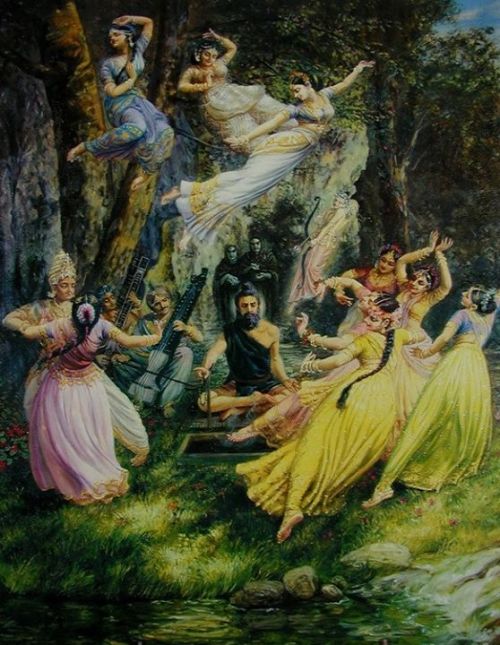
MARKANDEYA RSI TEMPTED BY CUPID AND HIS FOLLOWERS
Markandeya Rsi, a great devotional mystic, resided in a hermitage on the northern side of the Himalaya Mountains. Observing that the sage was becoming very powerful by performing severe penances and austerities, the demigod Indra became fearful of his growing mystic potency. To ruin the sage’s spiritual practice, Lord Indra sent Cupid, beautiful celestial singers, dancing girls, the season of spring, and a sandalwood-scented breeze from the Malaya Hills, along with greed and intoxication personified. Cupid, the master of many heavenly women, went to Markandeya’s hermitage carrying his bow and arrows. He was followed by groups of Gandharvas playing musical instruments and singing. The women danced before the sage, and the celestial singers sang to the charming accompaniment of drums, cymbals, and vinas.
While greed personified, spring, and the other servants of Indra all tried to agitate Markandeya’s mind, Cupid drew his five-headed arrow and fixed it upon his bow. The Apsara Puñjikasthali made a show of playing with a number of toy balls. Her waist seemed weighed down by her heavy breasts, and the wreath of flowers in her hair became disheveled. As she ran about after the balls, glancing here and there, the belt of her thin garment loosened, and suddenly the wind blew her clothes away. Cupid, thinking he had conquered the sage, then shot his arrow.
But all these attempts to seduce Markandeya Rsi proved futile, just like the useless endeavors of an atheist. In the midst of all these disturbing influences, Markandeya remained fixed in his meditation, defeating Cupid and his associates by burning them with his mystic potency. Though the followers of Lord Indra had impudently attacked the saintly Markandeya , he did not succumb to any influence of false ego. For great souls, such tolerance is not at all surprising.
The mighty King Indra was astonished when he heard of the mystic prowess of the exalted sage Markandeya and saw how Cupid and his associates had become powerless in his presence.
PAINTING BY JADURANI – DEVI DASI (1982)