
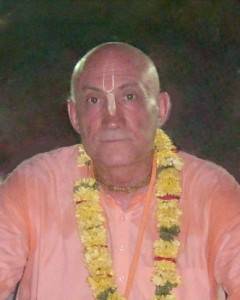
 By Dhanesvara Das
Since I first met him in 2004 it was my custom to visit with Aindra Prabhu each time that I went to India. Last year was no different, and I knocked on his door on 30 June 2010, not knowing that this would be our last meeting. Visiting Aindra was always a very special occasion. He was a devotee who didn’t wasted time, always was preaching, and always spoke from his realization. And his realizations were something extraordinary. I did have some things I wanted to tell him this time, however-his book. An electronic copy of it was passed to me some months earlier and I wanted to make him aware that it was circulating, perhaps against his wishes.
He had his own agenda however, and from the very beginning he was pressing me: “When will you come back to Vrindavana (even though I hadn’t even left yet!)? Will you be back for Kartika? You should come back and stay in Vrindavana for some time…” On and on he pressed these points, and he was intense about it, and but at the same time very personal, and clearly speaking for my welfare, like a concerned parent would to their teenager. After we spoke a bit more I wanted to excuse myself so as not to take too much of his time, but he wanted to go on, and did go on-for several hours. Quite amazingly it seemed that he knew exactly what I needed (and wanted) to hear and he kept on with it. Moreover, there was an unmistakable urgency to his message that touched me to the core. “There is no time to waste. We don’t know how much time we have in this world, and we should use every available minute for chanting the holy names in japa and harinam. And we should do whatever we can to live in Vrindavana. Vrindavana is such a special place because in Vrindavana you get 1,000 times the benefit for your devotional service than you do anywhere else.”
He had another intense lesson for me, repeatedly telling me that raganuga bhakti was a separate path from vaidhi bhakti, and that raganuga had to be intentionally cultivated as such. He went on and on about this too, but he was speaking about things that I was only partly familiar with, so remembering that I had my MP3 recorder I thought that I should record him. So I turned it on and he continued with his message. Here is (in part) what he said:
“Sadhya bhakti refers to from the stage of bhava onwards…means bhava and prema.
“This brahma bhuta prasanatma na sociti na kanksati, this idea of being established on the brahma buta platform refers to this verse in Bhagavad-gita where he says sa gunan samitiyaitan brahma buyaya kalpate, transcending the modes of material nature and coming to the level of brahman. But Prabhupada establishes in one of his purports that that brahma buyaya kalpate refers to the bhava platform. Which means that one isn’t established above the influence of material nature until he comes to the bhava platform. From the bhava platform, there, real spontaneous devotional service begins. And this is described in Bhakti Rasamrta Sindhu where Rupa Goswami says that actually real devotional service doesn’t begin until one comes to the platform of spontaneous devotional service.
“Spontaneous devotional service means sadhya bhakti, not sadhana bhakti. Raganuga is part of sadhana, not sadhya. This is a common misunderstanding among devotees.
“Bhava is the beginning of the stage of sadhya…See the problem is, I can show you, it will take some in-depth discussion, but I can show you where in Prabhupada’s Nectar of Devotion in one chapter there are six serious mistakes which have, I don’t blame it on Srila Prabhupada, but whether Srila Prabhupada read it or not, I don’t know, because it seems like he would have caught the mistakes, but in the Spontaneous Devotional Service chapter, instead of using the actual word used by Rupa Goswami, ragatmika, the word raganuga has been used. Which has created complete confusion among the vast number of devotees in our society who think that raganuga is something that happens after you have already gone to the bauma lilas of Krishna, and you are following in the footsteps of the eternal associates of Krishna, as a cowherd boy trainee in the bauma lilas of Krishna. They have this conception that that is what raganuga is all about, but it’s totally wrong.
“That conception has to change. At that stage it is ragatmika. Those eternal associates of Krishna and those who are sadhana siddhas and krpa siddhas, who come to the perfectional platform of becoming eternal associates of Krishna, they are ragatmika. Whereas raganuga refers to…if you study carefully the Chaitanya-charitamrita, it is correct. But in the Nectar of Devotion which was read long before, and first impressions are lasting impressions, so you may not get beyond the confusion because you are still harboring the misconception, so you don’t catch it.
“But in Bhakti Rasamrita Sindhu, Rupa Goswami, in his description of the process of sadhana bhakti, he describes that there are two margs. It’s not two levels, they are two paths of sadhana bhakti. One is vaidhi sadhana marg, and the other is raganuga sadhana marg. They are both sadhana bhaktis, and they both begin from sraddha. There is adhua shraddha…and, but one type of sraddha engenders vaidhi sadhana, and the other type engenders… there is what is called shastra visvas maya shraddha, vishvas means faith in the instructions or the injunctions of the shastras. Do’s and don’ts. Prohibitions. It is fear-based devotion based on the determination to hear shastric injunctions in order to avoid repercussions by committing offenses. That is vaidhi sadhana marg. And then there is raga sadhana marg. What does raga mean? Raga means attraction.
“Actually Srila Prabhupada didn’t come to give vaidhi bhakti, but to give raga bhakti. And this is described in Chaitanya-siksamrita, and you should read it very carefully, that the purpose of vidhi, rules, is to curtail one’s inordinate raga, or attraction, for mundane rasas. So the viddhi is simply there to force you to give up your attraction and attachment to mundane rasas so that you stand a fighting chance. By the influence and association of rasika Vaishnavas or raga bhaktas, they can help you to become acquainted to Krishna Who is all-attractive. And then when you become attracted to Krishna-lila then viddhi has already served its purpose and is no longer relevant. But there is a transitional stage where there are different degrees of the necessity for the influence of viddhi and the influence of attraction.
“It is very clear that there are two margs. One marg is based on shastra vishvas maya shraddha and the other is based on lobha maya shastra. Lobha means greed and greed is based on attraction. So it depends on what kind of association you have. If you are associating, and it depends on the receptivity, based on previous accumulation of bhaktyam mukhe sukriti, from previous lifetimes, which is based on the types of association you had in previous lifetimes. If you associated with ritualistic devotees in previous lives, then in this life you may be develop this shartra vishvas maya shraddha to a large extent and be more or less fixed up in your determination to follow vaidhi marg. Whereas if in previous lives you had association with rasika Vaishnavas then your natural receptivity toward the attractiveness of Krishna, and unalloyed devotional service in Krishna consciousness will engender lobha maya shraddha. This shraddha is based on greed to attain something that you have seen that is very attractive to you. You have high estimation to something that is very attractive and wonderful that has allured you to go beyond whatever would stand in your way to attain. Therefore Bhaktivinoda Thakur says that the difference between vaidhi marg and raga marg is that the vaidhi marg is very weak whereas the raga marg is very strong. By vaidhi marg, on account of the fact that you are lacking the attraction to the actual objective, you are only adhering to the principles of bhakti due to your fear of falling back into maya. And he says that it will be a very long time and laborious process by following the vaidhi marg to come from the stage of sraddha to the stage of bhava.
“And not only that, but the bhava that is realized by doing vaidhi bhakti is different from the bhava realized by raga. You wind up with a ritualistic form of bhava, or what is called mayada bhakti, or aisvarya jnana mayi bhakti. Whereas in the raga marg, because of the force of attraction, the magnetism that one experiences in coming with Krishna’s subject matter, which is attracting your heart, when that greed evolves in your heart, then naturally you don’t want anything to come between you and your objective, and you can very quickly progress through the stages anartha nivriti.
“This is described in Visvanatha’s Ragavartma Chandrika, which is a very important book to read. There is one book called “Bhakti Trilogy” that might include it. I can give you these electronically. I have all these books.
“The point is that in Nectar of Devotion, in the chapter titled “Spontaneous Devotional Service Further Described”, there is no mistake as such, where they are improperly using the word raganuga. It’s just that in the previous chapter you have read the word raganuga, raganuga, raganuga, and you get this idea of what raganuga is, but when you the next chapter you are wondering what are we talking about here because he’s using the same word raganuga to refer to something that is of a different nature. So you must be thinking that this is raganuga that is relative to term raganuga used in the previous chapter, and then you are totally confused.
“I wish we could sit longer, maybe if you have time tomorrow, and I can show you Banu Maharaja’s translation of Bhakti Rasamrta Sindu. I first discovered this many years ago when I read Banu Maharaja’s translation. In his translation the word ragatmika is used, then I went back to Prabhupada’s and I saw that there was a misuse of the terminology. And I realized that that is where all the confusion is coming from.” Unfortunately at this point the recorder battery was finished, but this significant segment of the conversation was captured, and this is what I wanted to share with the Dandavats readers. Aindra is absolutely correct in this mistake that appears in the “Nectar of Devotion.” The good news is that the correction has finally been made in the most recent English edition, and I recently confirmed this with Dravida Prabhu, the BBT editor. The bad news is that this mistake has been promulgated in the translations of NOD because they are all based on the English book. I have checked the Lithuanian book (where I am right now) and the mistakes are there. So I want to encourage all devotees who have friends in non-English speaking countries to tell them to correct these mistakes so that the confusion is not perpetuated. Two Different Paths? At first I was confused by Aindra’s statements that vaidhi-bhakti and raganuga-bhakti were two different paths, because Srila Prabhupada repeatedly and clearly makes it clear that one must follow vaidhi-bhakti until he has reached the stage of anartha-nivritti, being free from the impulse and desire to commit sinful activity. I needed to think this through carefully and research it. As I did it became clear that he was making the point that after one reaches anartha-nivritti one needs to intentionally take up the path of raganuga, not in-place of, but as far as necessary, along with vaidhi bhakti. This instruction is given by Srila Bhaktivinoda Thakur in “Sri Caitanya-siksamrita”:
“There is another type of sadhana bhakti besides vaidhi bhakti. It is called raganuga bhakti. Previously it was said that there are two ways of pleasing the Lord: by following rules and by attraction. It is necessary to differentiate between these two. That system of worship of the Lord that is executed through a sense of duty is called vaidhi bhakti. Rules that are executed through consideration of a sense of duty are called “vidhi.” The tendency that operates through a natural taste is called “raga”” To be completely and spontaneously absorbed in some object is called “raga.”
“The object pursued by raga is called the desired object. In the activities of raga there is no necessity of consideration or deliberation of what to do or what not do. Raga is a natural propensity. The raga exhibited by the soul in a conditioned state is a perversion due to false bodily identification, and the perverted raga accepts material things as its objects. Directing this raga towards flowers, food, drink, intoxicants, clothing, shelter, or lover, the living entities end up in a world of illusions. For this reason the conditioned souls are situated far apart from raga directed to the Lord. Since bhakti instigated by raga is therefore very rare, it is necessary to consider carefully what is beneficial and detrimental in worshipping the Lord. From this consideration arises rules or vidhi.
“The rules monitor the state of raga. Rules are not an opposing party to raga. Rules may be called ritual and raga may be called spontaneous attachment. Though they are different conceptions, in the pure state they are one. Rules in their pure state are assistants to raga. Pure raga follows the rules, which are the will of the Lord. For the Lord, the rules predominate, and for the jivas, raga predominates. The opposition of raga and vidhi seen in the material world is due to the unhealthy condition of raga. When raga recuperates, vidhi, having fulfilled its function, retreats. Therefore, in the healthy state raga predominates for the jiva. As much as raga for material things leads to degradation, so raga for the Lord becomes the highest condition of existence. The relation of raga with vidhi is like the relation of the body to medicine. Raga has many functions, but vidhi’s function is to protect and nourish raga. When raga is thoroughly nourished, it does not depend on vidhi any longer.
“Pure raga for the Lord takes shelter of only the pure soul, a soul who has been liberated from material contamination. That pure raga is called ragatmika bhakti. Only pure souls, who participate in the Lord’s pastimes, are qualified for ragatmika bhakti; none except the inhabitants of Vraja are qualified. When conditioned souls, by hearing the descriptions in the scriptures, develop a desire to follow after the inhabitants of Vraja who offer ragatmika bhakti to Krsna, the bhakti that results is called raganuga. The inspiration for this bhakti is greed for its object, not rules or scriptural guidelines. The rules, by various methods, attempt to stimulate the nature of the soul. When greed becomes the impetus for those rules, it is no longer called vaidhi bhakti, but raganuga bhakti. Thus there are two types of sadhana bhakti: vaidhi and raganuga.
“That person who becomes greedy to attain the emotional state in which the ragatmika devotees serve Krsna is qualified for raganuga bhakti. Raganuga bhakti includes all the same angas as vaidhi bhakti, but the devotee of raganuga bhakti performs those activities with a spontaneous mood, rather than by rule. The conditioned soul living in the world must necessarily carry out physical, mental and social activities to maintain his body. Those rules mentioned in the discussion of vaidhi bhakti, which serve to keep the devotee on the path of devotion and prevent him from becoming materially contaminated, must also be followed by the practitioners of raganuga bhakti.
“The practice of raganuga is internal, so what external rules should the person follow?
[Devotees! Please note this next important paragraph!]
“If devotees do not accept all the necessary rules of vaidhi bhakti which serve to make them fit for practicing internally, they will finish their life untimely or revert to material life, and reduce their propensity for raga. If the manner of cultivating devotion is not accepted in full, internal practice cannot be maintained or grow. Interest in raganuga may grow, but the angas of bhakti, such as hearing and chanting should not be given up.
“Just as in vaidhi bhakti, the rules of naitika dharma mature and change shape, so also, in raganuga bhakti, the rules of vaidhi bhakti change slightly in emotional content and display some independent qualities. In some circumstances the rules change slightly, and in other cases they transform entirely. This will be apparent from observing the conduct of the devotee. These changes do not arise from scripture, but according to the taste of the individual, and thus examples are hard to give. Examples can only be given for vaidhi bhakti.” This quotation should be sufficient to make the point perfectly clear. Please note the corrections to the Nectar of Devotion and make them in your copy. I did get the opportunity to tell Aindra about his book and he was more concerned whether the one circulating was the final copy of the book. Apparently he had made some changes that were important to him, and if anything was going to circulate he wanted it to be the final edition. In any case the paper edition is available and it is such a lovely and artistic book, both in the printing and case, as well as the language, which can only be Aindra’s. I love it. Alas, I didn’t go back the next day as I had made a hasty arrangement to return to Delhi that morning. But I was ecstatic about our conversation and was so much looking forward to meeting with Aindra again to continue the discussion. Sadly, that was the last conversation. He knew he was going to leave this world soon, and he said as much in his book. Perhaps that was why he spoke to me in such an urgent mood.
Dhanesvara Das
www.spiritual-econ.com http://spiritual-econ.blogspot.com http://gitagrad.blogspot.com
Dear Dhanesvara Prabhu, pranams.
Thank you so much to share this most fortunate conversation with all the readers of Dandavats. It is one of those posts that deserve the mention “MUST READ”.
We remain hungry for more of such nectarean exchanges. Million thanks.
May you realize all that you heard. Thanks again. Hare Krishna.
Your humble servant,
Prabhava Vigraha dasa
Dear Dhanesvara Prabhu,
Please accept my obeisances. All glories to Srila Prabhupada.
Please note: the errors in The Nectar of Devotion that Aindra Prabhu mentions in the third and fourth paragraphs of this transcript have been corrected by the BBT.
“For the latest printing of The Nectar of Devotion, at the beginning of chapter 15 the BBT’s editors have six times changed the word raganuga to ragatmika.”
For more details see:
http://www.bbtedit.com/node/278
Your servant,
Acyuta Dasa
This is a very passionate discussion by empassioned bhaktas. I will not stand on the tracks when that train is passing! However, in a general way, I want to try to emphasize several points. First, it is stated that Srila Prabhupad “did not come to give vaidhi bhakti”. Quite to the contrary, Srila Prabhupad instituted vaidhi bhakti. He wanted to give the medicine that is needed to draw the conditioned souls out from a life of useless sense gratification, into a life of serving Krishna. He certainly was very cautious about bhaktas trying to leap into Braja lila when they are not qualified. For example, when some tried to start a “gopi bhava club” at the LA temple in the mid-1970s, Srila Prabhupad criticized thusly (I was his secretary then): “What is this gopi bhava club?! Let them chant Hare Krishna for 300 years first, then talk of the gopis!” He was very cautious about sahaja-ism creeping into the mix. Vrindaban today is notorious for sahaja-ism.
Now, the consideration of raganuga bhakti is something that Srila Bhaktisiddhanta Saraswati Thakur Prabhupad alluded to by saying that “it should be taken upon one’s head as a worshipable ideal.” Generally, that is a proper mood to consider. One should not try to prematurely enter into a stage on the mental or emotional plane, when these planes are clearly transcendental and virtually inconceivable to the conditioned soul. The exchange of love with Krishna in Goloka is fully Krishna centric. For example, when Krishna calls the gopis with His flute, the gopis drop whatever they might be doing, in whatever condition of dress they might be in, and go to Krishna. The gopis are fully conscious of pleasing Krishna, without any desire for self-enjoyment. Their forgetfulness of self for absorption in Krishna consciousness is a sign of their extreme love…that Krishna asked Uddhava to visit Vrindaban to witness. Uddhava concluded that he would want to become a blade of grass in Vraja so he might be blessed by the dust of the lotus feet of the gopis. Whatever name you give to it, this is a worshipable state. Pusta Krishna das
Dear Pustakrishna prabhu, please accept my humble obeisances. All glories to Srila Prabhupada! All glories to the years of your dedicated service to our Founder-Acarya!
Thank you for emphasizing the importance of following rules. I think that every serious member of ISKCON is aware of its importance. Moreover, even the devotees that are emphasizing importance of raganuga-sadhana, like Radhakunda and Aindra prabhus, never broke the rules and never preached against the rules. The rules and regulations are called sadhana in sanskrit. Raganuga-bhakti is as much a sadhana as vaidhi-bhakti is and not a perfected stage that you are perhaps refering to. It has its clear rules, which are not against the rules of vaidhi-bhakti. The problem is, that the vaidhi-bhakti is not giving the same result as raganuga-bhakti, i.e. it is not giving Krishna prema as far as my understanding. Please correct me if I understood NOD or CC wrongly on this matter. The other problem is that ragatmika and raganuga-bhakti are often taken as same thing by ISKCON devotees, because of the problems of early Nectar of Devotion editions (it has been corrected in newest edition by BBT). The example you are giving with gopis responding to Krishna flute falls into category of ragatmika-bhakti and not raganuga-sadhana. Raganuga-sadhana means trying to reach the same perfection (raga) as one of the eternal associates of Krishna. So it is a way, not the goal. My understanding is that raganuga-sadhana is sadhana with rules and regulations as much as vaidhi-sadhana, but motives and goals are different, to put it very simple. In raganuga-sadhana there is drive from within, not from outside as in the vaidhi-bhakti. That means that disciple is becoming more mature, independently thoughtful and responsible and that is what Srila Prabhupada wanted, isn’t it? Some taste is already there.
Our raganuga-sadhana comprises not of siddha-pranali, but of intense chanting (certainly more then 16 rounds) and remembering Krishna. So it means more intense sadhana with a specific goal in relationship to our eternal service in Goloka-dhama which will be revealed only by that sadhana and not vaidhi-bhakti. I am not preaching against vaidhi-bhakti and its importance. I would just like to see that both paths are put in right perspective. Thank you very much for considering these points.
With Love
Your humble servant
Dhira Nitai das, Croatia/Germany
Thank you so much Dhanesvara Prabhu for sharing this precious talk by His Grace Aindra Prabhu. The points made about the two aspects of sadhana bhakti, vaidhi and raganuga bhakti, are really essential. We should’nt be just satisfied by “getting the job done” we should
be greedy after developing “internal devotional service” (as Aindra Prabhu reminded us) and more spontaneous love for the Lord.
Of course we should be very cautious about any deviation from the general rules of vaidhi bhakti and keep ourselves away from sahajism tendencies but simultaneously we should be greedy for getting the “nectar for which we are always anxious” . This is Lord Chaitanya Mouvement and it is based on developping love of God. It is not enough to simply follow the rules (altough it is essential if we want to reach gradually to a higher platform of spontenous devotional service) we should be greedy after getting a taste of love of God or bhava (even if it is a very small drop for most of us).
Srila Prabhupada certainly “instituted vaidhi bhakti” but simultaneously expected from his disciples (and grand disciples) that they reached a more spontaneous platform regarding their relation with Krishna. When asked “what pleases you the most, Srila Prabhupada?” by one of his disciple, Srila Prabhupada answered “If you love Krishna”. This should be the goal – and nothing else – behind every field of activity in the Krishna consciousness Mouvement.
The subtle point I shall try to put forward for a simple understanding. On the deepest level of bhakti, one is not at all self conscious, but rather fully absorbed in ecstatic love for Krishna. It is all for Krishna, no hint of self-absorption. Sometimes, and of course this science is promoted by none other than Srila Rupa Goswami, one thinks in a more academic or analytical manner to define where they are or where they are headed. Raganuga is spontaneous inside out flow of devotional service, whereas Vaidhi is imposed by rules imposed. All rules, as Srila Rupa Goswami describes culminate in this: Always remember Krishna, never forget Krishna. All of this becomes “jnana sunya bhakti”, loving serving without a tint of jnana, in the divine state of Krishna consciousness as revealed in Braja lila. The property of Krishna bhakti in its highest state is: All for Krishna. It is as if one is depositing in the bank of Krishna, and expecting no dividend return from Krishna. The gopis criticize Krishna for leaving them because their loving sentiment of separation draws out their loving exchange with Krishna whether He is visible before them or not. The rasa of exchange in madhurya is like that. And, it is worshipable by us. The major point is this: Do not try to consider your self as a gopi, to imitate them. No, No, No. Rather, meditate on their fine sentiments and lila. Take it upon your head. Avoid cheapening by drawing this down to our conditioned level of mental and emotional processing. That would be sahaja-ism. It is condemned by our acharyas. If one will one time in history be invited into that state of transcendental loving service, that is wonderful and divine. But, if you are thinking that “you” will enjoy that state, it is not suddha-bhakti, but mixed. It is best if you take a lower position…Always. “No, this cannot be it”. This will protect you from again becoming the ‘center’, rather than Krishna, the reservoir or love and joy, as the center. Remember, always deposit, never expect a dividend…and if you receive a dividend, then deposit that as well. I hope this clarifies what I am trying to share. With affection for our wonderful family of bhaktas, Pusta Krishna das
Dear Pusta Krishna Prabhu,
Please accept my humble obeisances. All glories to Srila Prabhupada. Thank you for your efforts to clarify things. You are quite right that any sadhaka who is attempting to enjoy Krishna’s lila is engaged in mixed devotional service. We must be careful to note that the enjoying mentality must be abandoned *before* the sadhaka can achieve the stage of anarta nivriti. The acharyas caution that one may only begin their bhajan (internal devotional service of raganuga bhakti) *after* they have achieved the stage of anarta nivriti, otherwise they risk grave offenses, becoming guilty of the sahaja-ism that you warn about.
Srila Bhaktivinoda Thakur makes it clear that raganuga bhakti is not a “spontaneous inside-out flow of devotional service” as you suggest, but a stage of sadhana (see above: “There is another type of sadhana bhakti besides vaidhi bhakti. It is called raganuga bhakti.”) or practice, based on attraction, not rules. That spontaneous devotional service, as demonstrated by Sri Krishna’s most intimate associates who are nitya-siddhas, is ragatmika bhakti. The distinction between these two is very important and is exactly the point that Aindra Prabhu was forcefully making to me, because if these two are confused then we cannot avoid misunderstanding the process of sadhana.
Raganuga sadhana is indeed a meditation on the sentiments and lila of the gopis, and in the practice of raganuga bhakti one does indeed meditate on their own participation in Krishna’s lila as a follower of the manjaris, serving Radha-Krishna in their daily eight-fold pastimes until they completely identify with that spiritual body. This practice is explicitly explained by Srila Bhaktivinoda Thakur in Sri Caitanya-siksamrita, and the Thakur recommends that “as this process is by nature very esoteric, the devotee, being spotless in character, should learn it from a well-qualified guru.” This important book should be studied thoroughly by those interested in understanding the complete path of sadhana bhakti that ultimately culminates in pure love of God.
We also extend your caution that the serious sadhaka must carefully follow the process of sadhana as given by the acharyas, and not try to jump ahead, which will certainly lead to an unfortunate result.
Your servant,
Dhanesvara Das
Dear Prabhus, pranams. All glories to Srila Prabhupada. Please accept our following comments wth a pinch of simplistic humor and… seriousness.
Just like learning any profession or craft, we have to learn our basics, or the fundamentals of our intended trade. Same applies to our practice of bhakti. Remaining humble and eager to hear, we may be ready for our first three lessons.
Lesson no 1: we are not the center. Krishna is the center. We are meant to serve Him, appreciating Him as the Supreme Enjoyer. We enjoy only when we satisfy Him always first.
Lesson no 2: keep practicing bhakti-yoga untill you grasp lesson no 1 right. Then and only then, move on to lesson no 3 if you think yourself fit to handle it.
Lesson no 3: Marvel that there is no need of any more lessons other than lessons 1 and 2 as ever. From that point on it is on-going causeless mercy taking place on the spiritual platform. Yours to discover.
“The spiritual entities are meant for enjoyment, as stated in the Vedanta-sutra (1.1.12): ananda-mayo ‘bhyasat. By nature and constitution, every living being — including the Supreme Lord and each of His parts and parcels — is meant for eternal enjoyment. The living beings who are encaged in the material tabernacle are constantly seeking enjoyment, but they are seeking it on the wrong platform. Apart from the material platform is the spiritual platform, where the Supreme Being enjoys Himself with His innumerable associates. On that platform there is no trace of material qualities, and therefore that platform is called nirguna. On the nirguna platform there is never a clash over the object of enjoyment. Here in the material world there is always a clash between different individual beings because here the proper center of enjoyment is missed. The real center of enjoyment is the Supreme Lord, who is the center of the sublime and spiritual rasa dance. We are all meant to join Him and enjoy life with one transcendental interest and without any clash. That is the highest platform of spiritual interest, and as soon as one realizes this perfect form of oneness, there can be no question of illusion (moha) or lamentation (soka).” —Srila Prabhupada’s purport of Sri Isopanisad, mantra 7.
The whole idea it to get off the bodily platform and on to the spiritual platform. Then we may be fit for higher service. In any case, we will only remain eternal servants. That alone is the basis of our satisfaction in all humility.
As Pustakrishna in No 6 puts it:
The words jnana-sunya are meant to completely eradicate any consciousness of the impersonal aspect of the supreme, and not the kind of knowledge of relationships (sambandha-jnana) which is favorable to the attainment of pure devotional service, nor the knowledge of actual execution the service itself (bhakti-rasa-jnana), and knowledge or arts for example.
This discussion was very deep to begin with, and it has remained deep throughout. I genuinely appreciate the sentiments. As always, when I have but a small of mercy, such discussions bring up a sense of lalasmayi or yearning for the purity of devotional service. I very much appreciate the maturity of comments, and I want to second the comments of His Grace Prabhava Vigraha #8. Again, I want to caution progressive bhaktas what I have commented upon in #3 above…don’t be eager to jump into a mental concoction of higher service just to think that you have arrived. I remember at the Mayapur festival, one American brahmacary wanted to go out into the field several hundred yards away from the one and only building that stood there so that he could chant Hare Krishna day and night. Srila Prabhupad cautioned him not to do that. The young man persisted in his obsession anyway, built a small lean to, and went out into the field to begin his ‘babaji’ lifestyle. He lasted less than 24 hours, disappeared, and was not heard from again. Lesson: to leapfrog into an esoteric or advanced stage of Krishna consciousness by ‘appearances’ only, will lead to disaster.
It is wise to be patient, and await the Causeless Mercy of the Lord, as Prabhava Vigraha has referred to above. The example of the Cakora bird is always good to remember…if mercy or joy will come from the divine side, it may be drank, and anything from the mundane side should be rejected or tolerated without taking that in to the treasure that is your Krishna consciousness.
For Dhanesvara das, I can’t help but feel a knot in my heart when I hear him describe that one must have a qualified guru to teach the esoteric side of bhakti. Certainly, I understand what he is trying to express, but we have seen the efforts that Srila Narayan Maharaj put forth to convince those attracted to him that he was just such a ‘rasic guru’. Please! Let us not encourage anything like this in ISKCON. Speak from realization! I too have read Srila Bhaktivinode Thakur’s works, and the final part of Jaiva Dharma is indeed perplexing and undigestible. If it will come by Krishna’s mercy, by grace of His internal potency, Srimati Radharani or Her representative, so be it. Otherwise, Srila Prabhupad advised not to indulge in some of the esoteric vaishnava writings. Krishna will preserve what you have…and give you what you need. Don’t ‘reach’ for it yourself, my advice. Pusta Krishna das
Pusta Krishna Prabhuji, those are Srila Bhaktivinoda’s words, not mine. He writes that sahajiyas were many in his day, yet he didn’t include so many caveats or disclaimers. Whatever else there may have been, there was one Gaura Kisora Das Babaji, and that was all that was needed. In this regard little changes over the years. Whatever else may be going on says nothing about the presence of a suitable and qualified personality who may be sent by Sri Krishna to bring His devotees closer to His personal loving service. Let’s be careful not throw the baby out with the bath water.
In any case your point is well made and I agree wholeheartedly that we should not artificially try to become something we are not. Further, it is not necessary. We have a powerful process of sadhana, which, when followed correctly, will bring us to the stage of anarta-nivritti, and nistha, the proper time to enter into the practice of the other stage of sadhana—raganuga. Correct following means to understand that nothing can be achieved artificially. By patient practice the dirt is removed from the heart and we advances to the next stage. This is not an impossible goal that must remain forever out of our reach. We should earnestly strive to achieve the stages of bhakti one after the other, step by step, being confident that if we follow properly we will be successful.
Part 2
Causeless mercy is of course necessary, but we should not think that the loving force of bhakti, lobha, is a sort of transcendental lotto, where we passively wait to see if we have are the lucky one with the winning number. It is an active process and our acharyas have given us the clear and concise science of bhakti. If we follow the science properly we will get the proper result. We must have faith in that. At the same time we pray to the Lord for his mercy. We must pay close attention to our progress, and if we are not getting the result that is expected we need to examine the details of our practice, determine what we are doing wrong, and correct it. Failure to do this is will cause our progress to be very slow, or cause us to think that progress is a function of mercy alone. As Aindra Prabhu puts it “it is a gradual process, but it doesn’t have to be that gradual.” The esoteric writings were written because they are required at the proper stage. When the sadhaka has achieved the proper stage, they become his next step. This is exactly what Aindra was endeavoring to make clear to me, and it is this that I desired to pass to others in writing this piece.
I do believe that Aindra Prabhu spoke from his realization, and hearing his lectures or reading his book indicates that his realization was considerable. His expressions, as well as his exhortations to me, indicate that it is indeed possible for us “ordinary devotees” to achieve that lofty peak of Love of God in this life. After all, isn’t that why Srila Prabhupada began this Movement? He said that if just one devotee achieves that pinnacle he would consider his effort a success. But why just one? While he may settle for one, he certainly hoped for a greater result. Why not hundreds, or thousands, and even more? After all, there are tens-of-thousands of devotees in this movement. The attainment of Krishna prema has become our birthright with our second birth. It is not impossible. Indeed, it is our destiny.
Aspiring to one day be a humble servant,
Dhanesvara Das
In #9 above, CCD, I believe Chaitanya Charitamrita das, discusses jnana-sunya bhakti which I brought up in #6. I hope to try to clarify this as best we can understand. In the spiritual plane of Vaikuntha and Goloka, the bhakta (one who is maintained by God), is exchanging love with his/her Lord. In Vaikuntha, there may be some recognition that Lord Vishnu is God. This is not to be denigrated. Those bhaktas have that eternal disposition of service with the particular form of Lord Vishnu that they are serving.
However, that knowledge is covered by yogamaya, the internal potency of Krishna, in Goloka, by Krishna’s desire. Such bhaktas, as we hear about in Krishna-lila in Vrindaban, may be oblivious and unconcerned that Krishna is God. He is however their All in All, their Friend, Lover, Child, Master, etc…raso vai sah. Krishna enjoys exchange of love in this manner with these category of bhaktas. In fact, hrishikesha hrishikena sevanam, Krishna has expanded His senses as He has expanded Himself into jiva-souls. This transcendental loving service is fully spiritual and in the realm of the spiritual environment, beyond the illusory environment of the apara-prakriti. Service with love and ecstatic exchange is taking place, and Sri Chaitanya Mahaprabhu tries to give us the understanding that it is not dry or boring, but rather ever-expanding, anandam budhi vardanam. The ocean of bliss is ever increasing. The bhaktas are fully spiritual and absorbed in Krishna consciousness. It is not sadhana or practice, but rather the eternal unconditioned activity of the soul.
So, jnana-sunya bhakti is not related to the “sunyavadi” or anything like that, but rather, the bhakti is not tinged or tainted or diluted or even disturbed by realization that Krishna is God…it would distract Mother Yashoda from caring for Krishna to know that He is maintaining everything and everyone. After all, she is His mother. Krishna sometimes will play with the devotee, as He does when He is accused of eating dirt and Mother Yashoda sees fantastic realities within His ‘small mouth’. Charming, loving, ecstasy for the devotee and for Krishna, such intimate rasa is the attraction of the fortunate jiva souls who are accepted into the realm of Goloka Vrindaban. Pusta Krishna das
Raga or that spontaneous stage is for one who has first realised he is not the body or the brahma-bhuta platform.That is where that lobha arises.That true greed is something of the soul beyond some psychological or sentimental adjustment.So for a conditioned soul or sadhaka who has not awakened this preliminary stage of liberation or self realisation there is no question of raga or those associated practices.Is this not a simple point?A brahma-bhuta realised soul is rare indeed,isn’t he? He alone is qualified for pure Devotional service.Otherwise jumpimg the gun would surely contain the danger of sahadjism.Not yet eligible!
Thanks prabhus for your very interesting and helpful points.
ysvt.
Chapter 18. Conclusion–The Perfection of Renunciation
TEXT 54
brahma-bhutah prasannatma
na socati na kanksati
samah sarvesu bhutesu
mad-bhaktim labhate param
TRANSLATION
One who is thus transcendentally situated at once realizes the Supreme Brahman. He never laments nor desires to have anything; he is equally disposed to every living entity. In that state he attains pure devotional service unto Me.
PURPORT
To the impersonalist, achieving the brahma-bhuta stage, becoming one with the Absolute, is the last word. But for the personalist, or pure devotee, one has to go still further to become engaged in pure devotional service. This means that one who is engaged in pure devotional service to the Supreme Lord is already in a state of liberation, called brahma-bhuta, oneness with the Absolute. Without being one with the Supreme, the Absolute, one cannot render service unto Him. In the absolute conception, there is no difference between the served and the servitor; yet the distinction is there, in a higher spiritual sense.
In the material concept of life, when one works for sense gratification, there is misery, but in the absolute world, when one is engaged in pure devotional service, there is no misery. The devotee in Krsna consciousness has nothing to lament or desire. Since God is full, a living entity who is engaged in God’s service, in Krsna consciousness, becomes also full in himself. He is just like a river cleansed of all dirty water. Because a pure devotee has no thought other th
There is one important point and that is that Srila Bhaktisiddhanta Saraswati Thakur first finished his vow of chanting the Hare Krishna mantra a billion times. Then he started his preaching mission. It took 30 years for Srila Prabhupada to perfect his chanting (I heard this was his personal statement) and then he started his preaching mission. My observation is that importance of having the taste for the Holy Names, perfecting personal sadhana and attaining genuine realizations “by hook or by crook” and then going out to preach is not stressed enough for our leaders. Aindra Prabhu is doing great service in this matter to our society. Only then will our preaching be really accepted by Krishna and common people at large.
Your humble servant
Dhira Nitai das
If I may be so bold as to summarize this very important exchange, the bhaktas desire to go forward with eagerness into Krishna consciousness. They have a foundation of faith, and they are hankering for further progress toward the ultimate goal of “prema-bhakti”. And, each of the contributors to this discussion have emphasized that this is not a mental or emotional, and therefore materially contrived state. It is a natural evolution of Krishna consciousness. It may take place in an instant, or it may take place over many lifetimes, but we have confidence that it must take place in due course by the grace of Sri Gurudeva and Sri Krishna. What has been written by the bhaktas, Srila Rupa Goswami or Srila Bhaktivinode Thakur, must be factual.
Indeed, it is a narrow path at that point. It is good to refrain from being an enjoyer at these lofty stages of bhakti. As I mentioned above, if you take a cautious position, “no, this cannot be it”, you will refrain from jumping into dangerous territory. When you arrive at the transcendentally gifted position of love for Krishna, surcharged by the Hladini Shakti personified as Srimati Radharani plans to increase Krishna’s pleasure through Her service, immersed in that natural position which the jiva soul was created to participate in, then Krishna’s interest will of course predominate, and we may be so fortunate to again meet those transcendentally generous souls to further guide us in the art of loving and serving Krishna as He desires.
Srila Rupa Goswami promotes enthusiasm, determination, and patience, as the three pronged formula by which to proceed. So, enthusiasm and determination must be tempered by patience, that is, awaiting the mercy of the Lord or Lord’s representative.
Hoping that this exchange has not offended anyone, as we always risk this when discussing such high topics, especially when an epiphany has stimulated the discussion, as it has. Hare Krishna. Pusta Krishna das