
 Answers by GBC members
Hare Krsna.
Please accept my humble obeisances. All glories to Srila Prabhupada.
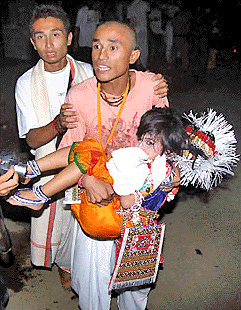
Since this unfortunate incident at our Manipur Temple many people have been questioning/asking/inquiring about “How could Lord Krsna let this happen to devotees, in His own temple”. There are several ways to answer these questions and at times its hard to find the right answer.
I have a humble request, it would be wonderful if we could post an/several articles spoken by one or many of our senior Sanyasis or GBC addressing this incident and these kinds of questions.
Thank you, All Glories to Srila Prabhupada.
Ramacandra das.
Answer by Badrinarayan dasa:
It all ultimately comes down to the question of why there is evil in this world? Why do small babies die horrible deaths? Why do devotees get cancer? What about the holocaust and Nazi concentration camps?
This world is not a nice comfortable place. Krishna has not promised us heaven on earth. He has promised us Vaikuntha/ Goloka but we have to give up all attachments to these bodies and this world. Thus the dicotomy, tension, struggle, and breaking of attachments.
Also, on a positive note, sometimes devotees suffer and are put in difficulty for their greater glory and success. The attack on the Bombay temple in the 1970s rallied local support, turned the tide, and ultimately resulted in the big and beautiful Juhu temple. We cannot see the future and Krishna’s plan. Also, when the devotees are put in distress and Krishna ultimately saves them, their love for Him and their surrender and faith are increased. The Pandavas were hunted in the forest by their enemies but the results of their constant moving was that they gained the weapons and allies to ultimately be prepared for success on the battlefield of Kuruksetra. We don’t know how and why Krishna is moving us but we know that it is ultimately for our good and the good of the world.
Your servant, Badrinarayan dasa
Answer by Virabahu das:
From Srimad-Bhagavatam [3.16.37]:
When something is arranged by the Supreme Personality of Godhead, one should not be disturbed by it, even if it appears to be a reverse according to one’s calculations. For example, sometimes we see that a powerful preacher is killed, or sometimes he is put into difficulty, just as Haridasa Thakura was. He was a great devotee who came into this material world to execute the will of the Lord by preaching the Lord’s glories. But Haridasa was punished at the hands of the Kazi by being beaten in twenty-two marketplaces. Similarly, Lord Jesus Christ was crucified, and Prahlada Maharaja was put through so many tribulations. The Pandavas, who were direct friends of Krsna, lost their kingdom, their wife was insulted, and they had to undergo many severe tribulations. Seeing all these reverses affect devotees, one should not be disturbed; one should simply understand that in these matters there must be some plan of the Supreme Personality of Godhead. The Bhagavatam’s conclusion is that a devotee is never disturbed by such reverses. He accepts even reverse conditions as the grace of the Lord. One who continues to serve the Lord even in reverse conditions is assured that he will go back to Godhead, back to the Vaikuntha planets. Lord Brahma assured the demigods that there was no use in talking about how the disturbing situation of darkness was taking place, since the actual fact was that it was ordered by the Supreme Lord. Brahma knew this because he was a great devotee; it was possible for him to understand the plan of the Lord.
Answer by Aniruddha das:
Krsna protects the devotion of His devotees. What ever service is rendered on His behalf never goes in vain. However, our karmas run deep. Even when we are engaged in devotional activities still we suffer reactions to past deeds, albeit reduced by His mercy.
We can not know exactly why devotees are attacked in such fashion but we can know it is a reaction to past misdeeds. For exalted devotees such as Prahlada Maharaja and the residents of Vrndavana Krsna personally appears to protect them; their devotion is so great. In other circumstances the Lord doesn’t appear.
We can then understand those devotees are either not as elevated as the residents of Vrndavana or that the Lord has another plan for them. He has relieved them of this body and will give them another suitable to take up His service again, elsewhere.
We must always remember we are not this body and that an attack on this body never reduces the service offered to Him. In fact, service rendered to the Lord ensures we will take up devotional service again even in our next body. There is never any spiritual loss for a devotee.
Answer by Praghosa das:
In the 9th chapter of the First Canto of the Srimad Bhagavatam we learn the following:
Bhismadeva impresses upon Maharaja Yudhisthira that there is no need to be despondent about the massacre that was the battle of Kuruksetra as it was the will of the Lord. All the suffering and injustices that the Pandavas endured were due to them being the the sons of religion personified. Queen Kunti also suffered greatly due to the actions of the Pandavas. Prabhupada says that she had to suffer due to providence and that this has to be tolerated without one being disturbed. Queen Kunti was of course the personification of not being disturbed by calamities, indeed she prayed for more.
It is explained that suffering is due to inevitable time, under whose control everyone in every planet is being carried. Everyone has to bear the action and reaction of time as long as they are within the conditions of the material world and even the most pious sinless man has to suffer this condition of material nature. Materially the Pandavas were well equipped with great warriors such as Bhima and Arjuna and spiritually Yudhisthira was the king of religion and Lord Krsna was also on their side. Still due to influence of kala so many reverses were experienced. Kala of course is no different than the Lord Himself, therefore all this was the will of the Lord and consequently there was no reason to lament.
It is further explained that no one can understand the will of the Lord. Even though great philosophers enquire exhaustively they remain bewildered.
Krsna temporarily put his devotees in a suffering condition to establish the kingdom of virtue over vice and establish Yudhisthira on the throne. Bhismadeva was of course most pleased by this even though he fought on the other side. This was also the plan of the Lord to show that even a great personality and fighter like Bhisma cannot be victorious when fighting for the wrong cause.
Prabhupada uses the example of the the housewife teaching the daughter-in-law by teaching the daughter. So in the same way the Lord teaches the world by teaching the devotee, just as the Lord taught the less intelligent by teaching Arjuna in the Bhagavad-gita. So a devotee’s duty is to happily accept such tribulations as a benediction from the Lord.
So while it may appear unusual for devotees to suffer in the way that they recently did in Manipur, in reality it is a special mercy of the Lord as explained in this part of the Srimad Bhagavatam.
In second chapter of Bhagavad Gita, Sri Krishna explains the qualities of sthi-prgyah or the devotee. Devotees is equanimous to external world of dualities and is not disturbed by them. That is due to internal advancement of devotee. Krishna who resides in everyone’s heart make devotee equanimous towards external events by making him realize the happiness within. That is true protection i.e. Krishna eliminates all the miseries of the devotees as those experience don’t cause him to suffer and he always maintains his happiness. Even though Pandavas externally had difficult circumstances, but internally they were happy, contended and enjoying the happiness from within and with Krishna.
Even though 100% equanimity is attained by exalted devotees, the aspiring devotees can still get glimpse of equanimity. That is true for every devotee. As he advances or comes closer to Krishna, he becomes more equanimous. As he becomes more equanimous, less experiences of life make him unhappy. So, automatically his suffering is reduced. That is greatest protection from misery i.e. to make us transcend the modes of nature.
In order to go to Vaikuntha, we need to transcend duality and become equanimous in our current life. When this happen, even current life on earth is like Vaikuntha i.e without anxiety and full of happiness. This state of without kuntha or suffering can easily be attained by practicing bhakti in proper way. We should aspire to become more advanced in this bhakti which results in more equanimity. If advancement comes, then we can automatically handle seemingly external situations of dukh.
Devotee does not ask “why this external event happened” as equanimous devotee is internally unaffected by such event. If one gets disturbed by duality, then one should focus more on bhakti so that one can advance and become more equanimous.
Death is a different issue. We need to look at death with proper perspective i.e. soul does not die. Therefore, the protection after death means that Krishna keeps bringing us closer to Him in our next life. As we continue to advance in next life, we become more equanimous and in next life, we are more blissful. As long as Krishna keeps giving us opportunities to advance in bhakti, we are protected from miseries. If in our current life we are experiencing advancement in bhakti, then we can be confident that we will continue to advance in next lives also.
Essence is that Krishna is always protecting us. He is giving us air to breathe, food, water etc. He even protects animals. He is always with us in our heart. He is ready to guide us, reciprocate to us, hear from us and so on. Unfortunately, we take all that protection for granted. If we focus our mind towards Him, then Krishna is ready to give us best gift i.e. bliss in current life and bliss after death. It is us who see miseries in external event and then, blame Krishna. Otherwise, external events cannot cause any misery and cannot disturb us if we accept Krishna in our life and in our mind.
Excellent replies. Here is some more from Srila Prabhupada.
Since Citraketu was a devotee of the Lord, he was not at all disturbed by the curse of mother Parvati. He knew very well that one suffers or enjoys the results of one’s past deeds as ordained by daiva-netra-superior authority, or the agents of the Supreme Personality of Godhead. He knew that he had not committed any offense at the lotus feet of Lord Siva or the goddess Parvati, yet he had been punished, and this means that the punishment had been ordained. Thus the King did not mind it. A devotee is naturally so humble and meek that he accepts any condition of life as a blessing from the Lord. Tat te ‘nukampam susamiksamanah (SB 10.14.8). A devotee always accepts punishment from anyone as the mercy of the Lord. If one lives in this conception of life, he sees whatever reverses occur to be due to his past misdeeds, and therefore he never accuses anyone. On the contrary, he becomes increasingly attached to the Supreme Personality of Godhead because of his being purified by his suffering. Suffering, therefore, is also a process of purification.
Srila Visvanatha Cakravarti Thakura says in this connection that one who has developed Krsna consciousness and who exists in love with Krsna is no longer subject to suffering and happiness under the laws of karma. Indeed, he is beyond karma. The Brahma-samhita says, karmani nirdahati kintu ca bhakti-bhajam: [Bs. 5.54] a devotee is free from the reactions of his karma because he has taken to devotional service. This same principle is confirmed in Bhagavad-gita (14.26). Sa gunan samatityaitan brahma-bhuyaya kalpate: one who is engaged in devotional service has already been freed from the reactions of his material karma, and thus he immediately becomes brahma-bhuta [SB 4.30.20], or transcendental. This is also expressed in Srimad-Bhagavatam (1.2.21). Ksiyante casya karmani: before attaining the stage of love, one becomes free from all the results of karma.
The Lord is very kind and affectionate toward His devotees, and therefore a devotee, in any condition, is not subjected to the results of karma. A devotee never aspires for the heavenly planets. The heavenly planets, liberation and hell are nondifferent for a devotee, for he does not discriminate between different positions in the material world. A devotee is always eager to return home, back to Godhead, and remain there as the Lord’s associate. This ambition becomes increasingly fervent in his heart, and therefore he does not care about material changes in his life. Srila Visvanatha Cakravarti Thakura comments that Maharaja Citraketu’s being cursed by Parvati should be considered the mercy of the Lord. The Lord wanted Citraketu to return to Godhead as soon as possible, and therefore he terminated all the reactions of his past deeds. Acting through the heart of Parvati, the Lord, who is situated in everyone’s heart, cursed Citraketu in order to end all his material reactions. Thus Citraketu became Vrtrasura in his next life and returned home, back to Godhead.
SB 6.17.18
TRANSLATION
My dear Lord, one who earnestly waits for You to bestow Your causeless mercy upon him, all the while patiently suffering the reactions of his past misdeeds and offering You respectful obeisances with his heart, words and body, is surely eligible for liberation, for it has become his rightful claim.
PURPORT
Srila Sridhara Svami explains in his commentary that just as a legitimate son has to simply remain alive to gain an inheritance from his father, one who simply remains alive in Krsna consciousness, following the regulative principles of bhakti-yoga, automatically becomes eligible to receive the mercy of the Personality of Godhead. In other words, he will be promoted to the kingdom of God.
The word su-samiksamana indicates that a devotee earnestly awaits the mercy of the Supreme Lord even while suffering the painful effects of previous sinful activities. Lord Krsna explains in the Bhagavad-gita that a devotee who fully surrenders unto Him is no longer liable to suffer the reactions of his previous karma. However, because in his mind a devotee may still maintain the remnants of his previous sinful mentality, the Lord removes the last vestiges of the enjoying spirit by giving His devotee punishments that may sometimes resemble sinful reactions. The purpose of the entire creation of God is to rectify the living entity’s tendency to enjoy without the Lord, and therefore the particular punishment given for a sinful activity is specifically designed to curtail the mentality that produced the activity. Although a devotee has surrendered to the Lord’s devotional service, until he is completely perfect in Krsna consciousness he may maintain a slight inclination to enjoy the false happiness of this world. The Lord therefore creates a particular situation to eradicate this remaining enjoying spirit. This unhappiness suffered by a sincere devotee is not technically a karmic reaction; it is rather the Lord’s special mercy for inducing His devotee to completely let go of the material world and return home, back to Godhead.
A sincere devotee earnestly desires to go back to the Lord’s abode. Therefore he willingly accepts the Lord’s merciful punishment and continues offering respects and obeisances to the Lord with his heart, words and body. Such a bona fide servant of the Lord, considering all hardship a small price to pay for gaining the personal association of the Lord, certainly becomes a legitimate son of God, as indicated here by the words daya-bhak. Just as one cannot approach the sun without becoming fire, one cannot approach the supreme pure, Lord Krsna, without undergoing a rigid purificatory process, which may appear like suffering but which is in fact a curative treatment administered by the personal hand of the Lord.
SB 10.14.8
Thanks to Krishna Dharma Prabhu for these nice quotes from the Bhagavatam. One note: the second one (SB 10.14.8) was written by His Holiness Hridayananda Das Goswami.
Thanks for that correction, Dravida prabhu. Also, the nice quotations offered by Praghosa prabhu are from the 1st canto 9th chapter, not 9th canto as stated.
When a determined enemy wishes to attack our temple, we must be prepared to defend and protect ourselves, as well as Lord Krishna’s Property. We can not just blame what happened on the Will of Providence. It may have been our own negligence, and lack of will to be strong, which contributed to the tragedy, as much as the perpetrators of the crime.
Here is another Newspaper article regarding the group that perportedly is suspected of the Terrorist Incident:
NEW DELHI, AUG18 [TOI] : Security agencies suspect that a little-known insurgent outfit in Manipur, Kanglei Yawol Kanna Lup (KYKL), was behind the lobbing of a Chinese grenade at devotees inside the Iskcon temple in Imphal during the Janamashtmi celebrations on Wednesday. The provocation – the shrine management failed to heed its ‘extortion’ demand.
Surely we must see everything as ultimately God’s will. However, we also have our God-given duty and if we are delinquent in that we are culpable. Leaders have a God-given duty to protect their followers and a failure in this regard is punishable. Bhishmadeva explains in the Shanti Parva that if an afflicted person cries out for a protector but finds none, then the king and all his ministers “sink into hell”.
However, as the afflicted we must take shelter of the understanding that in the end it is God’s will. We cannot blame anyone, as the Bhagavatam explains.
We need to examine the big picture behind this incident. We need to study the true motives behind the actions of others, to perhaps understand Lord Krishna’s plan for us. We need to study past history, geography, and politics, as well as forecast the future for the region our temple is located in.
What is KYKL’s true interest? On the surface they state their intent is to raise funds to help the poor. Then why resort to such violent means as blowing up a temple and its innocent devotees and congregation who are also dedicated to helping the poor?
KYKL has been attacking organizations, businesses, and private individuals on a regular basis over the last decade in Manipur. Perhaps KYKL’s true motive is to attack all persons the organization feels are aliens to the Manipur state (Indians and foreigners), and to make their lives hellish enough that they will quit Manipur. KYKL’s true motive might be to establish a free and sovereign state separate from India, rather than their pretentious mission to help the poor.
KYKL is supported and aided by Myanmar (Burma) to the East and China to the North. What is the possible motivation and interest in Manipur for these two countries? What purpose might be served by the weakening of the government of Manipur? India is separated and isolation from Manipur by Eastern Pakistan. Myanmar might be interested in expanding its rogue empire by acquiring the Manipur state, and other states in the region such as Nagaland, and Assam, and for this reason has been providing weapons to separatist organizations such as KYKL.
Is China planning to annex Manipur like it annexed Tibet? Tibet had no standing army to oppose China, so it was overrun. As a result its people now live in exile, its temples and places of worship are all smashed. Atheism now rules what was once the beautiful and holy land of Tibet. The name “Tibet” no longer can even be found on maps of the region.
Perhaps Lord Krishna wishes us to stand and fight for His land, and to preserve and nurture the Vedic Culture in Manipur. Perhaps His plan is that the Manipur State not fall into the hands of Godless atheists and demons. Perhaps this is what Lord Krishna desires for us, and why He allowed such a terrible incident to take place.
srsti-sthiti-pralaya-sadhana-saktir eka chayeva yasya bhuvanani bibharti durga icchanurupam api yasya ca cestate sa govindam adi-purusam tam aham bhajami
TRANSLATION
The external potency Maya who is of the nature of the shadow of the cit potency, is worshiped by all people as Durga, the creating, preserving and destroying agency of this mundane world. I adore the primeval Lord Govinda in accordance with whose will Durga conducts herself.
PURPORT
(The aforesaid presiding deity of Devi-dhama is being described.) The world, in which Brahma takes his stand and hymns the Lord of Goloka, is Devi-dhama consisting of the fourteen worlds and Durga is its presiding deity. She is ten-armed, representing the tenfold fruitive activities. She rides on the lion, representing her heroic prowess. She tramples down Mahisasura, representing the subduer of vices. She is the mother of two sons, Karttikeya and Ganesa, representing beauty and success. She is placed between Laksmi and Sarasvati, representing mundane opulence and mundane knowledge. She is armed with the twenty weapons, representing the various pious activities enjoined by the Vedas for suppression of vices. She holds the snake, representing the beauty of destructive time. Such is Durga possessing all these manifold forms.
Durga is possessed of durga, which means a prison house. When jivas begotten of the marginal potency (tatastha sakti) forget the service of Krsna they are confined in the mundane prison house, the citadel of Durga. The wheel of karma is the instrument of punishment at this place. The work of purifying these penalized jivas is the duty devolved upon Durga. She is incessantly engaged in discharging the same by the will of Govinda. When, luckily. the forgetfulness of Govinda on the part of imprisoned jivas is remarked by them by coming in contact with self-realized souls and their natural aptitude for the loving service of Krsna is aroused, Durga herself then becomes the agency of their deliverance by the will of Govinda.
So it behooves everybody to obtain the guileless grace of Durga, the mistress of this prison house, by propitiating her with the selfless service of Krsna. The boons received from Durga in the shape of wealth, property, recovery from illness, of wife and sons, should be realized as the deluding kindness of Durga. The mundane psychical jubilations of dasa-maha-vidya, the ten goddesses or forms of Durga, are elaborated for the delusion of the fettered souls of this world. Jiva is a spiritual atomic part of Krsna. When he forgets his service of Krsna he is at once deflected by the attracting power of Maya in this world, who throws him into the whirlpool of mundane fruitive activity (karma) by confining him in a gross body constituted by the five material elements, their five attributes and eleven senses, resembling the garb of a prisoner. In this whirlpool jiva has experience of happiness and miseries, heaven and hell.
Besides this, there is a subtle body. consisting of the mind, intelligence and ego, inside the gross body. By means of the subtle body. the jiva forsakes one gross body and takes recourse to another. The jiva cannot get rid of the subtle body. full of nescience and evil desires, unless and until he is liberated. On getting rid of the subtle body he bathes in the Viraja and goes up to Hari-dhama. Such are the duties performed by Durga in accordance with the will of Govinda. In the Bhagavata sloka, vilajyamanaya… durdhiyah — the relationship between Durga and the conditioned souls has been described.
Ref. VedaBase = Bs 5.44
Well, these things were going on when Krishna Himself was present. There were celebrations going on in Gokula. The terrorists were coming there while Krishna was having these festivals.
It is a difficult question to answer, “Why would Krishna allow this?”. Kamsa was getting ready and trying to kill Krishna as soon as it was His appearance day. This mentality continues in this material world. There are two kinds of personalities, devotees and demons. As Krishna consciousness spreads there is always opposition from the demons. They try to strike back. There could have been more lose of lifes and more damage to the property. That wasn’t the case. Maybe Krishna did some damage control. This is another way of looking at it.
Your servant, Lokanath Swami
I have noticed that His Holiness Bhakti Swarupa Damodar Maharaj in his 2006 Vyasapuja offering expresses grave concerns about the trend and danger of misleading within our Iskcon society. I quote verbatim the essential passage of his offering on page 12.
“When people misinterpret Your divine teachings and instructions, it can cause many difficulties and it may mislead many innocent seekers of truth. Therefore it may not serve the purpose of Your divine mission. Such a trend in our society can only be corrected by understanding and following the direct instructions of Your Divine Grace.
I am directly appealing to Your Divine Grace for Your kind mercy to all of us so that we can all properly understand Your divine instructions directly. Without this understanding, when some individuals misinterpret Your divine instructions, it will cause great disturbance and the truth may be lost. This danger is there.”
I would like to ask the following question:
“Could there be a direct relation between the occurrences described by HH Bhakti Svarupa Damodar Swami in the above quote and the temple attack.”
In the Vedabase we find the following quote:
in the Katha Upanisada there is the emphatic call—
uttinohata jagrata prapya varan nibodhata
knurasya dhara nicita duratyaya
durgaa pathas tat kavayo vadanti
“Please get up, awake and try to understand that boon of life which you now have in this human form of life. The path of spiritual realization is very difficult and is sharp like the razor’s edge. That is the opinion of learned transcendental scholars.”
I would like to express my deepest sympathy to all victims of the attack and Krishna Conscious prayers for the departed souls.
Yadavendra das