
By Vasant Pañcami das
War and Environmental Devastation: A Call for Peace and Climate Justice
How can we bring real peace to the world? Srila Prabhupada had a unique and visionary mission statement that resonates with us in today’s world of crisis and uncertainty.
Seven Purposes of ISKCON
To systematically propagate spiritual knowledge to society at large and to educate all people in the techniques of spritual life in order to check the imbalance of values in life, and to achieve real unity and peace in the world. To propagate a consciousness of K??? a as He is revealed in Bhagavad-gita and Srimad Bhagavatam. To bring the members of the society together with each other and nearer to Krsna, and thus to develop the idea within the members and humanity at large that each soul is part and parcel of the Supreme Personality of Godhead. To teach and encourage the sankirtan movement, congregational chanting of the holy name of God, and to reveal the teachings of Lord Caitanya Mahaprabhu. To erect for the members, and the society at large, a holy place of transcendental pastimes, dedicated to the Personality of Godhead. To bring the members closer together for the purpose of teaching a simple and more natural way of life. With a view towards achieving the aforementioned purposes, to publish and distribute periodicals, magazines, books and other writings.
Why War, not Harmony?
“Following such conclusions, the demoniac, who are lost to themselves and who have no intelligence, engage in unbeneficial, horrible works meant to destroy the world.” (Bhagavad-gita 16.9)
In the sacred text of the Bhagavad-gita, Lord Krishna enlightens us about the nature of those who perpetuate war and destruction. These individuals, devoid of wisdom and understanding, embark on actions that not only harm themselves but also threaten the very fabric of our planet. The words of Lord Krishna shed light on the dire consequences of war and the urgent need for a change in our collective consciousness.
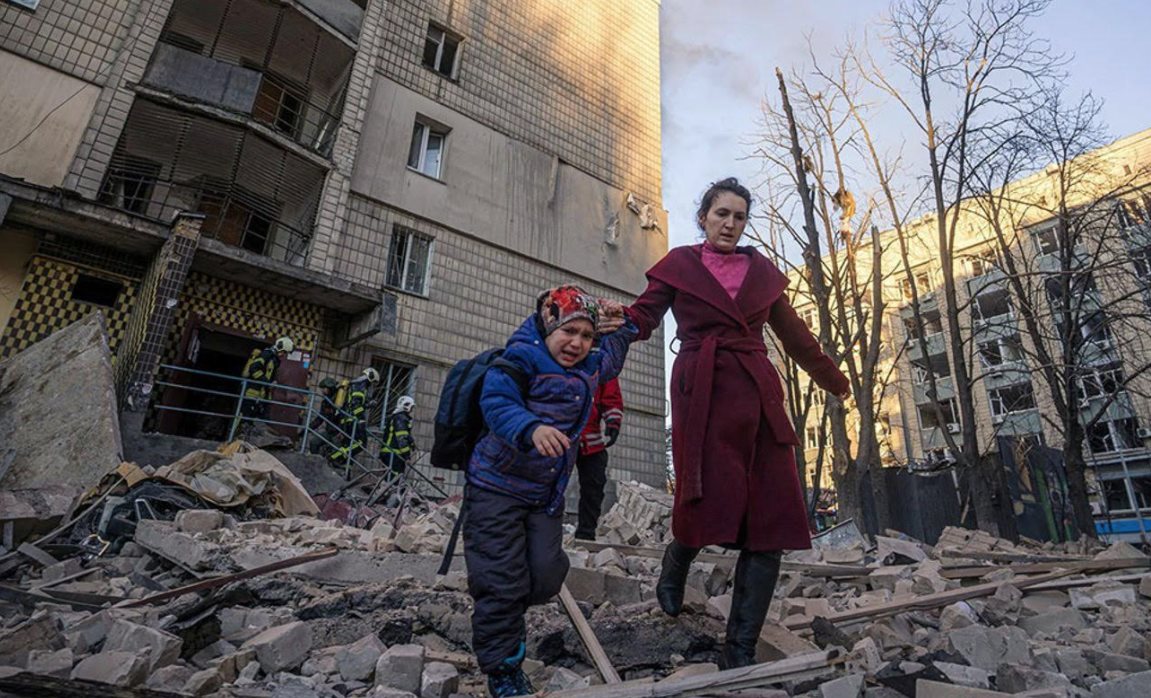
War, a destructive force that claims lives and ravages entire regions, has far-reaching consequences that extend beyond human suffering. The cost of weapons production, pollution, destruction, and the subsequent rebuilding efforts is enormous, and we can no longer afford to ignore the environmental impact of war. As we confront the existential threat of climate change, it becomes evident that war is not only a direct cause of immense human suffering but also a significant contributor to greenhouse gas emissions-a major obstacle on our path to climate justice.
The use of weapons, such as bombs and missiles, not only inflicts loss of life upon people and animals but also releases harmful chemicals and heavy metals into the environment, polluting the air, soil, and water. The destruction caused by war leads to the displacement of communities, resulting in deforestation, soil erosion, and the loss of precious biodiversity. The environmental impact of war lingers for years after the conflict has ceased, perpetuating a long-term threat to our planet. The very fabric of our environment is altered, affecting innumerable species and ecosystems.
As we delve deeper into the teachings of the Bhagavad-gita, we are reminded of the warning against the unintelligent actions of the demoniac, who engage in works meant to destroy the world. The materialistic mindset, which disregards the interconnectedness of all life and the sanctity of our planet, leads to a relentless pursuit of personal gratification. Materialists perceive their endeavors as progress, yet according to the Bhagavad-gita, they lack true intelligence and understanding.
It is essential that we confront the environmental consequences of war with compassion and wisdom. The staggering military expenditure worldwide in 2020, amounting to $1.98 trillion, serves as a stark reminder of our misplaced priorities. Such vast resources could have been channeled into renewable energy projects, reforestation initiatives, and other climate-friendly endeavors. Furthermore, the significant resources and energy required for post-war reconstruction contribute substantially to greenhouse gas emissions, further exacerbating the environmental toll of armed conflicts.
The consequences of war on the environment extend far beyond the immediate destruction caused during the conflict. Since the beginning of the War on Terror in 2001, the US military alone has released over 1.2 billion metric tons of greenhouse gases into the atmosphere-an amount equivalent to the annual emissions of 257 million cars. Additionally, the military’s consumption of over 100 million barrels of oil in Iraq and Afghanistan has made a considerable contribution to greenhouse gas emissions. These alarming statistics underscore the undeniable link between warfare and climate change.
We must recognize that war not only inflicts harm upon human life but also acts as a significant catalyst for climate change. It is imperative that we prioritize climate-friendly initiatives over excessive military spending. By investing in renewable energy, reforestation projects, and other sustainable endeavors, we can pave the way for a future that safeguards both the planet and humanity for generations to come.
As we confront the existential challenges posed by climate change, we must recognize that achieving climate justice necessitates the pursuit of peace. The teachings of the Bhagavad-gita urge us to seek harmony and understanding rather than engage in unbeneficial and destructive works.
It is incumbent upon us to actively seek peaceful resolutions to conflicts and commit to climate-friendly strategies. By joining forces and collaborating on initiatives that promote harmony, sustainability, and the well-being of all beings, we can strive to create a world free from the devastating effects of war and the looming threat of climate change.
Together, let us work tirelessly to build a future where peace, environmental stewardship, and climate justice prevail. It is our collective responsibility to forge a path towards a harmonious world-one that cherishes life, protects our planet, and safeguards the well-being of both current and future generations.
Dear Prabhu,
The Earth is certainly burdened by weapons of Godless Countries.
Krishna Book Chapter 1
"Once the world was overburdened by the unnecessary defense force of different kings, who were actually demons but were posing themselves as the royal order. "
The Earth is also burdened by godless citizens who use her resources for sinful activities.
ŚB 3.17.5
Purport
"When there are natural disturbances like blowing cyclones, too much heat or snowfall, and uprooting of trees by hurricanes, it is to be understood that the demoniac population is increasing and so the natural disturbance is also taking place. There are many countries on the globe, even at the present moment, where all these disturbances are current…. These assure that such places are inhabited by demoniac people who are accustomed to all kinds of forbidden, sinful activity."
SB 4.18.17. Mother Earth told Maharaja Prithu:
"I am being neglected by kings who are not punishing these rascals who have turned into thieves by using grains for sense gratification."
The Lord is presently descended in the form of the Maha Mantra. Spreading His name and decreasing sinful activities will decrease the burden on the Earth. Changing from one form of energy to another will not decrease the burden on the Earth if that alternative energy continues to be used for billions of heinous, sinful activities daily.