
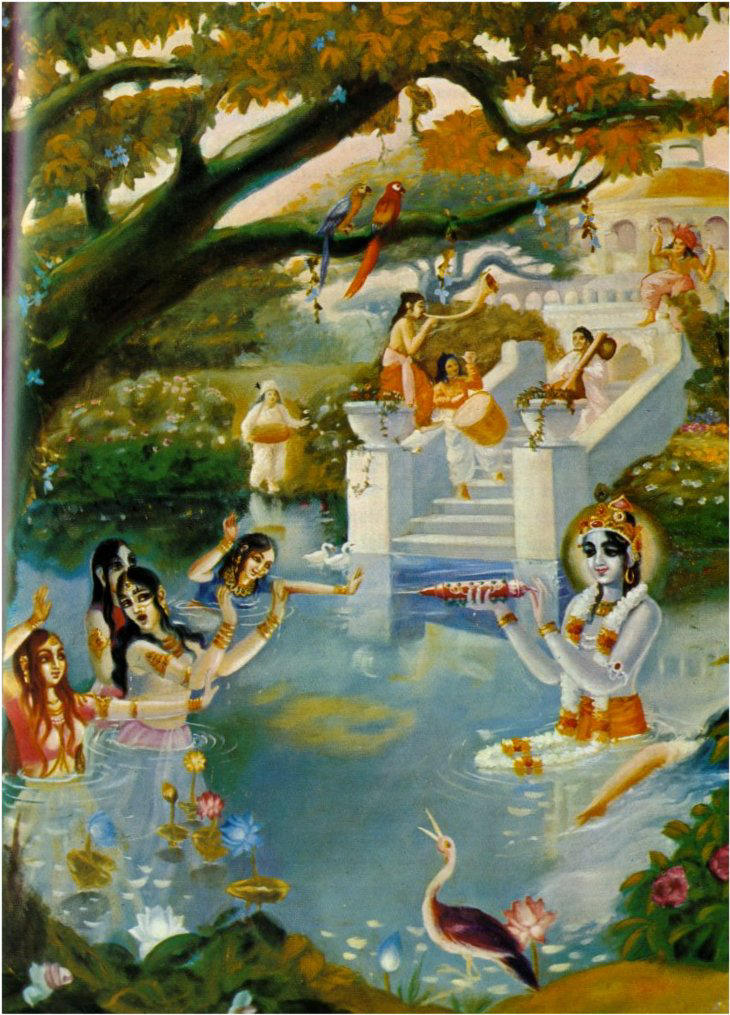
By Mayesvara Dasa ACBSP
Contents
Misgivings
It’s taken me over a week to try and figure out how to go about writing this article because I have two very strong but conflicting feelings about the way we are introducing the Holi Festival to the Western world. On one hand I have a tremendous respect for those who have made these events so exceptionally successful. The public response has been extraordinary and the credit for that goes to the devotees who visualized and successfully coordinated the huge Holi festivals which have been attracting tens of thousands of participants.
On the other hand it appears in the photos and video footage that I have seen that there are some very alarming things going on in the name of the Holi festival and the congregational chanting of the Hare Krishna mantra.
Writing this paper has been difficult because I am not convinced that it is appropriate to approach everything in a firm, legalistic or fanatical way. Yet the more we slip away from that orthodox standard, the greater the risk is of compromising our principles and injecting inappropriate concocted practices into our sampradaya.
There is already too much new-age thinking being embraced under the overused plea that doing so enhances our ability to reach out to those attracted to those teachings. Many justify doing that under the claim that they are simply adjusting their preaching techniques according to time, place and circumstance so they can be more easily heard. However this is often just an excuse for not really stepping up to the plate and saying what needs to be said. It is understandable why so many devotees fall into this avoidance behavior because one really needs to know what they are doing when they challenge the misconceptions of the day. Doing so requires that one have an excellent understanding of Vaishnava philosophy and that requires good training, many years of earnest studying and a lot of practice in the field.
So I present this paper with the hope that it will open up a serious discussion regarding how the Holi Festival can be presented to the Western world that best fulfills Srila Prabhupada’s mission. Some might immediately object and say: “The Holi Festival is a Hindu tradition that Srila Prabhupada never asked us to implement. As such there is no place for it in our mission and should therefore be abandoned.” I personally prefer to consider the Holi Festival in light of the principal that everything can be used in Krishna’s service. It is from that perspective that I have approached this commentary.
History of Holi
In the last two years Holi has literally erupted into the view of the South Western American public with an explosion of rainbow colors. Holi offers both extraordinary opportunities and grave responsibilities because it is rapidly becoming a very visible, large public phenomenon. The question we should be asking is: “What message do we want the public to get when they start to link the rather zany activities that define the Holi Festival to the Hare Krishna movement?” Will they dismiss it as more madness from the bald headed freaks that wore bed sheets in the 70’s, or will they see it as a brilliant public relations campaign that we leveraged to plant the seeds for a revolutionary new world view that is desperately needed?
The Festival of Holi evolved from the teachings in Bhagavad Gita where Lord Krishna clearly declares that He can be seen in the flowers which bloom in the spring:
“Of the hymns in the Sama Veda I am the Brhat-sama, and of poetry I am the Gayatri. Of months I am Margasirsa [November-December], and of seasons I am flower-bearing spring. “ – Bg 10.35
The frenzy of colors that are tossed all about at the Holi Festival represents the beautiful colors which emerge in the spring after the cold winter comes to an end. In India everyone knows this and that is the reason why Holi is always celebrated in the spring.
When this tradition gets transplanted into the Western culture very few people even know who Krishna is or what the Bhagavad Gita is. They also have no idea what the connection is between Krishna, the Spring, and all the colors that make this event the wildest thing to attract young people since the Hula-hoop, the Super ball and the Frisbee.
What makes these events so seductive is the bizarre act of throwing colors all over the place, not the fact that Krishna remarkably transforms the winter landscape into the breathtaking beauty of Spring. Those who are religiously inclined might make the connection between Spring and God, but for the poets Spring is used as an excellent metaphor to express the fantasies of the heart. Those who study botany are intrigued by the science that bursts forth in the Spring and farmers know that Spring is the beginning of the new food cycle that is essential for sustaining our bodies. For the youth however, Spring is associated with “Spring Break” and that has developed the notoriously bad reputation for when college students get drunk, wild, naked and reckless.
If we were to conduct a parking lot interview of the patrons as they depart the Mega Holi Festival what would they recall as the most noteworthy aspect of the festival? I suspect the word that would be most frequently used to answer that question is: “Fun”
Reckless Reverence?
OK. In a world that has become consumed with drugs, alcohol, sex, violence and crime, the Holi Festival is a pretty good opportunity to inundate ones senses in good, clean, safe fun. Of course this is based on the assumption that everyone plays by the rules and the Holi celebration does not get contaminated by these very same serious party killers.
Needless to say the Holi Festival has also proven to be a real big kamandehnu cash cow as well. Reclaiming Laksmi from the hands of indiscriminate conditioned souls so she can again be put back into the service of Krishna is actually a wonderful boon to everyone involved in that process. However the issue we are considering here is: “At what expense?”
Is providing a great place for kids to have good, clean, fun really the best we can do? Is it appropriate to present the Holi Festival as a form of adult day care where pseudo-spiritualists can get surcharged by the tribal drumming and dance-floor-be-bop-mantra rock? For the impersonalists Holi is a place where they can play out their fantasies about manifesting their own prosperity and becoming God.
It appears that the sense gratification which occurs at the Holi Festivals is hardly different than that which attracts the youth to large outdoor rock and roll festivals. The only real difference seems to be that everyone ends up looking like a box of crushed pastels. For this reason it appears that the Holi Festival is deteriorating into an exotic form of reckless entertainment intended specifically to agitate the senses. Little effort seems to be given towards connecting it to its historic origins and more importantly devotional opportunities. Those who are entrusted to teach the message of Bhagavad Gita should carefully consider if it is appropriate to let the Holi Festival decline into a big wild crazy party. Is this the type of behavior we want to encourage?
“One who is in knowledge of the Absolute Truth, O mighty-armed, does not engage himself in the senses and sense gratification, knowing well the differences between work in devotion and work for fruitive results.” -Bg 3.28
I have not personally attended any of these mega-holi-color mashes, but based on media that I have seen, it appears that the Holi patrons have no significant interest in what this ancient festival is all about. Would it be too presumptive to conclude that the majority of those who attend are there to be entertained and are not so interested in self-improvement or a serious desire to understand Krishna tattva?
Captive Audience
It seems to me when the kids line up to participate in this wild rogue fest of undulation, perspiration, and gyration they become a captive audience. Why don’t we take advantage of that and use the price of their admission to share with them informative literature designed to spark their own query into the higher purpose of life? The colors will wash off at the end of the day, but our literature is the seed that can transform their consciousness. Isn’t that really the only justification for holding this exotic event?
“Transcendental practices that do not ultimately help one realize the Supreme Personality of Godhead are useless, be they mystic yoga practices, the analytical study of matter, severe austerity, the acceptance of sannyäsa, or the study of Vedic literature. All these may be very important aspects of spiritual advancement, but unless one understands the Supreme Personality of Godhead, Hari, all these processes are useless.” – SB 4.31.12
This would be an excellent way to dovetail these otherwise useless events into an important part of our preaching mission. If that is not the real focus for sponsoring Holi, then what is? If it’s only to make money, then we have lost the focus of our mission.
“We are not interested in making profit; our interest is simply to promote Krsna consciousness” – SPL to Upendra, October 27th, 1969)
Chanting the Holy Name!
I realize that these festivals are accompanied by a lot of kirtan and assume that a good portion of that kirtan includes the chanting of the Hare Krishna Mantra. But if these young people are chanting Hare Krishna while lusting after each other that constitutes an example of chanting inattentively which is offensive. Isn’t that counter-productive at best and perhaps setting a very bad precedence for those who are being introduced to the Hare Krishna Mantra. Don’t we have some responsibility for at least attempting to explain this to people who come to hear the Maha Mantra for the first time?
If a young man is raised by a Lothario, then it would be very difficult to shift his attitude from exploiting women to respecting them as his mother. Similarly, if people associate chanting the Hare Krishna mantra with the pursuit of the opposite sex then how much harder would it be to later correct that deeply rooted misunderstanding?
Master violinists know that a single Stradivarius Violin can be worth several million dollars. If they are fortunate enough to be in the presence of one of these extremely rare instruments, they approach it with the utmost care and reverence. As mature Vaishnavas shouldn’t we be also educating the public about how extraordinary the Maha Mantra is? Doesn’t the holy name deserve at least the same type of respect a Stradivarius has in the world of professional violinists?
The potential wealth that can be earned at commercial Holi Festivals is no doubt very good. However what is the karmic price to be paid? When we turn a bunch of young people loose with their crazy ideas about spiritual life, they just dance erotically to the sound of the Maha-Rock-N-Roll-Mantra blasting out of large Fender amplifiers. Would I be stretching the analogy too far to suggest this would be like handing a Stradivarius Violin to an infant and turning him loose to play with it in his sand box?
Preserving the Sacred Nature of the Maha Mantra
Perhaps I am being a bit unfair because I have not personally attended one of the Mega Holi gatherings. If my assessments herein are incorrect then I request those who know otherwise to inform me accordingly. My intent is not to unnecessarily criticize but to balance the bewildering temptation to chase wealth against the transcendental admonitions to not misuse religious gatherings for our own personal gain.
There has been a lot written about the bona-fide way to chant Hare Krishna. Some insist that only the melodies sung by His Divine Grace are proper, while others say any melody is welcome. The same has been said about the instruments used to perform kirtan. Some insist that only Kartals and mrdungas are appropriate for congregational kirtan, while others say that any instrument can be encouraged.
I personally put great faith in Lord Chaitanya’s directive that there are no hard or fast rules in regards to how one goes about chanting. Based on that same line of reasoning I don’t personally object to the use of nontraditional instruments being played to accompany the Maha Mantra, even though that form of kirtan is often not my personal preference.
Regardless of how the Hare Krishna mantra is presented, it should be done so reverently. The Maha Mantra should not be seen as just another vehicle for pursuing ones’ mundane desires. The public is being exposed to misleading propaganda regarding kirtan. It is important that we set the record straight. Professional kirtan performers such as Deva Premal, Jai Utal and particularly Krishna Dasa have become very popular. Krishna Dasa is so envious of the devotees that he apparently has accused them of “Messing up the Hare Krishna Mantra.” Don’t let his name mislead you. He doesn’t show any respect to Sri Krishna. He is so confused that in a 72 minute movie which he commissioned to glorify himself, he personally declared how he conquered his own false ego!
This is the type of foolishness that creeps in when talented musicians grab onto sacred sound vibrations for their own personal aggrandizement. They don’t have the proper training to understand what they doing. Therefore the whole kirtan scene changes from heart fully chanted prayers intended for glorifying Krishna to: “Please purchase a ticket so you can applaud how talented I am.” This is not at all the mood of the Vaishnava which is succinctly captured by Lord Caitanya’s wonderful prayer:
“O Lord of the universe, I do not desire material wealth, materialistic followers, a beautiful wife or fruitive activities described in flowery language. All I want, life after life, is unmotivated devotional service to You.” – Siksastaka # 4 – Antya 20.29
I was taught that the Gayatri Mantra was so sacred and powerful that it should only be whispered into the ear of a student who has qualified himself to take Brahman initiation from his guru. However, now there are all sorts of CD’s available where this same sacred Gayatri Mantra is sung like a musical performance and then recorded for wide distribution and commercial profit. How can we in good conscience promote individuals who are so clearly motivated by the wrong reasons?
“Once Sri Sitanatha Bhaktitirtha Mahodaya stayed for some time at the Yogpitha in Mayapur. One day at dawn he started to sing ‘raj jago raj jago’ (Wake up dear Radika) in a very sweet voice , accompanying himself on the harmonium. Srila Bhaktisiddhanta heard about this and stopped his singing. ‘First wake up yourself! You should first be established in your eternal swarupa form. Then it is proper to wake up Srimati Radhikaji” – Live and Teaching of Bhakti Prajnan Kesava Gosvami c/o Narayan Maharaja, Sri Mahamantra Kirtan pg. 65.
Srila Prabhupada warned us many times about the dangers of hearing from those who make a profession out of reciting the Bhagavatam and this advice is equally applicable to those who have become professional kirtan singers.
“The words sajatiyasaye snigdhe sadhau sangah svato vare are very important. One should not associate with professional Bhagavatam reciters. A professional Bhagavatam reciter is one who is not in the disciplic succession or one who has no taste for bhakti-yoga. Simply on the strength of grammatical knowledge and word jugglery, professional reciters maintain their bodies and their desires for sense gratification by reading Srimad-Bhagavatam. One should also avoid those who are averse to Lord Visnu and His devotees, those who are Mayavadis, those who offend the chanting of the Hare Krsna mantra, those who simply dress as Vaisnavas or so-called gosvamis, and those who make a business by selling Vedic mantras and reciting Srimad-Bhagavatam to maintain their families. One should not try to understand Srimad-Bhagavatam from such materialistic people. According to the Vedic injunctions, yasya deve para bhaktih. The Srimad-Bhagavatam can be recited only by one who has unflinching faith in the lotus feet of Krsna and His devotee, the spiritual master.” – Madhya 22.131 p.
Yes… we want to get people to start chanting, but it is also a fact that…
“There are offenses to be considered while chanting the Hare Krsna mantra. Therefore simply by chanting Hare Krsna one does not become ecstatic.” – Adi 8.24
It is well known that Srila Prabhupada clearly preferred the traditional mirdanga and kartals above the use of Western instruments. It was only because he knew how attached we were to the sound of a guitar that he conceded to letting us use it to glorify Krishna.
Prabhupada: Electric guitar, if it is, they chant Hare Krsna only, nothing else, then it is all right. But as far as possible, simply mrdanga and kartal. But if GBC thinks that it attracts more people so they give contribution, that is a different thing. Otherwise there is no need. – London, August 15, 1971
In this quote Srila Prabhupada states that the use of the Guitar is acceptable if it generates contributions for Lord Caitanya’s mission. However he also makes it clear that our focus should always be on the sound vibration of the Hare Krishna mantra… not other things.
“Srila Prabhupada expressed some displeasure about the chanting of so many different mantras. ‘They can chant Nitai-Gaur, Hari-Bols’ but I will chant Hare Krishna and go back to Godhead” – “What is the Difficulty”, Entry 54, Page 87 by Srutakirti Dasa
The Maya of Deviation
The tendency to deviate is so deeply entrenched in our nature that it seems to creep in everywhere. A lack of proper Vaishnava training is evident everywhere. Even our young Vaishnava women seem to have missed the class where Prabhupada explained that…
“ Shyness is a particular extra-natural beauty of the fair sex, and it commands respect from the opposite sex… It is definitely stated here that the ladies were smiling there on the top of the palace, checked by shyness. This shyness is a gift of nature to the fair sex, and it enhances their beauty and prestige, even if they are of a less important family or even if they are less attractive. We have practical experience of this fact. A sweeper woman commanded the respect of many respectable gentlemen simply by manifesting a lady’s shyness. Half-naked ladies in the street do not command any respect, but a shy sweeper’s wife commands respect from all.” – SB 1.10.16p
When the young ladies in the Hare Krishna movement dress nicely in a sari and carry themselves with dignity they uphold the glorious reputation of the Hare Krishna movement as well as their own self-respect. However many ladies from the 2nd generation of Western Vaishnavas are observed wearing choli lenghas sans dupatta that leaves them with a very revealing midriff. Some also let their hair fly wildly unattended while they engage in the equivalent of a tribal dance of head-bashing-gypsy bohemians!
If our own Vaishnava ladies can’t set a good example on how to behave when Krishna is dancing on their tongues, then how can we expect all the non-devotee attendees mesmerized by the exotic nature of the World’s Happiest Event to know how to behave properly?
I have participated in countless Rathayatra Festivals for over 35 years and have observed many times how the kirtan will often slip away from the Hare Krishna mantra longer than is appropriate. Because of my extensive involvement in managing the safety of the cart procession, visiting senior devotees often approach me as if I am in charge of the kirtan party. Nobody objects to transitional mantras, but when the kirtan gets sidetracked with 15 minutes of other mantras, it is not uncommon for someone to ask me to instruct them to get back to chanting the Hare Krishna mantra. This not only has been a reoccurring problem at our own Rathayatra festivals, but it apparently it has always been a problem when less advanced devotees are asked to lead a kirtan.
“Srila Sitanath Bhaktitirtha, a disciple of Srila Bhativenode Thakur…was considered a prominent kirtaniya in Bengal and was an expert in all kinds of raga-raginis, rhythms, tunes, modulations of the voice etc. He was a master of harmonium, esaraja, vina, mrdanga, tabla and other instruments… He began to sing Sri Maha Mantra on the harmonioum in such a way that it took him ten or fifteen minutes to sing the sixteen words of the Hare Krishna Maha Mantra from the first Hare to the last Hare. In addition he was trying to display bhava by gesturing excessively with his hands and arms… Some time later… Srila Bhaktisiddhanta chided, ‘Did you listen to the kirtan? You could have performed kirtan of the whole Maha Mantra fifty times during the time it took him to pronounce Hare Krishna only once.. Those who have no taste for sri nama and their istadeva are only attached to tauryatrika kirtan (Defined Below), with different melodious tunes for the happiness of their senses…. They are only interested in the rhythm and not the inner moods… (they) are completely entangled in material gain, adoration and fame.’” – Live and Teaching of Bhakti Prajnan Kesava Gosvami c/o Narayan Maharaja, Sri Mahamantra Kirtan pg. 64-65. / Also Described by Bhata Vikasha Swami, Sri Bhaktisiddhanta Vaibhava, Volume 1.2.11 p251
Tauryatrika Kirtan
“According to the Monier Williams Sanskrit-English Dictionary, tauryatrika means “a triple symphony of song, dance, and musical instruments.” –Sri Caitanya Bhagavat Purana 23: Wandering about Navadvipa On the Day the Lord Delivered the Kazi
The Sanskrit word for the intoxicating effect that comes from dancing, singing, and playing musical instruments is called tauryatrika. During the days of Lord Caitanya, the stodgy Mayavadi pundits used this term in a disparaging ways to criticize the ecstatic kirtans performed by Vaishnavas. They considered it to be no different from the sense gratification derived from mundane non-devotional music.
“Mayavadi sannyasis neither chant nor dance. Their technical objection is that this method of chanting and dancing is called tauryatrika, which indicates that a sannyasi should completely avoid such activities and engage his time in the study of Vedanta.” – Adi 7.41
Ironically, now everything has flipped upside down and it is the Mayavadi kirtan singers who are openly offensive about glorifying the Supreme Personality of Godhead, Lord Sri Krishna yet they don’t hesitate to exploit kirtan for their own personal gain. They make a business out of singing the Hare Krishna mantra but they show no interest in learning, speaking or glorifying Krishna. Genuine devotees always relish Krishna katha.
“The thoughts of My pure devotees dwell in Me, their lives are fully devoted to My service, and they derive great satisfaction and bliss from always enlightening one another and conversing about Me.” – Bg 10.9
Srila Bhaktisiddhanta insisted that kirtan should not be allowed to degenerate into and artistic show for the purpose of simply satisfying our senses.
“Kirtan performed for sensual satisfaction is not Hari-Kirtan. Kirtan is not to be performed only through melodious musical tunes, chimes and the like. Sri Caitanya Maha prabhu has not asked us to be proficient in high-class music and well-practiced in the airs of accomplished musicians. He has asked us to always perform Hari-Kirtan. That which is meant for gratifying the mundane senses is not Hari Kirtan. That by which Krishna senses are satisfied is Hari Kirtan.”- Sri Bhaktisiddhanta Vaibhava c/o Bhata Vikasha Swami, Volume 1.2.11 p247
I have personally attended a kirtan led by one of the more popular Vaishnava youth singers where the Maha Mantra dropped away completely. What ensued for about 20 minutes was equivalent to nothing more than manic tribal drumming. This was non-distinguishable from the drumming craze which has become all the rage for pseudo-spiritualists who think that merging into the “Rhythm of the Beat” is equivalent to spiritual ecstasy!
If our own Vaishnava devotees have the tendency to fall into the trap of using Kirtan to parade their own musical talents then we should not expect less from the non-vaishnava musicians. There are several who have extraordinary musical talent but have demonstrated by their behavior, words and choice of songs that they have a very poor understanding of what Bhakti is. A mature devotee of Krishna simply wouldn’t waste any time vibrating a long winded salutation of “Om,” or chanting mantras in glorification of Goddess Kali, Mother Durga, Hanuman or Lord Shiva. Yet all of this is conducted at events when non-devotees are asked to participate.
More Mission Drift?
Most organizations adhere to some form of quality control to protect the reputation of their product. Lord Caitanya entrusted us to share the Maha Mantra with the public in a way that they will appreciate it as a very reverent mantra. In this way the Maha Mantra is the product that Lord Caitanya is giving freely to anyone interested in accepting it. Indeed, to vibrate the Hare Krishna mantra is to summon the Supreme Lord to the tip of ones’ lips. It’s not just a mundane musically-hip, top-ten, disco song intended to get your booty shaking. That is why it is incumbent upon us to be careful how we present it.
Are there any written guidelines given to those who attend the Holi Festival outlining what type of behavior is expected of them and what actions are considered unacceptable? Are those who see this program as an opportunity to get high and get wild warned that if they are under the influence of drugs they will be asked to leave?
If we do not carefully manage the message we are sending when we sponsor Holi Festivals then the whole affair will quickly degrade into another form of mission drift. The mission of the Hare Krishna movement is to lift humanity up from the clutches of mundane sense gratification, root out impersonalism and help everyone understand that the purpose of life is to restore our lost relationship with the Supreme Lord Krishna. This requires knowledge, discipline, humility and vigilance.
What value is there in just immersing individuals into the mania of throwing rainbow powders at each other while getting bombarded by a sortie of strange Sanskrit mantras at 120 decibels! What would Srila Prabhupada have to say about all this? My guess is he would probably frown and then simply want to know: “How many books were distributed?” Ruminating on that single thought alone provides the key to how we can leverage the Holi Festival to best serve Lord Caitanya’s mission.
Keeping Krishna in the Center
I have been watching the mega commercial Holi Festivals unfold in America now for over a year and have refrained from commenting about them because I am very sympathetic to the fact that it takes Laksmi to keep the temple doors open. The way we can preserve our mission and continue to glean the favor of Laksmi is to use the Holi Festival to be more pro-active about planting the seeds for Hari Katha in the hearts of all who attend.
Our foremost mission is to deliver the world from the influences of impersonalism and voidism and that generally doesn’t happen overnight, especially when it is being preached by the same impersonal musicians who use kirtan to promote it! However because the Holi Festival is capable of generating such nice profits, a portion of those funds should be used to print a very informative program guide which would then be given to everyone who attends.
That program would be very similar to the small BBT publications called ”Chant And Be Happy” or “Krishna the Reservoir of Pleasure.” It would not only explain the historic relevance of Holi but more importantly, what the Hare Krishna mantra is and why it is so sacred. A discount coupon for purchasing the Bhagavad Gita could be included in the program guide. Perhaps it could also include some type of carefully thought out contest designed to get those who participate in the Holi Festival to read selected portions of Bhagavad Gita As It Is Chapter 7. Some say that particular chapter is the most important and it includes numerous purports where Srila Prabhupada comments extensively about the mistakes of impersonal thinking. Those who complete the quiz/contest could be offered the prize of a Krishna Book! Meanwhile the phone numbers, address and email list that is collected from those who register to attend the Holi Festival could be used to identify which attendees are ready to go deeper into spiritual activities.
If we don’t make some type of effort like this, then we are hardly any better than the Mayavadis who scheme up all sorts of ways to extract money from their sycophant followers. They have no real interest in learning about the pastimes of Krishna and the end result is that we take their money but offer nothing of transcendent value in return.
“Devotees are very much attached to glorifying the activities of the Lord, whereas the Mayavadis cannot even think of these activities. According to them the Absolute Truth is impersonal. Without personal existence, how can there be activity? The impersonalists take the activities mentioned in the Srimad-Bhagavatam, Bhagavad-gita and other Vedic literatures as fictitious stories, and therefore they interpret them most mischievously. They have no idea of the Personality of Godhead. They unnecessarily poke their noses into the scripture and interpret it in a deceptive way in order to mislead the innocent public. The activities of Mayavada philosophy are very dangerous to the public, and therefore Lord Caitanya warned us never to hear from any Mayavadi about any scripture. They will spoil the entire process, and the person hearing them will never be able to come to the path of devotional service to attain the highest perfection, or will be able to do so only after a very long time.” – SB 3.25.34
Already Too Late?
It is our duty to keep the “World’s Happiest Event” on track and reciprocate with those who attend it in a transcendentally meaningful way. However it appears that maybe we are already getting lured into a different direction. Holi events are now being planned to occur at multiple times in one year and that seems to be equivalent to scheduling Christmas twice a year so the local churches can get second serge of donations in June. Am I the only one who feels uncomfortable about this?
“Corrupt money is the reason one falls down.” – Srila Vamsidasa Babaji Maharaja, (Live and Teaching of Bhakti Prajnan Kesava Gosvami c/o Narayan Maharaja, Obtaining the mercy of Srila Vamsidasa Babaji Maharaja pg. 79.)
The trade-off is obvious. If we get bewildered by the lure for financial gain, then we put our core principles at risk. Even the Christians understand this important principle which is clearly expressed in the mantra given by the apostle Mark.
“For what shall it profit a man, if he shall gain the whole world, and lose his own soul?“ – Mark 8.36
The “World’s Happiest Event” is already mutating beyond our control. What compelled me to reach for my computer keyboard and write this article was an advertisement I noticed in my local newspaper. A shrewd businessman apparently realized that all of this color stuff provided a great opportunity for him to also make a fist full of dollars. So he stole the concept and exploited it to suit his own greedy intentions. He plagiarized the wacky color throwing aspect of the Holi Festival and came up with his own godless version of it in the form of the “Happiness 5K Color Run”. (Link: http://thecolorrun.com) There is no mystery where he got this idea from. On their web page it is stated…
“Now the single largest event series in the nation, The Color Run is exploding since our debut event in January of 2012 and will grow from over 50 events and 600,000 participants in 2012, to over 100 events and over a million participants in 2013.” – The color run website
This is the nature of Kali Yuga. Everything is messed up, upside down and corrupted. This is why I copyright the original artwork I do with Lord Jagannatha’s image on it. I shudder to think of the day when that sacred image might fall into the public domain and McDonalds decides to use it to package their “Happy Meal!” I would not want that type of karma sitting on my head when I take my last breath.
It is my hope that those who are promoting the Holi Festivals will get some favorable insights into how to best manage it so that they can also rest well. Having done so, in a way that pleases Srila Prabhupada, our entire lineage of Acaryas and Sri Chaitanya Mahaprabhu Himself would be most rewarding.
Srila Sarasvati Thakur strongly opposed the paying of professional artists for kirtan performances. He would say, “They are not chanting ‘Hari! Hari!’ but ‘Money Money’ – thereby merely increasing their bile secretion.”- Sri Bhaktisiddhanta Vaibhava c/o Bhata Vikasha Swami, Volume 1.2.11 p251
Thank you.
…aspiring to serve the Vaishnavas, I remain…
mayesvara dasa ACBSP,
AKA: William G. Roberts MBS/ MIS, CCP
Director: American Vedic Association
Propriator: Jagannatha Enterprises
687 West Villanova Road
Ojai, California 93023
mdjagdasa @ gmail.com
william.roberts @ jagannatha.com (805) 640-0405
Dear Mayesvara Prabhu, even in Vrindavan, where I have been living for the past seventeen years, Holi has become a dreaded event for many residents, because it simply fills the streets with lusty persons eager to give vent to their lusty whims with impunity. It has nothing to do with the wonderful pastime described in Ananda Vrindavan Campu. Instead of flower pollen and aromatic scented waters, people throw–and even rub–dyed marble dust and water (sometimes taken straight from the gutter) mixed with toxic chemicals onto one another’s faces and bodies. It is a sad, degraded, affair.
Of course, the pastime is still peacefully observed in some temples, where rose or sandalwood water is sprayed from the altar onto the visitors. But externally and on the whole, the kind of mentality you are describing is not absent from the outer covering of the holy dhama.
Thank you for your concern and courage and for speaking without hatred or envy.
Your servant,
Visakha Priya dasi
Part One:
I admire the intentions of this article, but is there not an area that could have been covered, that might determine the true intent of such festivals as Holi? That is the subject of Sukrti or fortune.
Self-righteous individuals might refer to all those thousands of young people who attend the holi gatherings as revellers, bums or reckless and so on, quite conveniently forgetting, or choosing to ignore our own states of ignorance prior to joining ISKCON.
Are we not able to think that each of those thousands of young people will go away from those multi-coloured fun-fests, with the holy name reverberating? Possibly not in the same way as dedicated devotees, but they will tell their friends and families what a great time they had at that “Hare Krishna” Do or whatever?
Their repeating of the holy name indirectly or directly, in a favourable manner, must be as good as Nama-bhasa. Is this such a bad thing?
If Sri Chaitanya Mahaprabhu said that His name will be spread to every town and village, can it not be done this way? We should take note, that the Lord said His name will go forth first. From His name, when purification occurs, then we can think of rules and regulations, including the four regs. Why should we be overly concerned that all attendees must follow the four regs? At least this is the impression created.
The beginning of the article mentioned the fallen state of humanity. Are we to expect all of fallen humanity to abide by our lofty devotional ideals and standards? Clearly not, and neither will we encourage people to do so if we insist that they do, or expect them to. They cannot do so unless they have gotten the mercy of the holy name.
If all those young people are speaking favourably about this fun event – which causes spiritual advancement – in relation to Hare Krishna, surely they are creating good fortune or Sukrti for themselves and for others.
When they speak favourably of Hare Krishna – that is indirect devotion – kirtanam. When others hear of the fun in relation to Hare Krishna – that is indirect devotion – Sravanam. If good memories are retained of this Holi event in relation to Hare Krishna – that is also indirect devotion – smaranam.
Ts Kesava Krsna Dasa.
Part Two:
Otherwise, without knowledge of how the organisers of these events inform the attendees of the significance of Holi, and their logistics, it is so easy to write it off as asat. We are all agreed, that if such information and preaching is airtight, then we must applaud this creation of great fortune.
These events happening in the West are different from those in India, where a sense of knowing Holi is cultural, being neglected in many cases. If we think back to how desperate we were for genuine truth and knowledge before receiving the holy name, why should we berate all those thousands who are in desperate need as we were?
As long as the Holi festivals are properly organised and inform correctly, we should support them, lest we righteously hinder Nama-bhasa and ajnata/jnata sukrti.
Ys Kesava Krsna Dasa.
I like this discussion because it gives us an opportunity to define the ideal of vaishnavism. The bhakta is “maintained by Krishna, dependent upon Krishna”. Recognizing Krishna as the only enjoyer, the bhakta wants only to think, feel and will in a manner congruent with Krishna’s satisfaction. The Sri Gurudeva, we believe, is the living representative of those ideals. Acharyas…who are practical examples of the divine teachings. They are not “rock stars” trying to create a big material commotion for material enjoyment.
When Srila Prabhupad saw the flashing, exciting, and even Krishna centered activities of the “Transcendental Road Show” in the US during the mid-1970s, His Divine Grace requested that his disciples stop these activities…because “he thought that it could lead to the falldown of his disciples”. He requested traditional instruments and style for kirtans.
So, although there may be, as Keshava Krishna das notes, “sukriti” or some pious deposits in one’s life, it may not be the role, the responsibility, of responsible devotees. Na dhanam, na janam….Sriman Mahaprabhu is not seeking numbers of followers, but rather purity in His followers. We can debate this issue, we can justify any other response, but you risk diluting your own potential treasure when you do. Is it worth it? Just an opinion from afar.
Pusta Krishna das