
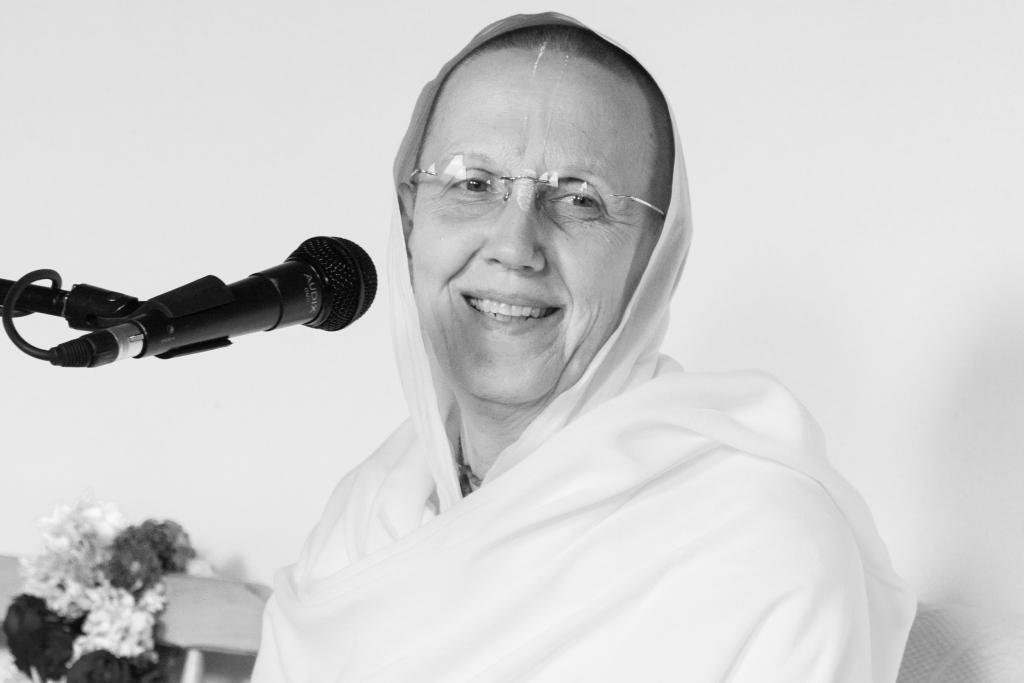
 By Vadhu Rupa Dasi
In this material world we can basically find two different cultures: materialistic culture which promotes sense enjoyment with sex life being the topmost pleasure, and spiritual culture which minimizes sense enjoyment and puts service to Krsna into the very center of life. Both cultures are so different – just like day and night (BG.2.69), because they promote opposite world views and ideologies.
Spiritual culture is Krsna’s culture which He has given to support us on our endeavors back home, back to Godhead. It promotes selfless service and care towards all the sections of society, whereas materialistic culture promotes envy, neglect and competition. It is a culture of abandoning each other: wives abandoning husbands, husbands abandoning wives, parents abandoning children, and children abandoning their parents and grand-parents. It is a culture of abandoning each other for the sake of sense enjoyment.
Devaki Mataji has introduced a simply brilliant course “Exploring the Roots of Spiritual culture”. She demonstrates her wonderful ability to give deep insights into spiritual knowledge based on so many amazing realizations, and based on Prabhupada’s purports from the Bhagavatam.
The topics are very systematically presented in the hand-outs, and the discussions are profound and give deep insights into the eternal principles of spiritual culture. I liked the atmosphere during the course – centered around discipline mixed with the spirit of respect and care. Everything was so nicely organised, with a wonderful service attitude.
I have been battling with my own false ego for the past twenty years, and it has not given me much success. In 2012 I listened to the recordings of this course, and my consciousness changed by receiving some understanding of the position of a woman within spiritual culture. Due to this transformation within my heart, and without any further external endeavor I could observe with great joy and surprise that the attitude of some senior men with whom I had had difficulties, had changed towards me!
And now after attending the whole course, I understand that the key to good relationships with men aswell as with women – the key to happiness and peace lies in getting rid of envy and pride. The key lies in the consciousness of becoming a true servant – to give, give, give….. And spiritual culture promotes and supports exactly this transformation of consciousness towards becoming a humble servant.
Being in a woman’s body, our roles and duties differ from the roles and duties of a soul in a male body. It is so important to deeply understand this, and to apply it in one’s life. We have to understand Krsna’s Divine plan behind everything. I am very grateful to Devaki Mataji for her revolutionary and relevant presentation of this topic. It is really something that everyone needs to know: Sannyasis, Gurus, grihasthas and brahmacharis. Genuine understanding of one’s roles and functions in the society will help us to make life stabel and peaceful, and thus spiritual practice will be easier for all ashrams and orders of life.
Devaki Mataji is also planning in the near future to conduct a course for the men aswell – they certainly also have to learn a few things about spiritual culture….!
Sometimes devotees might think that within spiritual culture there is no room for women to preach. They might be afraid that spiritual culture is closing the doors to preaching. But it is just the opposite: once we gain deeper insights into the secrets and beauty of spiritual culture, then the doors to preaching open more and more. Devaki Mataji is the best example herself: she is engaged in so many exciting preaching activities all around the world – all performed in the mood of a selfless mother, pushing the men to the front and assisting them to become good leaders. Behind every great man is a woman: either a mother or a wife…..! (SB. 4.26.15)
All I can do is highly recommend this course to any devotee in a female body! For further information please see www.therootsofspiritualculture.net
Please also see the video below, capturing the sweet atmosphere during the course.
With deep gratitude to Devaki Mataji and her assistants….,
your servant, Vadhu Rupa Dasi
Thank you for your very nice post. I have been looking for the audios of this seminar. Is there a link you can share?
The article says, “Sometimes devotees might think that within spiritual culture there is no room for women to preach.”
Those interested in this topic – women and preaching – would probably benefit by reading this book (it’s a free download and is based on Srila Prabhupada’s quotes):
https://sites.google.com/site/eyeofthestormbooks
“Devaki Mataji is also planning in the near future to conduct a course for the men aswell – they certainly also have to learn a few things about spiritual culture….!”
Yes, and we might also want to listen to the course for women if the materials are made available.
Thank you also Kaunteya for reminding us of the “Eye of the Storm” book about Srila Prabhupada’s instructions regarding women preachers and gurus. I am not sure we should get sidetracked into a discussion of this contentious issue here, in connection with Devaki’s course, but it is a good book which does have many relevant things to say about women’s service as preachers and otherwise.
[Basugosh Prabhu might want us to point out that although he is mentioned in the “Acknowledgments” as one whose ideas contributed to the book, he does not approve the book’s conclusions and did not appreciate being mentioned in the Aknowledgments, and was not contacted beforehand about it.]
I myself found the book to be very well written and I appreciated that it bent over backwards to understand and sympathize with the mentality and concerns of those who very strongly oppose the GBC’s decision that qualified women can serve as diksa gurus in ISKCON, although the book disagrees with them. Whenever there are very strongly-held views on some point, this may pose a challenge to the unity of the Society, but we have enough in common in our dedication to serving our common acaryas that we can remain united in spite of our differences.
I realize it may seem “easy for me to say,” because on this point I agree with the majority GBC opinion that women can be diksa gurus (for all the many reasons set forth in the book). I would like to think that if I were in the minority on one of these issues of contention I would be willing to still put my paramount loyalty to the overall Society above my disagreement about a single point such as this one.
Thank you Akruranatha Prabhu for your kind and wise words.
You mentioned that, “Basugosh Prabhu might want us to point out that although he is mentioned in the “Acknowledgments” as one whose ideas contributed to the book, he does not approve the book’s conclusions and did not appreciate being mentioned in the Aknowledgments.”
I checked and the Acknowledgements page simply says:
“Directly or indirectly; in bigger or smaller ways; knowingly or unknowingly; by writing, by editing, by giving feedback or by taking part in the dialogue; the following devotees have contributed to the realization of this book. Many, many thanks to all of them.”
Basu Ghosh Prabhu was thanked for “taking part in the dialogue”; which he certainly did with great vigor. He contributed to the realization of the book by sharing his ideas and opinions and in fact his words are quoted throughout the book.
I apologize on behalf of the “Eye of the Storm” if his inclusion in the Acknowledgments created any confusion or displeasure, but it should be clear that it was never the intention of the publishers to give the impression that he agreed with the conclusions of the book.
Its an amazing article. Reciprocating with this mood the if the husband gives their best to preserve the self esteem of the wife and fulfills her all needs and make her very happy in Krishna Consciousness then these reciprocal dealings can make the home atmosphere heavenly.
Thank you Kaunteya Prabhu for sharing this book. I think its a very nicely presented book with views from all possible angles. Its a good template for discussing similiar grey matters for which we might not have a straight yes or no answer.
However my concern is again on acknowledgements front. I think we need to revisit how we are showcasing the names in acknowledgements. There is a risk where reader might think that those mentioned in acknowledgements buy the conclusions of the book. Atleast they will be confused about their respective stands. And as most of them mentioned in the section are spiritual leaders, mentors and guides, those who take inspiration from them might get confused about this issue and related areas and change the course accordingly.
Once again many thanks for sharing this wonderful book.
Since this comment thread has been used to promote Kaunteya’s book the reader might do well to read critiques of that book such as the recent one by Dusyanta prabhu at http://www.dandavats.com/?p=12087
Regarding courses on Vaisnava Spiritual culture, HH Bhaktividya Purna Swami has been giving such courses since at least the mid to late 1990s.
You can find a whole series on Vaisnava etiquette and culture at ISKCON Desire Tree
http://audio.iskcondesiretree.info/index.php?q=f&f=%2F02_-_ISKCON_Swamis%2FISKCON_Swamis_-_A_to_C%2FHis_Holiness_Bhakti_Vidyapurna_Swami%2FSeminars%2FVaishnava_Etiquette_and_Culture
There are many other classes and seminars by him at this site.
And, for the record I am not a disciple of His Holiness but appreciate his efforts that have been on going through thick and thin for several decades.