
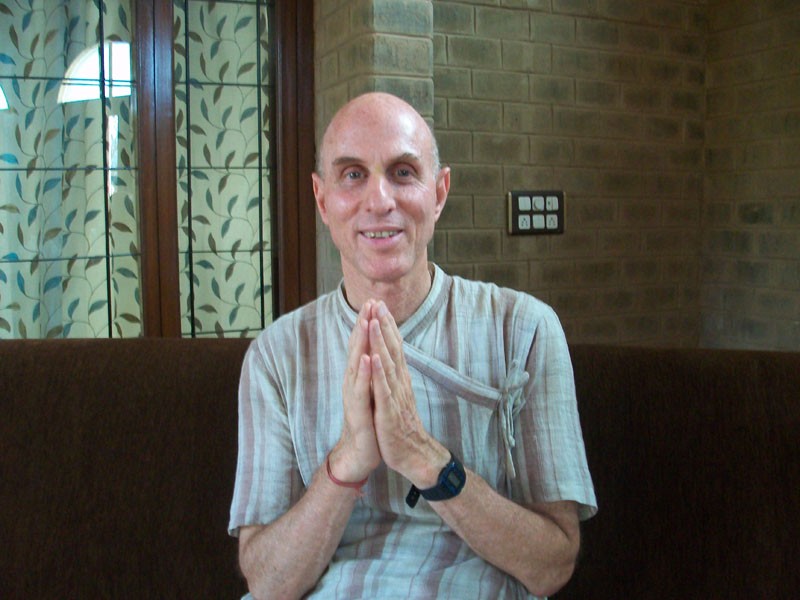
By Mahatma das
Citrarupini dasi expressed concern that my article titled ‘Self-Compassion’ posted on Dandavats might not be in line with our teachings. She wanted to know my sources and asked for sastric references in support of my main points. The following reply addresses her concerns.
Mahatma Das
Dear Citrarupini dasi,
The article which you are concerned about started out as a letter to a devotee who was dealing with continued feelings of guilt for not achieving his goals in Krsna consciousness. He was losing enthusiasm due to repeated failures in following the regulative principles. He had also lost self-confidence and focused on his faults rather than anything good within himself.
Since many devotees deal with problems similar to his, I decided it would be useful to share what I wrote.
I understand your concern about lack of sastric reference, but I am not clear if you are saying that my article is against our siddhanta or not, or that you just want to see more references. In any case, I offer many references at the end of this letter to show you where I have drawn my line of thinking.
Also, at the time I wrote this letter, I had read something from the yoga tradition about self-compassion that I felt would be helpful to the devotee I was writing to.
If you feel anything I wrote is not in line with our philosophy, then I would be happy to discuss this with you. So let me know what you think is against our siddhanta.
Now let me explain the source of my thinking on the issue of excessive guilt and self-hatred. Prabhupada and Krsna have spoken about being envious of oneself, and the Sri Isopanisad refers to material activities as being against one’s self-interest, causing a person to become a killer of the soul. As you may know, Prabhupada told Ramesvara that the highest realization is to save ourselves first. And, of course, there are thousands of statements from Prabhupada about the importance of sadhana, and sadhana is the basis of our “save yourself first” activities.
Yet there are many devotees who don’t seem to care enough about their sadhana. My realization is that this “I don’t care” attitude is the kind of helplessness and subtle self-hatred that is typical of the mode of ignorance, and that for many of the devotees who struggle with bad sadhana, a little more compassion on themselveswould improve their sadhana. (The lack of self-love may not be the case with all, but with many.)
Also, the continued search to fill some deeper need through sinful activities (that I referred to in the article) is symptomatic of raja-guna. The corresponding frustration from not finding the satisfaction one hoped for is due to tamo-guna. And the seed of desire that is generated by not finding this satisfaction (every sin produces the seed to commit the sin again) pushes one back to passion to begin the cycle again. The question is: why would a devotee torment himself like this when he has the option of eternity, knowledge and bliss? But many devotees find themselves caught in this paradox.
This passion and ignorance quite often results from apathy for sadhana, an apathy that stems from a lack of care about one’s own spiritual advancement. I believe this apathy is rooted in a kind of envy of one’s self. And this is an important aspect of the article. (The concept of self-envy came from Prabhupada and I refer to it at the end of this letter).
I also addressed the problem of berating oneself. This is another common problem and is symptomatic of tamo-guna. One gets so down on themselves for not being good enough, or for having failed, that one loses enthusiasm or even gives up. So lack of determination can stem from a lack of self-nurturing, a lack of desire to “save oneself first.”
These are my personal realizations gathered through my own devotional practice, study of Prabhupada’s teachings and the study of the nature of the mind and conditioning.
In the article I ask those who deal with these problems to confront them because many people ignore or run away from their problems. This self-reflection is necessary for our spiritual growth. It is also an aspect of humility, acknowledging a problem we have rather than pretending it doesn’t exist. Many of us have difficulty being honest about our problems. We may pretend we either don’t have a problem, or that we can’t overcome the problem, when in fact it has been pushing us around for years. Both are symptoms of tamo-guna.
The devotee I wrote to found my advice helpful for his problem. So I decided to share what I wrote with others. And Dandavats is a good platform for this. Also, others wrote to me personally to tell me that the article helped them. If what I write helps people advance in Krsna consciousness, even if it lacks the amount of sastric support that some readers would like, it still has value to the devotee community.
But since you have asked for more sastric support in my writings, I will take this suggestion and include more references in future writings.
Regarding sastric references to my article on Self-Compassion, here are a few references that molded my thinking in regards to a solution to the problem of berating oneself to the point that one’s enthusiasm to follow the principles of Krsna consciousness is lost.
The Nectar of Devotion asks us to be patient, or dhairyat (verse 3). And Prabhupada talks much about the necessity of patience to be successful. Who must we be patient with? This verse is referring to being patient with ourselves. Why? Because we often fail, and if we give up, we lose. Prabhupada said that if we lose enthusiasm, everything is finished. So self-hate can cause one to lose patience with oneself and thus feel like giving up. We need to patience with ourselves to remain encouraged to go on enthusiastically with our bhakti. Sometimes devotees lack enough self-forgiveness to have the patience needed to progress well in devotional service.
In a purport to Chapter 16, Text 18 of the Gita, we find a reference to the notion of self-envy: “He does not know that the present life is a preparation for the next life. Not knowing this, he is actually envious of his own self…”
The “killer of the soul” reference, which formed the basis for much of what I wrote, is found in Sri Isopanisad, Verse 3. In the purport to this verse, Prabhupada writes:
“The Vedic scriptures and the äcäryas, or saintly teachers, are compared to expert boatmen, and the facilities of the human body are compared to favorable breezes that help the boat ply smoothly to its desired destination. If, with all these facilities, a human being does not fully utilize his life for self-realization, he must be considered ätma-hä, a killer of the soul. Çré Éçopaniñad warns in clear terms that the killer of the soul is destined to enter into the darkest region of ignorance to suffer perpetually.”
Prabhupada said that if you go to a secluded place and slit your throat, no one can help you. In the same way, people are committing spiritual suicide through their sinful self-destructive activities.
Another reference to the “killer of the soul” is found in the purport to verse 13.123 of the Adi Lila, Caitanya Caritamrita, in reference to meat eaters being “killers of the soul.”
The idea of becoming our own worst enemy comes from a conversation in which Prabhupada was asked what the greatest obstacle to bhakti is. He replied: “You are the greatest obstacle.”
Çréla Prabhupäda was furthermore asked the following question: “In your Books, you mention that if one does not take the time to understand how his activities are producing his next life, then one actually becomes envious of his own self. Can you further explain that?” Prabhupäda replied: “Yes. If he’s going to become a dog next life and if he does not take precaution, then is he not envying himself?”
Srila Prabhupada has also referred to self-envy in the Srimad Bhagavatam (4.23.28). “Any person who engages himself within this material world in performing activities that necessitate great struggle, and who, after obtaining a human form of life — which is a chance to attain liberation from miseries — undertakes the difficult tasks of fruitive activities, must be considered to be cheated and envious of his own self.”
When asked if guilt is useful, Prabhupada said that a little guilt is useful, but My experience is that too much guilt leads to inertia. We feel so bad that we don’t feel there is any way or reason to improve. Prabhupada never made us feel more guilty about a mistake than was needed to rectify it. But some of us are unable to forgive ourselves for our deficiencies or failures. Although Prabhupada was always encouraging – and always forgiving – despite the reality of our own disqualifications, we do not always treat ourselves in this same way. We should learn to uplift ourselves as he uplifted us.
I mentioned that we need to accept where we are at despite the fact that we may not like its location. Prabhupada never made us feel inadequate, unqualified, useless, or in any way undeserving of the opportunity for devotional service. Mahaprabhu came for us, the most fallen. Prabhupada often glorified his disciples’ intelligence, sincerity, and enthusiasm. Such encouragement was magical. It helped us succeed beyond our own qualifications. We need to therefore encourage ourselves just as Prabhupada encouraged us.
Prabhupada talks about self-interest, that when we serve Krsna, this is our real self-interest: “But when one thinks in terms of serving the Supreme Personality of Godhead, that is real self-interest. So na te viduù svärtha-gatià hi viñëum [SB 7.5.31]. People do not know. [break]… svärtha-gatià hi viñëum. Real self-interest is to become Vaiñëava, servitor of Viñëu. Viñëur asya devatä iti vaiñëava. That is real self-interest.” (SB class 1.2.8)
So if we actually love ourselves, we serve Krsna. And if we have trouble loving ourselves, we may feel we don’t deserve to serve Krsna.
This clarifies the sources of my article, its intention, and its grounding in Prabhupada’s teachings. If you have any questions or doubts, I would be happy to discuss them with you.
Hare Krsna,
Mahatma das
“The Nectar of Devotion asks us to be patient, or dhairyat (verse 3).”
Of course Mahatma Prabhu meant Nectar of *Instruction* here. Yes, patience as well as enthusiasm is needed. We have to be committed to the Krishna consciousness path for the long haul. What other good path is there? (None)
As far as killers of the soul, there is also verse 10.1.4:
nivrtta-tarsair upagiyamanad
bhavausadhac chrotra-mano-’bhiramat
ka uttamasloka-gunanuvadat
puman virajyeta vina pasughnat
Translation: “Glorification of the Supreme Personality of Godhead is performed in the parampara system, that is, it is conveyed from the spiritual master to disciple. Such glorification is relished by those no longer interested in the false, temporary glorification of this cosmic manifestation. Descriptions of the Lord are the right medicine for the conditioned soul undergoing repeated birth and death. Therefore, who will cease hearing such glorification of the Lord except a butcher or one who is killing his own self?”
“Pasughnat” can refer to a killer of animals or a killer of one’s own soul, which is the animating force within the body. Actually one who unnecessarily kills animals is harming the living entities who are art and parcel of Krishna. Therefore , displeasing Krishna, one is actually harming one’s self.
The same may be doubly true for those who become inimical to devotees of Krishna. The devotees of Krishna can save the whole world because only they can explain Krishna consciousness correctly. This is especially true of those devotees who are completely free from being attracted by the alluring material energy. They can administer the medicine of Krishna-katha that can solve the problem of the struggle for existence.
But actually, with all devotees, and with all living entities, we should not quarrel or become inimical, because such enmity may reflect back on ourselves.
Having said that, I should clarify that I appreciate Citrarupini Mataji’s concern for keeping strictly within the teachings of Srila Prabhupada. In spiritual circles one should be prepared to back up one’s statements with citations to relevant authority. That way we won’t stray from the path of guru-parampara.
It is a healthy discussion that provokes further references to the teachings of our acaryas.