
 By Mithuna Das (with contributions by Bhakta Nicholas Jinkhoo).
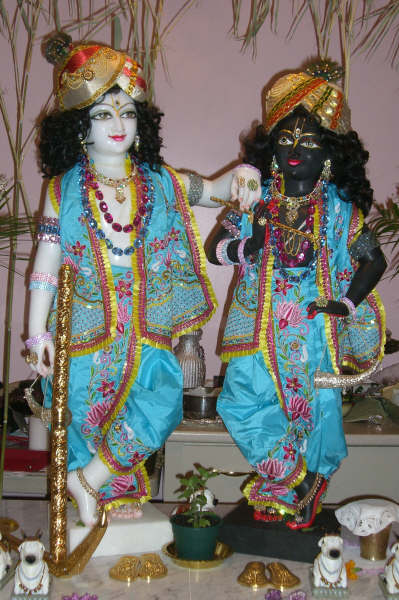
After months of waiting in their simple attire and humble confines, Sri Sri Krishna Balarama stepped out, and took Their places on the beautiful vedic-styled altar that had been prepared for Them. This venerable act of Their Lordships, was none other than the much talked about archa vigraha installation of Sri Sri Krishna Balarama at the SKC Mandir, Queens, New York, Sunday 13 August 2006.
After elaborate preparation and earnest endeavor by the community of local devotees and their well-wishers, Their Lordships were now ready. About three days before the ceremony, the atmosphere at the temple was at a joyful crescendo. Devotees were coming and going throughout the day, and others could be seen completing the final touches, as anxious camaraderie bejeweled their hearts and faces; this mood festered and continued up to, and throughout the day of the actual ceremony. On Sunday 13 August 2006, the program started around 6:00 p.m. By this time, nearly one hundred (100) swaying devotees, immersed in an ecstatic kirtan led by Keshava Acarya das br. (26 Second Avenue, NY), filled the relatively small temple hall. At the same time, some seventy five (75) persons stood on the pavement outside the temple, talking to and greeting each other; anxious mothers could be seen pacing back and forth, intending to pacify their crying babies. Not being able to find accommodation in the temple hall, some of the arriving guests chose to leave; one devotee said that the number of persons who left before the program started could have been about fifty (50). By 6:30 p.m., the officiating purohit HG Ravindra Svarupa das (GBC member and guru) had taken his seat, while his assistant, HG Mahesvara das (PA) continued to add the final touches to the sacrificial fire. Behind a screened section, the Two Lords waited, as the resident brahmanas pacified Their impatience. As he started the ceremony, HG Ravindra Svarupa praised the kirtan; he mentioned that Srila Prabhupada had said that the deities are really installed by kirtan, and not by the actual rituals. Dressed in tilak and vaisnava attire , the devotees echoing the Vedic mantras chanted by the purohit, invoked memories of the great sages who once assembled in the forest at Naimisaranya As the agni hotra ended and the screen was removed, there was a moment of stiletto silence; the fall of a pin could be heard. In the next nano moment, the consummate beauty of the black, iron-like Krishna and His radiantly white brother, Balarama, shattered this silence. The devotees immediately paid obeisances amidst loud cries of Sri Sri Krishna Balarama ki jaya, Srila Prabhupada ki jaya, Haribol!
As a part of the Mahaabishek ceremony, Their Lordships were bathed with panchamrta and other sacred substances. After Their baths, the two Lords were again screened off, and were privately attended to by the officiating purohit, his assistant, and the resident brahmanas. Waiting upon Their Lordships with ecstatic kirtan, the devotees from Sri Sri Radha Govinda Mandir (Brooklyn), Sri Krishna Chaitanya Mandir (Queens) and Bhaktivedanta Ashram (26 second Ave, Manhattan) bonded in a most wondrous display of camaraderie. They danced as if there was no tomorrow, somewhat reminiscent (if only externally) of the seventy two (72) hours of non-stop dancing by Vrakeshwar Pandit in Lord Chaitanya’s Lila. Apart from the officiating purohit and his assistant ,other disciples of HDG AC Bhaktivedanta Swami Prabhupada present were HH Chandrasekhar Maharaja, HG Maheshvara das(NY), HG Bushara das and HG Saudamani devi dasi.
In the midst of the roaring kirtan, HG Ravindra Svarupa suddenly emerged from behind the screen. Formally introducing Krishna and Balarama, he said, “They are Krishna and Balarama, but here in Queens Their names will be Sri Sri Hari Haladhari.” In immediate response and in unison, the crowd of devotees cried out “Haribol, Haribol.” The officiating purohit continued, “They have these names because Hari means one who takes away everything inauspicious, and Haladhari means He who holds the plow; one function of the plow is to uproot the weeds of devotional service.” As the transcendental conch echoed the length and breath of the temple hall and the screens were again removed, there in all Their Majesty, stood the astoundingly beautiful Sri Sri Hari Haladhari. Again, the devotees paid obeisances, crying out Sri Sri Hari Haladhari ki jaya! Bedecked in a peacock feather, glittering jewels, and fine garments, Lord Hari glanced upon the devotees. Not to be outdone, the equally attractive and beautifully dressed Lord Haladhari stood cross legged, resting His transcendental arm on the right shoulder of His younger brother; in His other hand, He held a golden plow , and with the most gorgeous lotus eyes, He too ,mercifully glanced upon the assembled devotees. This “head turning” dressing of Their Lordships for Their first public darshan, was the commendable service of HG Ghandarvika devi dasi. A special recognition also goes to temple president HG Sunanda das and his wife Trishakti devi dasi for pioneering the project of bringing Sri Sri Hari Haladhari to Queens, NY. As is customary, temple president HG Sunanda das offered the first arati to Their Lordships. Simultaneously, the assembled devotees making rows, circles, hoops, sways, mobiuses, and other intricate geometries danced with the seeming innocence of little children. It was both a sight and experience to behold. With bright smiles on their faces, the devotee photographers seemed to be having a field day, as they monitored their tripod mounted cameras. As these transcendentally joyful moments flowed unabated, continuous bursts of flashlights from digital cameras and would try to capture them.
At 10:30 p.m., a sumptuous prasadam feast was distributed to the nearly three hundred (300) persons who were present. At 11:30 p.m., some seventy (70) devotees were still in front of the temple premises discussing the wonderful program and other topics about Krishna. Appearing transcendentally absorbed, few of them seem to be interested in going home, to their houses.
During His discourse, HG Ravindra Svarupa had mentioned that in the conditioned state, we cannot see spirit, therefore the Lord out of His mercy, descends in a concrete and apparently helpless form. This form of the Lord is the Deity, and herein, we have the opportunity to bathe, clothe, feed, offer articles and prayers, have darshan, sing and dance for, maintain the Lord, as well as enjoin the community to do the same. In this way, our senses become purified, and we are able to enter into a deeper relationship with the Holy Name. This Holy Name is non-different from Krishna, and when we acquire the suitable adhikar, The Lord will reveal that Rupa, Guna and Lila are non-different from this Sri Nama. Now that Sri Sri Hari Haladari is here in Queens, NY, They will be worshipped according to the standard of Deity worship indicated in the Pancaratra Pradipa. All devotees are invited to visit our temple and take the darshan of Sri Sri Hari Haladhari. ISKCON sanyasis, gurus, and preachers who schedule in advance with the temple president can give lectures at our Sunday feasts (5:30 p.m.) and other programs. The Sri Krishna Chaitanya Mandir is located about twenty ( 25) and fifteen (15) minutes respectively from the La Guardia and JFK airports, and the address is 111-14 101 Avenue, South Richmond Hill, NY, 11419. You may contact our temple administration personnel at 718 848 9010, 917 604 1085 and sunandanadas@hotmail.com. You may also visit our website at www.skcmnyc.org
On behalf of all the devotees serving at the Sri Krishna Chaitanya Mandir, Queens, NY.
Mithuna Das (with contributions by Bhakta Nicholas Jinkhoo).
Hare Krishna.
All Glories to Sri Guru & Gauranga.
My obeisances to you Mithuna das prabhu and many thanks for such a wonderful article. Sri Sri Hari Haladhari is certainly beautiful to behold. Your words describing their installation put me right there at Sri Krishna Chaitanya Mandir in Queens. My humble obeisances and thanks also go HG Sunanda das and his wife Trishakti devi dasi for arranging Sri Sri Hari Haladhari’s presence in new york.
I will today send a donation to Sri Sri Hari Haladhari as a welcoming gift and do urge other devotees to join me.
Sri Sri Hari Haladhari ki jaya !!
Haribol. janhava devidasi @ buffalo, new york
Wow, it sounds like it was a wonderful program!
Mithuna Prabhu, a small question; I don’t mean at all to be challenging, but isn’t the name “Halidhari” feminine gender in Sanskrit? Shouldn’t it be “Sri Sri Hari Haladhara”?
All glories to your wonderful seva!
Hare Krishna all Devotees,
I regret missing the opportunity to attend this beautiful ceremony. After reading this article by Mithuna das , I felt that I was actually there in both physical presence and emotion. Now I feel as if I never missed the occasion.
Please accept my humble obeisances. All glories to Srila Prabhupada.
Krishnadas Prabhu wrote: “. . . isn’t the name ‘Haladhari’ feminine gender in Sanskrit? Shouldn’t it be ‘Sri Sri Hari Haladhara’?”
This web-site needs diacritics. The name Haladhari (with a final long i) is masculine in gender. It is the nominative singular of the masculine noun ‘dharin,’ meaning bearer or holder. This idental usage of ‘dhari’ occurs in the word “giri-vara-dhari,” as found in Srila Bhaktivinoda Thakura’s famous song. The same masculine long i ending is also familar to us in words like ‘yogi,’ and ‘svami.’
I thank Mithua Prabhu for his vivid description of the installation. The wonderful, spirited chanting of the assembled devotees, always increasing in intensity, reminded me of the installation of Krishna-Balarama in Vrindaban. For three days the local brahmana performed elaborate rituals, but Srila Prabhupada told us that it was actually our chanting that installed the Dieties. The Dieties are manifest in response to the call of the devotees, and They certainly received a wonderful welcome in Richmond Hills that night!
Hare Krishna
Krishnadas Prabhu, ( comment # 2)thank you for your interesting question. You quoted the name as ” Halidhari”, but in the article it is spelt as Haladhari. Any how I have referred your question to HG Ravindra Svarupa. His initial response was that Haladhari is correct , and it is not feminine gender. Due to his present busy schedule of preparing for the upcoming Philadelphia Ratha Yatra, he could not immediately elaborate his response. However, he said that he would post a reply to your inquiry, soon.
My pranams. All glories to Srila Prabhupada!
Dear Mithuna Prabhu, thanks. “Halidhari”, was a typo on my part.
Dear Ravindara Svarup Prabhu, thank you for taking the time to clarify. Your explanation makes everything clear.
pranams. all glories to Srila Prabhupada.
To make diacritics come up on this or any other website you simply need to visit here:
http://convert.granthamandira.org/convert-online.php
you can paste your text into the box, set the conversion to ‘Balaram to UNICODE HTML’ and click convert. You can then copy that text into the webpage or post. Your text will retain diacritics when copying from Vedabase or another similar source.
example ….
Haladharé —-> Haladharī
yogé —-> yogī
tat te ‘nukampäà su-samékñamäëo bhuïjäna evätma-kåtaà vipäkam —> tat te ‘nukampāṁ su-samīkṣamāṇo bhuñjāna evātma-kṛtaṁ vipākam
ys, ekendra das