
 By KrishnaKirti Das
Water: A Repudiation of Manu
From the Srimad-Bhagavatam:
All the Manus offered their prayers as follows: As Your order carriers, O Lord, we, the Manus, are the law-givers for human society, but because of the temporary supremacy of this great demon, Hiranyakasipu, our laws for maintaining varnasrama-dharma were destroyed. O Lord, now that You have killed this great demon, we are in our normal condition. Kindly order us, Your eternal servants, what to do now.
PURPORT
In many places in Bhagavad-gita, the Supreme Lord, Krsna, refers to the varnasrama-dharma of four varnas and four asramas. He teaches people about this varnasrama-dharma so that all of human society can live peacefully by observing the principles for the four social divisions and four spiritual divisions (varna and asrama) and thus make advancement in spiritual knowledge. The Manus compiled the Manu-samhita. The word samhita means Vedic knowledge, and manu indicates that this knowledge is given by Manu. The Manus are sometimes incarnations of the Supreme Lord and sometimes empowered living entities. Formerly, many long years ago, Lord Krsna instructed the sun-god. The Manus are generally sons of the sun-god. Therefore, while speaking to Arjuna about the importance of Bhagavad-gita, Krsna said, imam vivasvate yogam proktavan aham avyayam vivasvan manave praha: [Bg. 4.1] “This instruction was given to Vivasvan, the sun-god, who in turn instructed his son Manu.” Manu gave the law known as Manu-samhita, which is full of directions based on varna and asrama concerning how to live as a human being. These are very scientific ways of life, but under the rule of demons like Hiranyakasipu, human society breaks all these systems of law and order and gradually becomes lower and lower. Thus there is no peace in the world. The conclusion is that if we want real peace and order in the human society, we must follow the principles laid down by the Manu-samhita and confirmed by the Supreme Personality of Godhead, Krsna.
Srimad-Bhagavatam 7.8.48 trans. and purport
Bhagavad-gita was not the only scripture received through the parampara, the disciplic succession. Manu-smriti also was received through the disciplic succession, and, just as the understanding of the Bhagavad-gita had in the course of time been corrupted, so had the understanding of Manu-samhita. On the plea of this corruption, a powerful section of Indian society’s intelligentsia is trying to permanently discredit Manu.
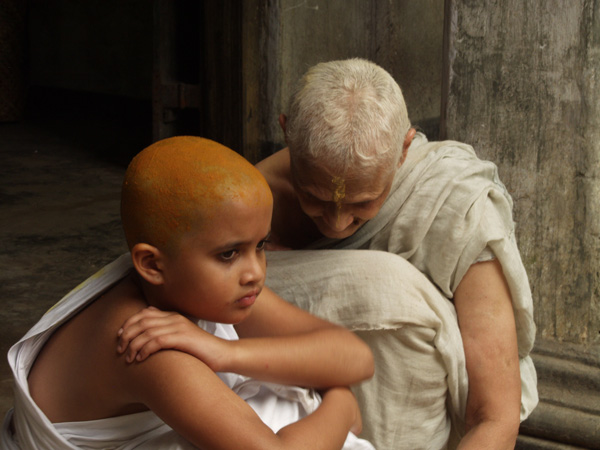
The recent Hindi film Water (Deepa Mehta 2006) tells a story about two young widows, one of them, Kalyani (Lisa Ray), 20 years old, beautiful and desirous of marriage, has been a widow since the age of 9. The other girl, Chuyia (Sarala), is eight years old and, on the death of her adult husband, has just been cast into widowhood. After becoming a widow, Chuyia’s parents, who she never sees again, drop her off at an ashram of widows in the village of Rawalpur, on the bank of the Ganges. In the widow’s ashram, she quickly makes friends with Kalyani and gradually adjusts to the austere life of a Hindu widow. On account of Chuyia’s innocent antics, Kalyani meets Narayana (John Abraham), a young, Gandhian idealist who has just passed his bar exams for law. Narayana falls in love with her and asks her to marry him, even knowing that she is a widow.
The elderly widow leader of that ashram, Madhumati (Manorama), however, exploits the other widows for her own selfish ends. In order to raise money for the ashram and for herself, she has coerced Kalyani into prostitution. One of Madhumati’s clients is a wealthy brahmana who lives across the river from the ashram. It is later revealed that this brahmana is Narayana’s father. When Narayana finds out about his father’s sordid relationship with Kalyani, whom Narayana has just asked to marry, he becomes disgusted with both his father and his traditions but still resolves to marry Kalyani. In the meantime, Kalyani, knowing that Narayana will certainly discover this dark secret about her, drowns herself in the Ganges during the night. In the morning Narayana comes to look for her but finds out that she has perished. Soon afterwards, Madhumati entices the eight-year-old Chuyia to replace Kalyani as the ashram’s prostitute. Chuyia, of course, is too young to suspect what Madhumati has planned for her. Madhumati sends Chuyia to visit Narayana’s father, who then rapes Chuyia.
Soon afterwards, Gandhi, by train, passes through Rawalpur and stops at the station to give a lecture. Shakuntala (Seema Biswas), an elderly brahmana widow, has witnessed all the evil that has befallen Kalyani and Chuyia. On account of witnessing their misfortune, Shakuntala has become disillusioned with her religious traditions, and she takes Chuyia with her to see Gandhi. As the train with Gandhi leaves the station, she runs with the train and passes Chuyia to Narayana, who is on that train. She tells Narayana that Chuyia is a widow and asks him to give her to Gandhi.
The film’s opening establishment shot begins with this verse from Manu-samhita:
A widow should be long suffering until death, self-restrained and chaste. A virtuous wife who remains chaste when her husband has died goes to heaven. A woman who is unfaithful to her husband is reborn in the womb of a jackal.
The Laws of Manu
Chapter 5 verse 156 – 161
Dharmashastras
(Sacred Hindu texts)
From start to finish, the film lays the blame for the plight of India’s widows at the feet of Manu, and the film’s notion of wickedness and corruption is very broad. This notion not only includes the obvious evils of rape and forced prostitution, the film also focuses on elderly widows who lament their own early widowhood and the loss of love and other luxuries. Whether such denial is mandated by society or by scripture, the film casts such denial as an unnecessary tragedy. If forbidding widows to remarry is inhumane (and the film presumes that it is), then laws which forbid a widow to remarry are also inhumane. The message of the film is clear—Manu-samhita, the law book for mankind, is not fit for civilized men.
The film’s exploration of the evils it portrays is shallow and superficial. The closest the film comes to plumbing the depths of human depravation is in this scene on the bank of the river, where Shakuntala asks this of the Pundit she has been serving for years:
“Punditji, you have studied the Holy Scriptures. Is it written that widows should be treated badly?”
“The scriptures say that widows have three options,” replied the Pundit. “They can burn with their dead husbands, or lead a life of self-denial, or, if the family permits, marry their husband’s younger brother. However, a law was recently passed, which favors widow remarriage.”
“A law?” asks Shakuntala. “Why don’t we know about it?”
“We [men] ignore the laws that don’t benefit us,” said the Pundit.
The Pundit never said that widows should not be treated badly. He merely repeated the ways of life for widows prescribed by the scriptures. The film’s pundit, by not objecting to bad treatment on the authority of scripture, affirms for the audience the notion that the scriptures are indeed inhumane, since the film’s narrative suggests they contain no obvious provision that disapproves of such treatment.
Yet Vedic literature never condones unkind or cruel treatment to the innocent. The Kauravas were destroyed on account of their mistreatment of Draupadi; why have India’s intelligentsia chosen to forget this and other, innumerable and obvious acts of mercy and compassion found in Vedic literature? This question is not exactly rhetorical, because it gets to the heart of where the theists and atheists differ, and this difference is not always obvious.
Theists and atheists actually agree that there are some acts which are fundamentally immoral and reprehensible. Because both kinds of people form societies—one directed toward self-realization and the other toward sense-gratification—the societies they produce inevitably place moral and legal restraints on its individuals. Theists and atheists, for example, generally agree that murder and rape are forbidden acts. What they disagree on, however, is what constitutes the good life and, hence, have important disagreements as to what should be the laws, customs, attitudes, and institutions of a society.
A society that believes self-realization is in the best interests of the individual and society at large encourages and protects charity, austerity, penance, and religion itself. Such a society tries to form individuals who reasonably conform to these ideals and arranges its social institutions so that its citizens can most easily develop such character. In a word, such a society tries to produce people who are fit to practice yoga. A society that believes sense gratification is in the best interests of the individual and society at large, however, encourages sense enjoyment. Such a society tries to form individual character and its institutions such that the individual may most easily attain worldly happiness. In a word, such a society tries to produce people who are fit for “life, liberty, and the pursuit of happiness.”
The film Water’s failing is it never rises to the level of examining what is the good life. It presumes the good life is for the sake of worldly pleasure. The film narrates the lives of widows who wish they could remarry and have all manner of luxuries but who are denied these by a society that has long since embraced sense-gratification as its ultimate goal. Although the film speaks against institutionalized hypocrisy, it does not, however, speak against sense-gratification as a human objective, which it agrees with. It speaks against ideals that a visibly corrupt society has long since abandoned. The film attacks the authority for a society that is quite different—one that rejects sense gratification in favor of self-realization—so the film’s ultimate objective is to discredit Manu.
The film Water ends by blaming Manu’s laws for the condition of India’s widows. At its conclusion, the film shows a frame with only this caption:
There are over 34 million widows in India according to the 2001 Census. Many continue to live in conditions of social, economic and cultural deprivation as prescribed 2000 years ago by the Sacred Texts of Manu
That the film says Manu prescribes “social, economic and cultural deprivation” means the film never considers the possibility that something good has been corrupted but that Vedic civilization is itself an inherently corrupt notion of society.
I have seen this movie, and it is not mocking the Manu-Samhita, just the so-called followers of Manu-Samhita.
The Brahmana community must not live at the expense of human society, exploit others for their own enjoyment, take advantage of their prestigious position based only on birthright or financial position, or be perceived of as useless leaches of society. Brahmans are meant to live a simple life, filled with self-realization, and distribution of spiritual knowledge and consciousness. We must give back much more service to humanity than we take.
Everyone in human society has a duty to perform. All people have a responsibility to follow the strict laws of God, or accept the consequences for their actions. All over the world people in general despise religious hypocrisy. So many religions, including our own, have strict standards, and laws, which we require all others to live by, but so often we don’t follow ourselves. This has happened time and again, from Roman Catholic priests molesting and raping young boys, to our own society molesting and beating children as well.
First we must strictly follow Manu-Samhita ourselves, and maintain the highest standard for all the world to see, then we can, with great humility, inspire others to live by the same strict laws.
At the same time, the Brahmana community has brought this humiliation on itself (in the form of this movie) by not properly protecting, feeding and caring for the millions of widows of India, whom we expect and force to follow the Manu-Samhita, even though we don’t strictly follow all the rules ourselves.
The movie,”Water”, was filmed with elegance and visually poignancy. The way the child, Chuyia, was portrayed with innocence and simplicity showed the nature of children in India. She was playful, cheeky and intelligent. Chuyia gave viewers a chance to see the amazing purity of a village child. Her character was dealt with sensitivity by the makers to remind or introduce the audience to village life. Village and others’ understanding of the complex laws of Manu Samhita, however, has not always been sophistocated or indeed pure.
The ‘undermining’of Manu Samhita seemed to be lack of knowlege on behalf of the makers of the movie, rather than an atheistic challenge. Many Indian people who have been ‘educated’ after the British Raj have little appreciation for their own spiritual culture. It could be an opportunity for someone learned to converse with the producers to discuss the application of Manu’s Laws in this world. These laws were to maintain order, maintain purity and enforce protection of those who could not protect themselves.
The movie gave a voice to those who have been exploited. Adhering to the Laws of Manu for a Vaisnava, is a priority. Sticking to laws out of convenience or tradition or sentiment or ritual don’t necessarily gain the person the benefit of Manu’s blessings. If a widow is given shelter as a dependant and an opportunity to fulfill life’s goal of spiritual emancipation, that was valuable. If a child, married in name only, was abandoned by parents according to the “Laws of Manu” and ithen exploited because of unscrupulous care givers, that was not valuable. What does Manu Samhita say about ‘brahmins’ exploting children?
It seems that “Water” is really not a debate about the Laws of Manu being right or wrong. The debate appears to be that laws adhered to without proper societal and spiritual support, can have disasterous consequences for innocent individuals. The karmic reactions for those who go against the “Laws of Manu” for the explotation of the innocents were not discussed, but can be considered.
This is a letter from Tamala Krishna Goswami wrote after consulting with Srila Prabhupada regarding Manu-samhita:
My dear Madhusudana Prabhu,
Please accept my humble obeisances. I beg to acknowledge receipt of your letter dated May 4th, 1977.
I discussed the contents of your letter with His Divine Grace Srila Prabhupada. Srila Prabhupada stated that our grhasthas should simply chant 50 rounds before conceiving a child. Prabhupada said: “We do not want all these rituals. Chanting Hare Krishna is our only business. According to the Manu-samhita you are all mlecchas and yavanas. You cannot touch the Manu-samhita, what to speak of translating it. So if you try to follow the Manu-samhita then you become a mleccha and yavana and your career is finished.” I hope this makes the matter clear.
Hoping this meets you well.
Your servant,
Tamal Krishna Gosvami
Secretary to Srila Prabhupada
Personally I do not agree that following the Laws of Manu is a priority for this movement. Chanting and propagating maha-mantra and Bhagavatam are ISKCONs priority. I do not know if you have read Manu-samhita, but mleccha as I am, I’ve read its fragments, and I would be worried if ISKCON would try to introduce its letter. Perhaps some principles behind it can be followed, but imho trying to established its letter in the present world would not do any good to anybody.
Srila Prabhupada several times authorized remarriage for women that lost their husbands for various reasons. There are serious issues regarding the
purity of certain Sanskrit texts. For example, the six Goswamis at times quote, in their books, verses from Puranas, Samhitas etc, and we no longer
find those verses in the texts today. So even in the last few hundred years, those texts have been corrupted.
Similarly, Sripada Madhvacarya wrote a book on the Mahabharata, the Mahabharata-tatparya-nirnaya, in which he explains that the Sanskrit text of
the Mahabharata, available to him almost a millenium ago, is full of text corruptions: interpolations, extrapolations, and transpositions of texts.
Fortunately, our important scriptures: Bhagavad-gita, Srimad-bhagavatam, and Caitanya-Caritamrta, are pure and intact. But texts such as Manu-samhita
may not be so.
Ultimately, we have the great commandment:
smartavyah satatam visnur vismartavyo na jatucit
sarve vidhi-nisehah syuh etayor eva kinkarah
“Always remember Krishna! Never forget Krishna!
All injunctions and prohibitions are servants of these two.”
Srila Prabhupada perfectly demonstrated this pure understanding in his practical dealings, such as remarrying certain women who lost husbands.