
 By Madhavananda Das
Taking the position of being a leader is a serious thing, Hari-bhakti-vilāsa (1.77) states:
rājñi cāmātyajā doṣāḥ patnī-pāpaṁ sva-bhartari
tathā śiṣyārjitaṁ pāpaṁ guruḥ prāpnoti niścitamThe sins of a counselor fall on his king, and the sins of a wife fall on her husband. In the same way a guru takes the sins of his disciple. That is certain.
Srila Prabhupada has described the thankless and dangerous service of being a manager in an institution:
… if we do not understand the responsibility… Just like in an establishment one man is promoted. His first charge is doorkeeper, then gradually he is given promotion; he may come to the post of the manager. Just like in bank, it so happens. They must go through all the different stages of service. So when he becomes manager if he does not understand the responsibility, then again he falls to the lowest position. Again he has to strive for the top. So if we forget our responsibility and become like cats and dogs, then we are going to come back again to take the forms of cats and dogs. [Room Conversation — Los Angeles, June 14, 1972]
Although some scholars consider the following story to be interpolated, it is found in most editions of Vālmīki Rāmāyaṇa, Uttara Khanda. We present it here because it nicely illustrates the points Srila Prabhupada has made above:
* * * * * * * * * * *
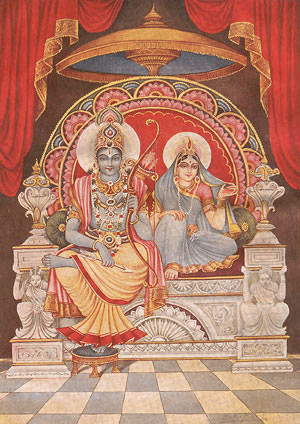
One early morning lotus eyed Rama arrived at the royal council chamber along with Vasishtha and Kasyapa to attend the duties of state administration. That royal assembly consisted of ministers, persons expert in common practices, teachers of law, diplomats, kings, and other respectable persons. The exalted assembly of Sri Rama looked like the assembly of Indra, Yamaraja or Varuna. Rama ordered his brother, “O long-armed Lakshman, go to the palace gate and see if anyone has come with any petitions.”
Lakshman soon returned and said, “O Lord, it appears that there is no one in the Kosala Kingdom who is in need of anything.”
Rama, however, insisted, “Go again and look more carefully. I do not wish to be accused of the slightest neglect. Nor do I want the least bit of adharma to go undetected in My kingdom.”
Going out again, Lakshman then noticed a dog sitting near the palace gate, its head bleeding. While looking at Lakshman, the dog whined mournfully. Thus Lakshman asked, “What is wrong? Why have you come here? Please do not fear, for you may tell me everything.”
The dog replied, “I wish to speak directly to Lord Rama, whose lotus feet award one fearlessness and who is the shelter of the distressed.”
Lakshman then said, “If you have something to say, then you are welcome to come speak to the King himself.”
lakṣmaṇasya vacaḥ śrutvā sārameyo ’bhyabhāṣata
devāgāre nṛpāgāre dvija-veśmasu vai tathāvahniḥ śata-kratuś caiva sūryo vāyuś ca tiṣṭhiti
nātra yogyāstu saumitre yonīnām adhamā vayamHearing Lakshman, the dog replied, “Agni the fire god, Indra the king of heaven, Surya the sun god and Vayu the wind god are all present in the temples, the palace of the king, and the abodes of the brahmāṇas. Lowborn creatures like myself are unfit to enter these places. (Texts 60.20-21)
“The King is the embodiment of dharma. He always speaks the truth, is expert at fighting, and is devoted to the welfare of everyone. Sri Rama knows the proper dispensation of justice. He is omniscient and is the foremost of those who delight others. He is the moon god, death personified, as well as the gods of wealth, fire, water and the sun. Sri Rama is Indra, the king of the gods, and he is the protector of his subjects. O Laksman, tell him that without his permission I do not want to enter into the royal palace.”
When Lakshman reported the matter, Rama immediately commanded, “Whoever it may be, usher them in without delay!”
The dog then humbly came before Rama and said, “O Lord, the King is the representative of the Supreme Personality of Godhead. Thus he is the savior of all creatures. While others sleep peacefully, the king remains alert, always working for the welfare of his subjects. However, since everything depends upon him, when the king is negligent his subjects very soon perish. The king is the upholder of religious principles, and thus curbs the forces of evil. Those who follow religious principles experience happiness in this life and the next. Thus the king receives great merit for sustaining dharma. O Rama, you are the model of a religious king. With my head placed at your lotus feet I seek your mercy. Do not become angry at what I have to say.”
Rama reassured the dog, saying, “Go on! Speak without fear!”
Thus encouraged, the dog continued, “A mendicant brahmāṇa named Sarvartha-siddha has injured my head, although there was no fault on my part.”
Immediately, Rama had his men summon Sarvartha-siddha. Soon thereafter, when the brahmāṇa came before him, Rama inquired, “Why did you strike this dog? What was his fault?
krodhaḥ prāṇa-haraḥ śatruḥ krodho mitra-mukho ripuḥ
krodho hy asir mahātīkṣṇaḥ sarvaṁ krodho ‘pakarṣatiAnger is a deadly enemy, a sweet spoken enemy in the garb of a friend. It is like a sharp sword and it destroys everything. (Text 61.21)
tapate jagate caiva yaś ca dānaṁ prayacchati
krodhena sarvaṁ harati tasmāt krodhaṁ visarjayetAnger nullifies whatever sacrifices and austerities one has performed as well as whatever charity one has given. (Text 61.22)
indriyāṇāṁ praduṣṭānāṁ hayānām iva dhāvatām
kurvitā dhṛtyā sāradhyaṁ sahṛtyendriya-gocaramTherefore one should give up anger, and as a driver controls a chariot, one should control the senses, which are running towards their objects like wicked horses. (Text 61.23)
manasā karmaṇā vācā cakṣuṣā ca samācare
śṛeyo lokasya carato na dveṣṭi na ca lipyateBy ones thoughts, words, and deeds one should do good to those nearby. One should not hurt others. Sin will not come to one who behaves like this. (Text 61.24)
na tat kuryād asis tīkṣṇaḥ sarpo vā vyāhataḥ padā
arir vā nitya-saṅkruddho yathātmā dur-anuṣṭitaḥThe harm that can be accomplished by an uncontrolled mind is greater than that which can be done by a sharp sword, a poisonous snake that has been stepped on, or an enemy who has been provoked. (Text 61.25)
vinīta vinayasy āpi prakṛtirna vidhīyate
prakṛtiṁ gūhamānasya niścayena kṛtir dhruvāIn spite of making an external show of proper social behavior one’s nature will be revealed by one’s actions. (Text 61.26)
The brahmāṇa then replied, “I was wandering about for a long time, begging for alms, when I came upon this dog squatting in the middle of the road, blocking my path. I told him, ‘Make way!’ but he got up so slowly that I struck him over the head with my staff. I was famished and my anger was easily aroused. O King, I admit my guilt. You should punish me as you see fit, just to save me from falling down into a hellish condition of life.”
Rama turned to his ministers and inquired, “What punishment should be inflicted on him? Justice must be done, for nothing instills more confidence in people’s minds than the administration of fair punishment to all wrong-doers.”
Bhrigu, Angiras, Vasishtha, Kasyapa, and other knowers of religious principles replied, “A brahmāṇa is never to be punished. This is the unanimous opinion of those conversant with rāja-dharma. Still, O Rama, you are the ultimate judge, for you are the Lord of the entire universe. You are Lord Vishnu himself. Thus, whatever is spoken by you is eternal religion.”
The dog then interrupted, saying, “O King, you have asked, ‘What can I do for you?’ If you truly wish to please me then kindly appoint this brahmāṇa as the head of the Kalanjara Monastery.”
Rama fulfilled the dog’s request, and thus the delighted brahmāṇa, Sarvartha-siddha, became honored as a spiritual leader and was placed atop a magnificently decorated elephant. Seeing this, however, the ministers became greatly upset and protested, “O King, this cannot be considered a punishment! Rather than punishing the brahmāṇa you have awarded him an exalted position!”
Rama replied, “You do not understand the intricacies of karma. The dog, however, does.”
Then, prompted by Rama, the dog explained, “In my last life I was the head of the Kalanjara Monastery. I duly worshipped the deities and the brahmāṇas and I always took prasādam. I performed my sacred duties carefully, and properly maintained the servants and maidservants. I was modest and well behaved and was always engaged in doing good to all living beings. Still, in spite of taking so much care, due to some unknown fault I had to take this lowest birth as a wretched dog. If in spite of having taken so much care I had to take a birth like this then what to speak of this brahmāṇa! He is hot-tempered, ruthless, and harsh. He cannot control his anger and he is engaged in harming others. He is certainly unfit to be an ācārya. For his audacity in accepting such a position he will degrade seven generations of his family.
“Therefore if you wish to condemn someone to hell, put them in charge of the brahmāṇas, cows, and deity worship. Anyone who steals from the brahmāṇas, the demigods, women or children is doomed, as is one who takes back a gift that was freely given. Indeed, even the very thought of stealing from the demigods and brahmāṇas will send a man to the lowest of hells.”
Saying this, the dog suddenly departed while Rama and the others sat wonder-struck with wide-open eyes. Although previously born in a very high family, that living being had somehow been forced to accept the body of a dog. After leaving the royal court at Ayodhya, the dog gave up his life by abstaining from food and water with the hope of attaining a better birth.
* * * * * * * * * * *
Now, one could argue that since the Lord personally gave the exalted position to the brahmāṇa Sarvartha-siddha, how could there be any danger in his accepting it? Certainly there is no inherent fault in accepting the post of a leader. From the example of Maharaja Priyavrata in the fifth canto of Śrīmad Bhāgavatam we can understand that if one accepts a position for the pleasure of Guru and Krishna, he is protected from material entanglement. Srila Prabhupada has described:
When Priyavrata’s father, Svayambhuva Manu, requested him to accept the responsibility of ruling over the world, he did not welcome the suggestion. This is the symptom of a great, liberated devotee. Even though engaged in worldly affairs, he does not take pleasure in them, but remains always absorbed in the Lord’s service. While thus serving the Lord, he deals externally with worldly affairs without being affected. … By serving the lotus feet of his spiritual master, prince Priyavrata very soon attained the perfectional stage of Krishna consciousness. This is the only way to advance in spiritual life. [Purport to Bhāg. 5.1.6.]
King Priyavrata had to be persuaded by Lord Brahma to accept the post of emperor of the entire universe. Similarly, his father, Svayambhuva Manu, felt relieved to entrust the universal government to Priyavrata. Thus it is evident that the kings and executive heads of government in the Vedic age never accepted their positions for sense enjoyment. Such exalted kings, who were known as rājarṣis, ruled only to maintain and protect the kingdom for the welfare of the citizens. The history of Priyavrata and Svayambhuva Manu describes how exemplary, responsible monarchs performed the duties of government with disinterest, keeping themselves always aloof from the contamination of material attachment. [Purport to Bhāg. 5.1.22]
However, unlike Maharaja Priyavrata, Sarvartha-siddha accepted the position of head of the Kalanjara Monastery not for the service of the Lord but for his own self-aggrandizement. The dog understood this, and thus knew that he would be suitably punished in due course of time.
==========
Excerpted from issue number 60 of Sri Krishna Kathamrita Bindu the fortnightly email magazine from ISKCON Gopal Jiu Publications. For information about obtaining a free subscription to Sri Krishna Kathamrita Bindu, write to:
katha@gopaljiu.org
or visit our website:
http://www.gopaljiu.org ==========
Bibliography
— Krishna Dvaipayan Vyasadev. Śrīmad Bhāgavatam. English translation and commentary by A.C. Bhaktivedanta Swami Prabhupada. Bhaktivedanta Book Trust. Singapore. 1982.
— Sanatan Das. Śrī Guru-vandanā. English translation by Kisori Vinoda Das.
— Sanatan Goswami. Śrī Śrī Hari-bhakti-vilāsa. Sanskrit with Bengali translation by Kanailal Adhikari. Sri Chaitanya Gaudiya Math. Mayapur. 2000.
— Valmiki Muni. Rāmāyaṇa. Sanskrit with English translation. Gita Press. Gorakhpur, India. 1995.
— Valmiki Muni. Rāmāyaṇa. English translation by Hari Prasad Shastri. Shanti Sadan. London. 1985.
Hare Krishna. Very nice article. It is also said that a King has to accept half the sins of the citizens and that current world “leaders” are reborn as amoeba. Actually while everyone is scrambling for positions of recognition in this material world a wise person would think carefully about taking anyone under their leadership unless they were confident that they could help them to advance spiritually.
Let me to discuss the moral of this story. Lord Rama, incarnation of Supreme Personality Of Godhead wanted to demonstrate difference between Impersonal Brahman and Supreme Personality Of Godhead to His all followers including all sages. So first time when Laskhman went, He could not see any one at the door but Lord Rama could see sitting in palace. So this is because, the dog in first visit came as street dog, which is impersonal Brahman and Lakshmana ignored the dog’s presence. When second time Lord Rama asked to see, Laskhman could see one injured dog. That injured dog is follower of Supreme Personality Of Godhead Rama. That dog is always faithful to Rama, knowing Rama as Supreme Personality Of Godhead and even got injured by the street dog in fight who came as a Brahman.
The moral of the story is that a real Vaisnava always follows His master including Guru and Krsna. But those who are not real Vaisnava, they are like street dog without any master and move here and there. They try to trespass to enter to Rama’s place but Rama’s own dog fights with the street dog and defeats, even kills that street dog even getting injury. So a devotee in the standard of Lakshmana will not see all those street dogs, even though they are presenting in front of Rama’s door. Lakshmana can see on real Rama’s dog and allows it to come to Rama.
So from this example, all followers of Prabhupada should know what difference between street dog and Rama’s dog is. A real Vaisnava will fight for Rama and even give up life knowing that Rama is supreme protection. That’s what the second dog had done. Though today we are seeing many difficulties to the devotee of ISKCON by Kazak Government but we should not be disappointed. We must fight for Krsna, even though we get injury. Lord Krsna is taking all material pain in that region from impersonals who are from other religions and full of material energy. ISKCON devotees must fight and even should take all injury for their cause to get mercy from Krsna. Let them to bulldoze devotees first and if it is so, that will be great service to Prabhupada and Krsna. A real devotee of Krsna will never give up Krsna or Krsna’s property without any fight. So the example of Rama’s dog is appropriate in this case which is the 2nd dog seen by Lakshmana and Lord Rama.
This explains a lot about ISKCON and about my own spiritual situation. Last year I was elected to a responsible post with authority over the local Vaishnava community. I reluctantly accepted, afraid of making offense but hopeful that the Lord had some use for me in that position. Long story short, within a year my faith in devotees was ruined, and I remain hopelessly unable to resurrect it.
So this gives both insight and good warning.
Dear Pandu Das,
I see your position is similar to the injured dog. But according to this lesson, you need to find another dog who is same faithful as you towards service of Rama. Then only you can give up your life and achieve abode of Rama. That is the lesson of this story.
A dog who is serving Rama faithfully can not give up its body and achieve Lord Rama, until it finds another faithful dog like him for service of Lord Rama.
Another way to say,
If you are Brahmana and dedicated yourself to the service of Rama faithfully like a dog, then find another Brahmana in your place similar to you who can serve Rama faithfully like you and then only, you can achieve abode of Rama.
Another way to say,
Any devotee who is engaged in the service of Lord faithfully like a dog, who can obey all orders of his master, then he must find another devotee who can serve like him to achieve the abode of Lord. Otherwise the chain of service will be interrupted and Lord will be displeased. So this interruption of service is Aparadha. In this story that is the Aparadha that dog did in its previous life.
It is always appropriate and auspicious to accept the instructions and arrangements of Sri Guru and Krsna. Srila Prabhupada has said many times, “This is the secret of success in spiritual life”.
Whatever comes in the faithful execution of their instructions and desires is “All good”.
Interesting…,whatever that dog did, got him the merciful darshan of the Supreme Lord. There is something to be learned in that also. We should become the “dog” of the spiritual master. That is perfect!
When will Gopaljui Publications produce Srila Gour Govinda Maharaja’s books again?
Yikes, Pandu. I am sorry to hear of your experience.
The story is a great warning and gives me much admiration for those who, at great risk to their devotional creepers, take up responsible leadership positions in ISKCON.
We always see how fast political leaders like U.S. presidents seem to age while they are in office.
We also see that ISKCON leaders and gurus have sometimes fallen down. Sometimes we are tempted to think with satisfaction, “this guy was lording it over me and now he is getting his comeuppance.”
But we should remember that even when Krishna’s devotees fall down they are never like ordinary karmis (na vai jano jatu kathancanavrjen… First Canto, Fifth Chapter)
We know that they took great risk by being positioned over devotees, and we hope they quickly come back to Krishna’s lotus feet, because there is a sweet fragrance there that exists nowhere else.