It seems like some secular university with a spray on coating of Krsna consciousness. Of the 10 courses offered a large percentage (Classical & Medieval Philosophy, Reason and Revelation, World Religions, Introduction to Kavya) are not related to Vaisnavism. (Anyone could find out about these topics in depth by reading them on wikipedia.) And, we see that an important course like “Vedas & Upanisads” is taught by a non devotee, of what possible value could that be? These can only be understood what to speak of taught by someone who has complete faith in Krsna and Guru (yasya deve para bhaktir yatha deva tatha guru…). And what is the value of “Interfaith” until and unless we have a good and solid understanding of our own culture and tradition? This seems to be the root of the problem at the “Bhaktivedanta” College.
Perhaps the “Bhaktivedanta” College should try to find out what our acaryas considered should be the syllabus for study. Here is the syllabus approved by Srila Bhaktisiddhanta Sarasvati Thakur:
It sounds like an interesting curriculum and I would love to attend such courses with faithful devotees. I wish I could do it. It would be a big step up from what I mostly do with my time these days.
Where is Bhaktivedanta College? Is this in Belgium? England? Who can enroll? How much does tuition cost? How about room and board?
I am sure that with the number of devotees involved in the project, Sugriva’s fears that the discourse will become mundane will not come true. I imagine part of the curriculum requires good morning and evening program from all students: japa, tulasi puja, Bhagavatam and Gita classes, aratis, so how could these classes become mundane?
Is Rembert Lutjeharms really a “nondevotee”? (I have no idea, but I would suspect not, given the other teachers and the nature of the school)
To learn subjects like western philosophy and comparative religions from devotees and from the perspective of devotees would be awesome.
Didn’t Srila Prabhupada actually request the “Dialectic Materialism” discourses with Syamasundara, Hyagriva etc., from just such a motive? Such comparative understanding demonstrating the true glory of Gaudiya Vaisnava conclusions in the context of world philosophies and religious sounds like a great foundation for any preacher.
It only requires that the students and teachers retain their unflinching faith (yasya deve para bhaktir. . . ), and this Krishna Consciousness will undoubtedly conquer the world and attain its rightful place in the firmament of human thought. Prabhupada would ask, “They have this big university, but where is the department that teaches about spirit?” I would say it looks like Bhaktivedanta College is that department, or at least that Bhaktivedanta College and similar programs now growing ins ISKCON will be the beginning of developing such departments.
I somehow survived mundane university and law school without always having good association of devotees (and certainly without deserving such good association). I cannot think of a sweeter life than attending classes on these subjects with students and teachers who are all ISKCON devotees with good sadhana and faith in Srila Prabhupada. Oh how I wish I could do it!
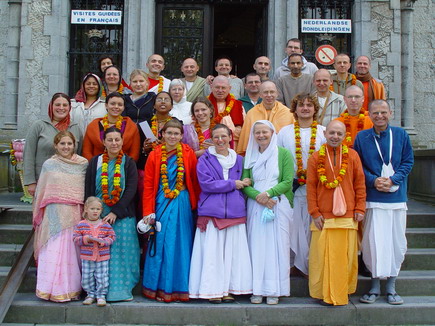
I guess it must be Belgium because I see French and Dutch signs in the photo. I take it that the medium of instruction is English?
There was an old play or movie or something about American tourists on a whirlwind, guided tour of Europe, entitled “If It’s Tuesday It Must Be Belgium”. I never saw the play, but I love the title which says it all. :-)
In contrast to Sugriva, I kind of feel that the kind of survey of western philosophy and world religion offered in a short program like this might be too superficial, kind of like the tourists who try to “do Europe” in two weeks from an air-conditioned guided tour bus.
I do not agree that most people could really learn that much about philosophy or religion from Wikipedia. It helps to have discussion with good teachers, and trying to read good translations of the primary materials is indispensible for getting a real sense of the subjects.
Not every devotee needs to dive deep into reading all these different things. Still, many preachers and book distributors will find it worthwhile to be able to at least have a passing knowledge and be able to converse with university graduates about such subjects in relations to Krishna consciousness.
And there may be some rare talents who, after more in depth study, can forcefully present Krishna consciousness in language that appeals to top scientists, philosophers and religionists. That is also wanted.
Lord Caitanya took sannyas so He could reach the intellectual leaders of His time and place, the Mayavadi sannyasis. Naturally there will be top-notch educated devotees who, without sacrificing their purity and effulgence, will also be able to explain Krishna consciousness to today’s intellectual leaders.
Such devotees will be equipped to show such intellectuals how the best parts of their own traditions actually point to Srimad Bhagavatam and Sankirtan yajna, just as Lord Caitanya explained the real purport of Vedanta Sutra to Prakasananda Sarasvati and Sarvabhauma Bhattacarya.
pray that some day the Bhaktivedanta College will live up to its name. blah blah
we see that an important course like “Vedas & Upanisads” is taught by a non devotee
Ignorance is not always a bliss. As in this particular expression, when someone who sees a name of devotee, who is a full time devotee and chanting his rounds and a head above everyone else, but due to ignorance assumes that he is not a devotee. Just is you see someone reading book, say by Professor Sanyal – your would suggest – why would do you read a non-devotee book? It appears that until you know, you will not be able to understand… and will be too quick to judge thus exposing even your further ignorance. It’s sad especially if you compete in the same market. All the courses above are courses in Vaisnava philosophy by devotees and for the devotees. I guess you did not even bother to check the website before posting the comment I may suggest yasya deva parA bhaktir yathA deve tathA gurau did not really work in this particular instance. I have not been in Radhadesh for last 11 years, but I know that developments there are certainly all Prabhupadas grace..
I hope and pray it works in all other cases and is not just an external show of wearing Vivekananda style hats and wooden shoes under the plea of following genus of the Bhaktisiddhanta Sarasvati Thakura who said shedding some light for all of us:
So far about our propaganda work. Now, as to the manner in which that work is to be carried out. A self-conceited or vain-glorious man can never successfully carry on propaganda work. How will it be possible for him?
… being quite ignorant of the true significance of right worship, the true object of pilgrimage, the right duty of the proper ways of preceptorship, the true culture of theistic works like the Bhagavata and the real difference between true and false bhakti. And it is painful to see people wasting their valuable time in no better work than mischievous, ill-conceived criticisms of others’ conduct. They excel only in giving advice to others. (Their damned mind is, no doubt, responsible for this.) So, every morning, on rising from bed they should make their wicked mind hear the following immortal song of Thakur Bhaktivinoda:
bhaja re bhaja re amara mana ati manda
(bhaja) vraja-vane radha-krsna caranaravinda
Please accept my humble obeisance. All glories to Srila Prabhupada.
Some seminars (that are according to Srila Prabhupada’s teachings) sound great and I would like to attend. But what about the other ones…?Life is short, time is running, we will die sooner then we expect, so why waste our time on mundane teachings? Why to invite and establish some seminars that have thing to do with Bhakti? Why try to impress people outside of ISKCON or to study mundane things just for the sake of better salary (higher degree=better salary) or to think that intellectuals will accept KC just because we know their field so well? That ‘s not true, because SP said that if we read and study his books, we can debate with any academic.
But do we really read and study in depth his books? There are many devotees who are 1st and 2nd initiated, but do not read or never read SB, or complete BG, etc. (please do the test in your area and ask devotees directly, and you will be surprised how many are initiated but never read SB, or BG). Why give initiation to devotes who do not read and study SP’s books? It will be wise first to read BG, SB, CC, NOD, Isopanisad. Then initiation. Not before. So if someone is eager to be initiated, they will be forced (for their own benefit) to read these books. Why then to encourage some of those seminars that are not even related to vaisnavism or have nothing to do with Krsna Bhakti when we do not care if devotees in ISKCON read SP’s books?
To not study mundane topics is not ignorance. Ignorant person is a person who does not inquire about the Absoluth Truth, Sri Krsna. Mundane education will not save anybody at the time of death.
Most of us went to Primary and Secondary School, and there we already got very solid knowledge about World Religions, History of the World, etc… If someone wants to study again all those topics this world is full of such schools, colleges (thousands and thousands), with the highly qualified professors in those subjects . But what is the use to have one more such school within our society? We need to offer to the world the Bhaktivedanta College with the program based on guru-sadhu-sastra and teachings of our Acaryas and Srila Prabhupada primarily.
Our soul (our real identity) needs to be feed with bhakti every day. Otherwise we will die. Soul cries for Bhakti, not for mundane topics. Give us shelter in ISKCON education, and feed the soul, please…
I don’t undestand what’s the problem? If you do not want to study the things that The Bhaktivedanta College has to offer, you don’t have to do it. There are people who just want to study Prabhupada’s books and skip all the rest. Fair enough. Enroll on Bhaktisastri course or something like that. Now, there are people who want to or need to have some knowledge about the context of other culture, often those we grew up in. Let them do that! What’s the problem? Nobody is being forced to attend Bhaktivedanta College to be a devotee or to be initiated. Why you want to force others to do things your way?
And believe it or not, many of the questions our tradition deals with, and many of the problems our movement faces, are not that unique. Others face them too and deal with them too. We can learn from them, they can learn from us. Also on the academic level, and I think that’s one of the ideas with the Bhaktivedanta College. I personally think they are doing a great job. And I think it’s great that there is a variety of educational possibilities offered for devotees with different inclinations. On one hand projects like bhaktisastri courses and Gopiparanadhana Prabhu’s bhraminical school, on the other hand initiatives giving devotees a chance to study western philosophy as well, but in devotional context. You may not need it as an individual, and that’s fine. But some need it as individuals and we certainly need it as a movement.
Please accept my humble obeisance. All glories to Srila Prabhupada.
Maybe we should reread some of the texts recently posted on this website about the many devotees who left their bodies. What were they doing to prepare themselves for leaving the body? Obviously, they chanted, other devotees were reading to them from Srila Prabhupada’s books, giving them maha and more chanting. I never heard that any of them wanted to listen from any other books than SP’s or to listen about Western philosophies. Krsna mercifully gave them time to prepare themselves and because they knew that there was not much time left they focused on what is important (and we definitely do not know how much of time is left for us). Intelligent and non-self-destructive persons will be focused on what is important. Not on mundane teachings. We already went through all kinds of education in many lifetimes, including this one, and now is our chance to do something for ourselves, for the soul. Krsna says (BG 7.19) that KC is a multi-life-time process – and it is again our choice what to do. Use it or lose it – it’s always our choice.
Srila Prabhupada said that ISKCON is meant to create a class of brahmanas, not academics. In comment # 6 it was already admitted that Bhaktivedanta College (BC) is not a brahminical school, pointing us to Gopiparanadhana Prabhu’s school. If BC is not for creating Brahmanas as SP wanted, then which objective of SP’s is BC fulfilling? Please read again Vision & Mission of the BC. Is it even fulfilling its own stated mission?
I don’t know, Tungavidya, but to me it looks like a very brahminical curriculum. Modern Vaisnava preachers ought to be able to discern what is good and bad within other religions and within the dominant intellectual traditions of the contemporary world.
I know nothing about Bhaktivedanta College. I have never been to Radha Desa. However, looking at this curriculum does not make me think they are trying to create mundane academic scholars who have no faith in Prabhupada’s books.
Faithful devotees should not be afraid that exposure to the writings of David Hume or to the Koran or to William Shakespeare is going to make them lose their faith in Krishna Consciousness. Actually, if the teachers and students are qualified, such exposure will increase their faith and their effectiveness as brahmanas.
When I was at University of Michigan Law School, I was going through a low ebb in my Krishna consciousness. I tried to connect with devotees, but when I encountered devotees in this college town (Ann Arbor), they sometimes came across as anti-intellectuals, fundamentalists who were afraid of learning.
I am sure the fault was primarily with me, but it was unattractive to me the way a young devotee was preaching to me that the teachers were all demons and so on. It seemed he was inexperienced, unlearned, impatient, and above all frightened. I wish him well, whoever he is, and hope he is happily advancing in devotional service.
Not all devotees need to be able to engage people of other religious or intellectual backgrounds. Not even all brahmanas have to have that quality (although all brahmanas should be self-satisfied by virtue of deep spiritual knowledge and should never be afraid of philosophy).
If our ISKCON devotees are going to fulfill the role of brahmanas in modern society, though, at least some of them should be prepared to engage modern intellectual traditions, and to extract the essence like swans.
Really, there is nothing new under the sun. A.N. Whitehead famously said that all philosophy is “footnotes to Plato.” He might as well have said “footnotes to the Vedas”, because the Vedas are the true root of all knowledge, and the Bhagavatam and Gita are the ripened fruits of the desire tree of Vedic wisdom.
It seems to me the faculty of BC understands this. I am sure that all these subjects will be discussed in light of Srila Prabhupada’s books. They are not trying to produce mundane scholars. Don’t fear.
Please accept my humble obeisances. All glories to Srila Prabhupada.
Please forgive my ignorance but I have not read anything yet that supports the teaching of these non-sastra courses. The teachings from Srila Prabhupada’s books are purely spiritual and, therefore, transcendental. Teachings of Western philosophy are material and mundane even when taught by a devotee.
I do not remember Srila Prabhupada ever encouraging us to study these mundane teachings. How can these teachings help us solve ISKCON’s problems. How can one solve siritual problems with material solutions?
How can these teachings help us in our preaching efforts? Will we impress others with our knowledge of Western philosophy and therefore help them to take to Krishna Consciousness? I always thought that we had to give them spiritual knowledge as taught in Srila Prabhupada’s books to elevate the fallen conditioned souls.
Rather than spend our energy teaching these mundane courses why not devote that energy to teaching more spiritual courses. Do we already have enough teaching of Srila Prabhupada’s books? Can we ever have enough?
The question “Why you want to force others to do things your way?” baffles me. Why should anyone consider that they are being “forced” to study Srila Prabhupada’s teachings and why would they feel “denied” when his teachings are promoted and material teachings are suppressed?
We have an entire movement that is in deep need of more of Srila Prabhupada’s teachings so that we can in turn spread it to the fallen conditioned souls of this material world who are in even greater need of these teachings. We have not been authorized to learn and spread this mundane philosophy. We have been deputised to fully absorb Srila Prabhupada’s teachings and to spread it to every town and villiage.
Aren’t our brains already full of enough material mundane knowledge? If we are to fully absorb ourselves in transcentental knowledge how can we find time and brain cells to absorb this material knowledge? And for what? How does this help us to become more knowledgeble in Vaisnava philosophy and how does it help us to spread Srila Prabhupada’s teachings?
Again, I must appologise for my ignorance. Could someone please open these darkened eyes? Please give me the understanding that I cannot find here.
Your humble servant,
Jivananda dasa Vanacari ACBSP
“We can challenge any nonsense philosophy. Socrates, Plato, Kant, Darwin–all of them–so many mental speculators and word jugglers who have misled so many people. Now it is your task to find them out and expose them, so that the people may appreciate the real philosophy. We must become now very serious to save the people of the world from this very dangerous situation. So become very convinced yourself of our philosophy and then your preaching will act.”
“I am sure that all these subjects will be discussed in light of Srila Prabhupada’s books. They are not trying to produce mundane scholars. Don’t fear.”
So it does seem that he knows a lot more about Bhaktivedanta College than he lets on.
He also said:
“I don’t know, Tungavidya, but to me it looks like a very brahminical curriculum.”
But has Akruranatha Prabhu checked out a real Brahminical curriculum, one designed and authorized by Srila Bhaktisiddhanta Sarasvati Thakura, at the Bhaktivedanta Academy in Sridam Mayapura? Here is a link to the syllabus
Gosh, I am really surprised at the negative reaction of three devotees to this innocuous course schedule.
In it, we find courses on Caitanya Caritamrta, Vedas and Upanisads, and the writings of Vaisnava acaryas. I cannot imagine anyone objects to those classes.
We also have practical classes on congregational development and interfaith preaching. Surely those are not objectionable.
Then there are classes on Sanskrt and on classical Sanskrt poetics. Is there a problem there?
Learning Sanskrt cannot be forbidden. Prabhupada included word-for-word translations in his books; he must have considered that some understanding of the Sanskrt language is useful. The title is “Sanskrt for Scriptual Study 2”, which kind of says it all. Most of our scriptures are in Sanskrt. Shouldn’t we expect well-educated devotees to know Sanskrt?
And why should devotees find knowledge of poetics offensive? Among the 26 qualities of pure devotees we find “poetic.” Most of our holy scriptures are written in Sanskrt poetry. This must not be what is causing consternation.
That means that out of the 10 courses listed for study, only three might be drawing the objection of devotees here: Two classes on western philosophy and one survey class on major world religions. I still do not understand why there is an objection to devotees discussing such things, as if they were radioactive or something.
Prabhupada made it a point to record his discussions of various Western philosophers’ ideas with his disciples Syamasundara and Hyagriva. These discussions were eventually published in a book entitled “Dialectic Spiritualism” (a smaller version is now in print as “Beyond Illusion & Doubt”) If Prabhupada did not want devotees to consider those ideas, then why did he bother with these dialogues?
No one is discouraging devotees from reading Prabhupada’s books. No one is criticising devotees who read nothing but Srila Prabhupada’s books (though someone who truly never read anything else might seem uninformed and strange to the people in general.) However, it is nice to know that for those devotees who want to understand world religions or European philosophy, there is an organized college in which these topics can be studied and discussed with like-minded devotees. What could possibly wrong with that?
It may go back to the question of yukta vairagya. If these things can be used in Krishna’s service, shouldn’t some of us do that?
Tungavidya invokes devotees who recently left their bodies. Prabhupada encouraged H.H. Bhaktisvarupa Damodara Maharaja to complete his Ph.D., and then to devote his life to Bhaktivedanta Institute preaching. Why would Prabhupada do that if he wanted devotees to take a “hands off” policy toward thinking and learning?
Jivananda argues that such learning wastes our energy. I would suggest it is only a waste of energy if it is not in relation to the Lord.
“One must dedicate everything in the service of the Lord. If one is a learned scholar, scientist, philosopher, poet, etc., then he should employ his learning to establish the supremacy of the Lord.” (S.B. 1.5.32 purport)
Someone might argue that the above instruction only applies to people who became learned scholars, scientists, etc. before they “joined” ISKCON. Once they “join”, all “outside” work and education must immediately be renounced (I used to hear that argument in the 1970s, not so much lately). It seems artificial to me somehow. It is tinged with phalgu vairagya, IMHO.
Of course, if someone can just chant 190 rounds a day or something, it might be a waste for them to do anything else (but then again they might do other things for preaching–Prabhupada required only 16).
Most of us have to learn how to use our own propensities to work in different ways, and engage them in service to Krishna.
And what about children born in ISKCON? Are they supposed to never contact boooks other than BBT books? Don’t they also have to learn to worship Krishna according to their own occupational duty? (It is not realistic to expect that they all will just be pujaris. At least, it has not turned out that way. )
Some people will want to learn how to program computers or operate cranes or repair jet engines. For that we do not need Vaisnava instructors (although it would be nice, someday, if all our instructors and students for everything would be Vaisnavas).
But to learn Philosophy and Religion, to compare and contrast Vaisnava philosophy with that of others (the way Prabhupada showed us by his own example in the Philosophy dialogues), is something only Vaisnavas can really do. It seems like a brahminical occupation, and a much needed one.
Of course it will be nice to have the garbagemen and grease monkeys be Vaisnavas, and I mean no disrespect to them. However, when the philosophers, scientists, cultural and political leaders are devotees, that will make a big impact.
Okay Sugriva I have looked at the Bhaktivedanta Academy curiculum in Mayapur and it looks very nice. You get no argument from me there.
However, I would say there can be more than one academy (there should be many). Not everyone has to do things the same way. From what I can see I would be happy going to either school, and would be much improved by the good association I would get there.
We can talk about devotees wasting energy, but I think the greater waste is that we spend so much time criticizing the sincere devotional service of other devotees. Our energy would be better spent praising what is good about it, or striving to set a better example ourselves.
(I know I am a big faultfinder, but I am trying to do better) :-)
It seems to me that this disagreement about what should be in the curricula at Vaisnava postsecondary schools reflects broader disagreements about how devotees should or should not interact with the world “outside” the ISKCON ashram.
It is probably safest for newbies not to take a step outside the door. However, if we can do it, we are encouraged to go out for book distribution and preaching engagements. And some are going to leave the ashram to make their way in the world, whether we like it or not. We hope they can stay engaged somehow.
The really great devotees (sara grahis) can extract the essence and see value in all kinds of endeavors. I would even say they could find something of value in the writings of Western philosophers, most of whom were Christians at least.
Srila Prabhupada was very engaged with the outside world. Otherwise he could not have become the greatest preacher in living memory. Look at his old BTG articles. He makes great use of current events in Indian politics. Look at “Easy Journey”. He takes something out of a science article as a springboard for explaining Bhagavad Gita. In the ’70s he often responded to current events, like the impeachment of Nixon. He would look at Time or Newsweek and would respond in his preaching to things he saw there.
You can quote Srila Prabhupada saying Socrates and Plato and Kant and Darwin are fools and rascals, but can you say *why* they are rascals, what is wrong (and right) about their ideas? If you want to do that, you might find it worthwhile to discuss these things with Mahendra and Anupama. :-)
“Religion without philosophy is fanaticism.” True philosophers shouldn’t shrink from examining the propositions of other darshans.
The world is a big place full of different ideas, knowledge, skills, talents, wealth, fame, and beauty. If not for the devotees, who is going to put the “One” of Krishna in front of all those zeros?
I always had the feeling that, by trying to understand “mundane” ideas in light of Srila Prabhupada’s books, in some sense I was spiritualizing them, “reclaiming” territory for Krishna consciousness. It is just like using a microphone or tape recorder in Krishna’s service.
Krishna consciousness is not going to take over the world by getting everyone to quit their jobs, their hobbies, their customary methods of self-expression, and getting them to move into ISKCON temples.
It will take over the world when a sufficient number of people take up chanting Hare Krishna, reading Prabhupada’s books, and using what they have to glorify Krishna.
All they really have to give up is meat eating, intoxication, gambling and illicit sex. They do not have to give up science, music, art, philosophy, poetry, cinema, astronomy, banking, politics.
It would be nice if we could learn to live without heavy, iron-age industry, cars, airplanes, power plants, but it is not really necessary. It probably won’t happen right away. Devotees use cars and planes and computers. Of course they do.
When we sell books, we try to interact with people who like to read books. We try to tell them that these books have some of the qualities they are looking for in books they’d like to read. It can be helpful to be able to honestly relate to these people on the basis of Krishna consciousness.
Now, reading mundane books is an anartha. Serious devotees should try to give it up. But there is an intellectual or literary class that is addicted to it. It is not against the four regs. Let them dovetail it somehow. It will spiritualize culture.
The world has become a smaller place with advances in communications and transportation. Lord Caitanya’s Sankirtan Movement, the “Hidden Glory of India” (props to a Prabhu for this phrase), is poised to become less and less hidden.
Scholar-devotees like a and many others are popping up all over. Devotees everywhere are writing books. Krishna Ksetra Prabhu is a professor in China. Tamal Krishna Maharaja went to Oxford. This is nothing new.
Therefore I am surprised that offering courses on western philosophy and world religion from Vaisnava perspective in a devotee college raises any eyebrows.
Please accept my humble obeisance. All glories to Srila Prabhupada.
Sugriva Prabhu sent a relevant quote by Srila Prabhupada: “Now it is your task to find them out and expose them, so that the people may appreciate the real philosophy.” How this can be done? It is a standard in Vedic philosophical debate that before refuting others one must first fairly present the strongest possible version of the opposing view /purva-paksa/. How one can do that if one doesn’t know the opposing philosophy? If that’s my field of service, I would prefer to learn it from devotees, instead from the mundane view of a Wikipedia author.
I don’t understand the logic of promoting a good thing as the only possible one. Can’t we have many educational projects serving different needs of the devotee community? Bhaktivedanta College may not be the perfect one, but is certainly trying to fulfill Prabhupada’s vision (see letter to Tusta Krsna, 9 Nov. ’75). It is also supported by ISKCON leaders, like for example Sesa Prabhu (the Minister of Educational development), who is also a teacher there, and Radhanath Swami (one of the Trustees).
What good is there in declaring a project a useless endeavor without looking at the results? Many students who studied there expressed their deep appreciation of the tremendous spiritual benefits from their life in the College. There will be always young devotees (not yet fully aware that there’s little time left) who will want to study at a College, get a degree (… and waste time by reading and writing in on-line forums). Why not give them a chance to do it in a spiritual atmosphere, where they can learn to practice strong sadhana, serve the Deities and the devotees, and get the rare association of advanced Vaisnavas?
Please accept my humble obeisance. All glories to Srila Prabhupada.
These are my simple points:
I have no problems with devotees reading other books with the proviso that they have read ALL of SP’s books and listened to and assimilated ALL of his recorded lectures and conversations. If they do not then they will not have a standard by which to measure what they are reading. I myself have read on a very wide range. My personal library has approximately 1200 titles on subjects such as: Assyriology, Ayurveda, Niti, Nyaya, Tarka, Vastu, Vedanta, Upanishads, puranas, itihasa, ancient and modern education, world history (ancient to modern, Eastern and Western), history of science, mathematics and philosophy [from pre-Socratics to Godel and Wittgenstein], history of Christianity starting with Eusebuis; many of the classic Greek and Latin writers — Homer, Herodotus, Thucydides, Livy, Suetonius, Lucian, etc, (studied) Greek and Sanskrit, political science, pure mathematics, collected works of Shakespeare, and Plato, technology, web design, art, psychology, economics, Buddhism, Confucianism, Shintoism, Koran etc. My library has gotten so large that I have a person cataloging all the titles so that I can keep track of them all so as to avoid purchasing a book I already have. And for the record I do not live a cloistered life in a temple out of touch with the rest of the so-called real world. In my profession (consultant) I deal with the public on a national and international basis.
The important point is that while I have read these books I only did so AFTER I read and assimilated ALL of Srila Prabhupada’s teachings twice. Hence, when I read other subjects I do so in light of SP’s teachings.
Have the students at BC who will be taking the apasampradaya courses read all of SP’s books and listened to all of his recordings? If not, then the study of other philosophies is premature especially in consideration of the next point.
I objected that a large percentage of the syllabus, 30%, was dedicated to apasampradayas. We should thoroughly know our own philosophy first then learn that of the opponents.
“You can quote Srila Prabhupada saying Socrates and Plato and Kant and Darwin are fools and rascals, but can you say *why* they are rascals, what is wrong (and right) about their ideas? If you want to do that, you might find it worthwhile to discuss these things with Mahendra and Anupama. :-)”
Yes I can. Why? Because I have studied Srila Prabhupada’s books, hence when I read the works of others I find it is easy to pick them apart. You mentioned Srila Prabhupada and “Dialectic Spiritualism.” I read that book in 1986 when it was first published and also listened to recordings of the conversations. We note that SP did not do a deep study of any of the philosophers, he was just presented an encapsulation of each of their positions and then deconstructed them. He did it easily because he was a master of our own siddhanta.
Mahendra Prabhu wrote:
“Sugriva Prabhu sent a relevant quote by Srila Prabhupada: “Now it is your task to find them out and expose them, so that the people may appreciate the real philosophy.” How this can be done? It is a standard in Vedic philosophical debate that before refuting others one must first fairly present the strongest possible version of the opposing view /purva-paksa/. How one can do that if one doesn’t know the opposing philosophy? If that’s my field of service, I would prefer to learn it from devotees, instead from the mundane view of a Wikipedia author.”
In Pancanga Nyaya you must of course have a thorough understanding of the purva-paksa but that deep study of the purva-paksa is only done AFTER you have studied and assimilated your own position otherwise how you can present the siddhanta?
So this has been my point all along which you all seemed to have missed. I object that the students are deeply studying the purva-paksa before mastering our Siddhanta. I have no objection to teaching mature students who have mastered our siddhanta the positions of opposing thinkers. But I do object that instead of making our students masters of our siddhanta first that 30% of the syllabus is spent on the purva-paksa at the expense of our own siddhanta.
Who among the readers objects that devotees should be thoroughly versed in our own teachings first before they venture into other subjects? Never forget that spiritual life is a razor’s edge, one mistake and you must take birth again.
If you have capacity to understand Prabhupada’s books and additionally other philosophies in that context, there is nothing wrong with that.
Obviously learning Western philosophies without learning Vedic philosophy can be pratikula. However, learning both is not wrong, especially for a preacher.
Personally, I learned “Western” philosophy at university before reading Srila Prabhupada’s books. As Mahendra says, without purvapaksa, your refutation is incomplete. Rational, intelligent people respect people who have both reason and faith on their side, and that’s the situation of the madhyama-adhikari.
Sri Caitanya Mahaprabhu’s style of argumentation against Prakasananda Sarasvati is the argument of an uttama-adhikari. We know that Mahaprabhu did have a lot more knowledge than He displayed in that exchange.
On the other hand, the kanistha-adhikari doesn’t know much about the rational underpinnings of their own faith, or others. They argue more from enthusiasm and sometimes fanatical conviction, but they don’t experience the deep, sustained ecstasy in their practice that Mahaprabhu displayed.
IN order to go from kanistha to madhyama study and preaching are necessary. We can discover something about ourselves and our faith in contrast to others. We get Krishna’s mercy by sharing Him with others. Part of that can be reasoned conversations designed to demonstrate the value of what we have. Different people have different capacities for knowledge, and each should fully engage their faculties of reason in the development of their faith in this way.
At the time that Srila Prabhupada was physically present the movement was immature and the members were all new. There was not an established culture of study and understanding.
Now, some 30 years later we might expect the movement to develop some more symptoms of madhyama-adhikari, rather than remaining kanistha, or faux-uttama, which is also kanistha, forever.
Of course we always have to be careful not to fall into the trap of being deviated from the core, but we have been left the work of fleshing out the framework and creating a full-blown society, rather than just a cult.
Okay Sugriva. I misunderstood your point. I see now you approve of devotees learning about a wide variety of topics, but only after they have become qualified to do so.
I can appreciate that. I would still say it should be left up to the individual colleges, the students, and their spiritual masters and well wishing advisors.
You questioned before whether I knew more about BC than I was letting on. The truth is that pretty much everything I know about it comes from this little article, with its blissful picture and its description of the curriculum. I have met Kadamba Kanan Swami, who is on the faculty, and now I hear that Sesa and H.H. Radhanatha Swami are involved. It seems evident this is a good project.
Maybe I am just inclined to have a positive outlook on things. People tell me that. I am naive, optimistic. I hear that all the time. I guess I prefer to give devotees the benefit of the doubt, especially if I have no evidence they are doing something wrong.
I am glad to hear you are a learned devotee and a professional man. Please forgive me if my words caused you any discomfort or embarrassment. Anyone who has truly assimilated all of Srila Prabhupada’s teachings is fit to be guru of the universe. I would be happy to take classes from you. Really.
I was surprised by your negative reaction, though. I would have thought someone who assimilated so much would be more like a bee seeking nectar. But perhaps you have some personal bad experience with Bhaktivedanta College or its faculty I am not aware of. (My nature compells me to give you the benefit of the doubt, too.)
Regarding “Dialectic Spiritualism,” I agree with you that “SP did not do a deep study of any of the philosophers, he was just presented an encapsulation of each of their positions . . .” As such, the book is not very well appreciated by academic philosophers.
I wonder though, what was Prabhupada’s purpose? Was he setting an example that we should not to study these philosophers deeply? Or was he showing us that we *should* undertake to expose what was good and bad in European intellectual history, in light of the Bhagavata tradition?
Who can understand the mind of a Vaisnava? I tend to think he was doing the latter. You and I agree that it is a job for advanced devotees.
As for my comments on how we “engage the world” as devotees, it is a topic on my mind. I see it everywhere I go, in every Dandavats article I read. Please forgive me.
I remember when H.H. Hrdayananda Maharaja was starting to go back to graduate school, it must have been in 1979 or 1980. He compared being a student at mundane university to being one of those guys in the carnival side show who can eat anything.
You know, the freak show act in which a guy eats glass, bicycle tires, filed down iron horse shoes, and so on? Hrdayananda Maharaja called these performers “garbage eaters”, and he said that modern students are like “garbage eaters,” because they are required to carefully consider and digest so much that is not really fit for human consumption.
In Prabhupada’s instructions on gurukula, he did say that the students need not be taught to do mundane research, but they should be given basic knowledge so that they do not appear to be fools. (I hate to give “Prabhupada said” quotes from memory, because I may not be getting it exactly right. I read those gurukula instructions 25 years ago.)
For example, if devotees grow up not knowing what century the Franco-Prussian war was in, or what continent Paraguay is in, or who was the first president of the United States, or the last Czar of Russia, it will not hurt their progress in devotional service. However, it might make them lose respect in the eyes of the public. (Although probably less than 10% of U.S. high school graduates could answer more than two of the above questions).
Still, those were instructions for gurukula students in general. I can imagine that some students with a particular propensity could go on to have careers in academic scholarship or science or math at a professional level, especially if they could use such things in preaching.
Prabhupada encouraged Rabindra Swarupa to complete his Ph.D. He founded the Bhaktivedanta Institute. He wanted the top intellectual leaders to appreciate Krishna consciousness.
I am not sure I am being clear. Am I saying that devotees who are not yet paramahamsas but who have a propensity to work as professors and scientists can dovetail their inclinations by finding ways to glorify Krishna consciousness with their own academic work? Certainly.
Am I saying that those who really have thoroughly assimilated the Bhaktivedanta purports and become paramahamsas should embark on academic careers? No. At least not all of them should. But if some of them, for preaching, learn how to attract the hearts of the intelligentsia, the world will be grateful. The paramahamsas can do anything.
Concerning making a comparative study and critique of philosophy, unless one
is very expert it is difficult for him. First of all, let people understand
Krishna. We are doing that. Maybe one or two are interested in philosophy
and for so few persons we can’t spare so much valuable time. Better to
induce everyone to chant Hare Krishna and take prasadam. That will be a mass
benevolent activity. In the western countries many Ph.D.’s are out of
employment because they did not get any service. We do not want to become
great philosophers but rather to understand the philosophy in our own books.
If we remain strong in our own literature, we can meet anyone else without
any fear.

It seems like some secular university with a spray on coating of Krsna consciousness. Of the 10 courses offered a large percentage (Classical & Medieval Philosophy, Reason and Revelation, World Religions, Introduction to Kavya) are not related to Vaisnavism. (Anyone could find out about these topics in depth by reading them on wikipedia.) And, we see that an important course like “Vedas & Upanisads” is taught by a non devotee, of what possible value could that be? These can only be understood what to speak of taught by someone who has complete faith in Krsna and Guru (yasya deve para bhaktir yatha deva tatha guru…). And what is the value of “Interfaith” until and unless we have a good and solid understanding of our own culture and tradition? This seems to be the root of the problem at the “Bhaktivedanta” College.
Perhaps the “Bhaktivedanta” College should try to find out what our acaryas considered should be the syllabus for study. Here is the syllabus approved by Srila Bhaktisiddhanta Sarasvati Thakur:
http://www.vidyapitha.com/curriculum/curriculum.html
We pray that some day the Bhaktivedanta College will live up to its name.
It sounds like an interesting curriculum and I would love to attend such courses with faithful devotees. I wish I could do it. It would be a big step up from what I mostly do with my time these days.
Where is Bhaktivedanta College? Is this in Belgium? England? Who can enroll? How much does tuition cost? How about room and board?
I am sure that with the number of devotees involved in the project, Sugriva’s fears that the discourse will become mundane will not come true. I imagine part of the curriculum requires good morning and evening program from all students: japa, tulasi puja, Bhagavatam and Gita classes, aratis, so how could these classes become mundane?
Is Rembert Lutjeharms really a “nondevotee”? (I have no idea, but I would suspect not, given the other teachers and the nature of the school)
To learn subjects like western philosophy and comparative religions from devotees and from the perspective of devotees would be awesome.
Didn’t Srila Prabhupada actually request the “Dialectic Materialism” discourses with Syamasundara, Hyagriva etc., from just such a motive? Such comparative understanding demonstrating the true glory of Gaudiya Vaisnava conclusions in the context of world philosophies and religious sounds like a great foundation for any preacher.
It only requires that the students and teachers retain their unflinching faith (yasya deve para bhaktir. . . ), and this Krishna Consciousness will undoubtedly conquer the world and attain its rightful place in the firmament of human thought. Prabhupada would ask, “They have this big university, but where is the department that teaches about spirit?” I would say it looks like Bhaktivedanta College is that department, or at least that Bhaktivedanta College and similar programs now growing ins ISKCON will be the beginning of developing such departments.
I somehow survived mundane university and law school without always having good association of devotees (and certainly without deserving such good association). I cannot think of a sweeter life than attending classes on these subjects with students and teachers who are all ISKCON devotees with good sadhana and faith in Srila Prabhupada. Oh how I wish I could do it!
I guess it must be Belgium because I see French and Dutch signs in the photo. I take it that the medium of instruction is English?
There was an old play or movie or something about American tourists on a whirlwind, guided tour of Europe, entitled “If It’s Tuesday It Must Be Belgium”. I never saw the play, but I love the title which says it all. :-)
In contrast to Sugriva, I kind of feel that the kind of survey of western philosophy and world religion offered in a short program like this might be too superficial, kind of like the tourists who try to “do Europe” in two weeks from an air-conditioned guided tour bus.
I do not agree that most people could really learn that much about philosophy or religion from Wikipedia. It helps to have discussion with good teachers, and trying to read good translations of the primary materials is indispensible for getting a real sense of the subjects.
Not every devotee needs to dive deep into reading all these different things. Still, many preachers and book distributors will find it worthwhile to be able to at least have a passing knowledge and be able to converse with university graduates about such subjects in relations to Krishna consciousness.
And there may be some rare talents who, after more in depth study, can forcefully present Krishna consciousness in language that appeals to top scientists, philosophers and religionists. That is also wanted.
Lord Caitanya took sannyas so He could reach the intellectual leaders of His time and place, the Mayavadi sannyasis. Naturally there will be top-notch educated devotees who, without sacrificing their purity and effulgence, will also be able to explain Krishna consciousness to today’s intellectual leaders.
Such devotees will be equipped to show such intellectuals how the best parts of their own traditions actually point to Srimad Bhagavatam and Sankirtan yajna, just as Lord Caitanya explained the real purport of Vedanta Sutra to Prakasananda Sarasvati and Sarvabhauma Bhattacarya.
Ignorance is not always a bliss. As in this particular expression, when someone who sees a name of devotee, who is a full time devotee and chanting his rounds and a head above everyone else, but due to ignorance assumes that he is not a devotee. Just is you see someone reading book, say by Professor Sanyal – your would suggest – why would do you read a non-devotee book? It appears that until you know, you will not be able to understand… and will be too quick to judge thus exposing even your further ignorance. It’s sad especially if you compete in the same market. All the courses above are courses in Vaisnava philosophy by devotees and for the devotees. I guess you did not even bother to check the website before posting the comment I may suggest yasya deva parA bhaktir yathA deve tathA gurau did not really work in this particular instance. I have not been in Radhadesh for last 11 years, but I know that developments there are certainly all Prabhupadas grace..
I hope and pray it works in all other cases and is not just an external show of wearing Vivekananda style hats and wooden shoes under the plea of following genus of the Bhaktisiddhanta Sarasvati Thakura who said shedding some light for all of us:
Dear Devotees,
Please accept my humble obeisance. All glories to Srila Prabhupada.
Some seminars (that are according to Srila Prabhupada’s teachings) sound great and I would like to attend. But what about the other ones…?Life is short, time is running, we will die sooner then we expect, so why waste our time on mundane teachings? Why to invite and establish some seminars that have thing to do with Bhakti? Why try to impress people outside of ISKCON or to study mundane things just for the sake of better salary (higher degree=better salary) or to think that intellectuals will accept KC just because we know their field so well? That ‘s not true, because SP said that if we read and study his books, we can debate with any academic.
But do we really read and study in depth his books? There are many devotees who are 1st and 2nd initiated, but do not read or never read SB, or complete BG, etc. (please do the test in your area and ask devotees directly, and you will be surprised how many are initiated but never read SB, or BG). Why give initiation to devotes who do not read and study SP’s books? It will be wise first to read BG, SB, CC, NOD, Isopanisad. Then initiation. Not before. So if someone is eager to be initiated, they will be forced (for their own benefit) to read these books. Why then to encourage some of those seminars that are not even related to vaisnavism or have nothing to do with Krsna Bhakti when we do not care if devotees in ISKCON read SP’s books?
To not study mundane topics is not ignorance. Ignorant person is a person who does not inquire about the Absoluth Truth, Sri Krsna. Mundane education will not save anybody at the time of death.
Most of us went to Primary and Secondary School, and there we already got very solid knowledge about World Religions, History of the World, etc… If someone wants to study again all those topics this world is full of such schools, colleges (thousands and thousands), with the highly qualified professors in those subjects . But what is the use to have one more such school within our society? We need to offer to the world the Bhaktivedanta College with the program based on guru-sadhu-sastra and teachings of our Acaryas and Srila Prabhupada primarily.
Our soul (our real identity) needs to be feed with bhakti every day. Otherwise we will die. Soul cries for Bhakti, not for mundane topics. Give us shelter in ISKCON education, and feed the soul, please…
Your servant:
Tungavidya devi dasi
I don’t undestand what’s the problem? If you do not want to study the things that The Bhaktivedanta College has to offer, you don’t have to do it. There are people who just want to study Prabhupada’s books and skip all the rest. Fair enough. Enroll on Bhaktisastri course or something like that. Now, there are people who want to or need to have some knowledge about the context of other culture, often those we grew up in. Let them do that! What’s the problem? Nobody is being forced to attend Bhaktivedanta College to be a devotee or to be initiated. Why you want to force others to do things your way?
And believe it or not, many of the questions our tradition deals with, and many of the problems our movement faces, are not that unique. Others face them too and deal with them too. We can learn from them, they can learn from us. Also on the academic level, and I think that’s one of the ideas with the Bhaktivedanta College. I personally think they are doing a great job. And I think it’s great that there is a variety of educational possibilities offered for devotees with different inclinations. On one hand projects like bhaktisastri courses and Gopiparanadhana Prabhu’s bhraminical school, on the other hand initiatives giving devotees a chance to study western philosophy as well, but in devotional context. You may not need it as an individual, and that’s fine. But some need it as individuals and we certainly need it as a movement.
Dear Devotees,
Please accept my humble obeisance. All glories to Srila Prabhupada.
Maybe we should reread some of the texts recently posted on this website about the many devotees who left their bodies. What were they doing to prepare themselves for leaving the body? Obviously, they chanted, other devotees were reading to them from Srila Prabhupada’s books, giving them maha and more chanting. I never heard that any of them wanted to listen from any other books than SP’s or to listen about Western philosophies. Krsna mercifully gave them time to prepare themselves and because they knew that there was not much time left they focused on what is important (and we definitely do not know how much of time is left for us). Intelligent and non-self-destructive persons will be focused on what is important. Not on mundane teachings. We already went through all kinds of education in many lifetimes, including this one, and now is our chance to do something for ourselves, for the soul. Krsna says (BG 7.19) that KC is a multi-life-time process – and it is again our choice what to do. Use it or lose it – it’s always our choice.
Srila Prabhupada said that ISKCON is meant to create a class of brahmanas, not academics. In comment # 6 it was already admitted that Bhaktivedanta College (BC) is not a brahminical school, pointing us to Gopiparanadhana Prabhu’s school. If BC is not for creating Brahmanas as SP wanted, then which objective of SP’s is BC fulfilling? Please read again Vision & Mission of the BC. Is it even fulfilling its own stated mission?
I don’t know, Tungavidya, but to me it looks like a very brahminical curriculum. Modern Vaisnava preachers ought to be able to discern what is good and bad within other religions and within the dominant intellectual traditions of the contemporary world.
I know nothing about Bhaktivedanta College. I have never been to Radha Desa. However, looking at this curriculum does not make me think they are trying to create mundane academic scholars who have no faith in Prabhupada’s books.
Faithful devotees should not be afraid that exposure to the writings of David Hume or to the Koran or to William Shakespeare is going to make them lose their faith in Krishna Consciousness. Actually, if the teachers and students are qualified, such exposure will increase their faith and their effectiveness as brahmanas.
When I was at University of Michigan Law School, I was going through a low ebb in my Krishna consciousness. I tried to connect with devotees, but when I encountered devotees in this college town (Ann Arbor), they sometimes came across as anti-intellectuals, fundamentalists who were afraid of learning.
I am sure the fault was primarily with me, but it was unattractive to me the way a young devotee was preaching to me that the teachers were all demons and so on. It seemed he was inexperienced, unlearned, impatient, and above all frightened. I wish him well, whoever he is, and hope he is happily advancing in devotional service.
Not all devotees need to be able to engage people of other religious or intellectual backgrounds. Not even all brahmanas have to have that quality (although all brahmanas should be self-satisfied by virtue of deep spiritual knowledge and should never be afraid of philosophy).
If our ISKCON devotees are going to fulfill the role of brahmanas in modern society, though, at least some of them should be prepared to engage modern intellectual traditions, and to extract the essence like swans.
Really, there is nothing new under the sun. A.N. Whitehead famously said that all philosophy is “footnotes to Plato.” He might as well have said “footnotes to the Vedas”, because the Vedas are the true root of all knowledge, and the Bhagavatam and Gita are the ripened fruits of the desire tree of Vedic wisdom.
It seems to me the faculty of BC understands this. I am sure that all these subjects will be discussed in light of Srila Prabhupada’s books. They are not trying to produce mundane scholars. Don’t fear.
Hare Krishna to all.
Please accept my humble obeisances. All glories to Srila Prabhupada.
Please forgive my ignorance but I have not read anything yet that supports the teaching of these non-sastra courses. The teachings from Srila Prabhupada’s books are purely spiritual and, therefore, transcendental. Teachings of Western philosophy are material and mundane even when taught by a devotee.
I do not remember Srila Prabhupada ever encouraging us to study these mundane teachings. How can these teachings help us solve ISKCON’s problems. How can one solve siritual problems with material solutions?
How can these teachings help us in our preaching efforts? Will we impress others with our knowledge of Western philosophy and therefore help them to take to Krishna Consciousness? I always thought that we had to give them spiritual knowledge as taught in Srila Prabhupada’s books to elevate the fallen conditioned souls.
Rather than spend our energy teaching these mundane courses why not devote that energy to teaching more spiritual courses. Do we already have enough teaching of Srila Prabhupada’s books? Can we ever have enough?
The question “Why you want to force others to do things your way?” baffles me. Why should anyone consider that they are being “forced” to study Srila Prabhupada’s teachings and why would they feel “denied” when his teachings are promoted and material teachings are suppressed?
We have an entire movement that is in deep need of more of Srila Prabhupada’s teachings so that we can in turn spread it to the fallen conditioned souls of this material world who are in even greater need of these teachings. We have not been authorized to learn and spread this mundane philosophy. We have been deputised to fully absorb Srila Prabhupada’s teachings and to spread it to every town and villiage.
Aren’t our brains already full of enough material mundane knowledge? If we are to fully absorb ourselves in transcentental knowledge how can we find time and brain cells to absorb this material knowledge? And for what? How does this help us to become more knowledgeble in Vaisnava philosophy and how does it help us to spread Srila Prabhupada’s teachings?
Again, I must appologise for my ignorance. Could someone please open these darkened eyes? Please give me the understanding that I cannot find here.
Your humble servant,
Jivananda dasa Vanacari ACBSP
“We can challenge any nonsense philosophy. Socrates, Plato, Kant, Darwin–all of them–so many mental speculators and word jugglers who have misled so many people. Now it is your task to find them out and expose them, so that the people may appreciate the real philosophy. We must become now very serious to save the people of the world from this very dangerous situation. So become very convinced yourself of our philosophy and then your preaching will act.”
Letter to: Locana, 24 November, 1971
First Akruranatha says:
“I know nothing about Bhaktivedanta College.”
But in the last paragraph he assures us that:
“I am sure that all these subjects will be discussed in light of Srila Prabhupada’s books. They are not trying to produce mundane scholars. Don’t fear.”
So it does seem that he knows a lot more about Bhaktivedanta College than he lets on.
He also said:
“I don’t know, Tungavidya, but to me it looks like a very brahminical curriculum.”
But has Akruranatha Prabhu checked out a real Brahminical curriculum, one designed and authorized by Srila Bhaktisiddhanta Sarasvati Thakura, at the Bhaktivedanta Academy in Sridam Mayapura? Here is a link to the syllabus
http://www.vidyapitha.com/curriculum/curriculum.html
Gosh, I am really surprised at the negative reaction of three devotees to this innocuous course schedule.
In it, we find courses on Caitanya Caritamrta, Vedas and Upanisads, and the writings of Vaisnava acaryas. I cannot imagine anyone objects to those classes.
We also have practical classes on congregational development and interfaith preaching. Surely those are not objectionable.
Then there are classes on Sanskrt and on classical Sanskrt poetics. Is there a problem there?
Learning Sanskrt cannot be forbidden. Prabhupada included word-for-word translations in his books; he must have considered that some understanding of the Sanskrt language is useful. The title is “Sanskrt for Scriptual Study 2”, which kind of says it all. Most of our scriptures are in Sanskrt. Shouldn’t we expect well-educated devotees to know Sanskrt?
And why should devotees find knowledge of poetics offensive? Among the 26 qualities of pure devotees we find “poetic.” Most of our holy scriptures are written in Sanskrt poetry. This must not be what is causing consternation.
That means that out of the 10 courses listed for study, only three might be drawing the objection of devotees here: Two classes on western philosophy and one survey class on major world religions. I still do not understand why there is an objection to devotees discussing such things, as if they were radioactive or something.
Prabhupada made it a point to record his discussions of various Western philosophers’ ideas with his disciples Syamasundara and Hyagriva. These discussions were eventually published in a book entitled “Dialectic Spiritualism” (a smaller version is now in print as “Beyond Illusion & Doubt”) If Prabhupada did not want devotees to consider those ideas, then why did he bother with these dialogues?
No one is discouraging devotees from reading Prabhupada’s books. No one is criticising devotees who read nothing but Srila Prabhupada’s books (though someone who truly never read anything else might seem uninformed and strange to the people in general.) However, it is nice to know that for those devotees who want to understand world religions or European philosophy, there is an organized college in which these topics can be studied and discussed with like-minded devotees. What could possibly wrong with that?
It may go back to the question of yukta vairagya. If these things can be used in Krishna’s service, shouldn’t some of us do that?
Tungavidya invokes devotees who recently left their bodies. Prabhupada encouraged H.H. Bhaktisvarupa Damodara Maharaja to complete his Ph.D., and then to devote his life to Bhaktivedanta Institute preaching. Why would Prabhupada do that if he wanted devotees to take a “hands off” policy toward thinking and learning?
Jivananda argues that such learning wastes our energy. I would suggest it is only a waste of energy if it is not in relation to the Lord.
“One must dedicate everything in the service of the Lord. If one is a learned scholar, scientist, philosopher, poet, etc., then he should employ his learning to establish the supremacy of the Lord.” (S.B. 1.5.32 purport)
Someone might argue that the above instruction only applies to people who became learned scholars, scientists, etc. before they “joined” ISKCON. Once they “join”, all “outside” work and education must immediately be renounced (I used to hear that argument in the 1970s, not so much lately). It seems artificial to me somehow. It is tinged with phalgu vairagya, IMHO.
Of course, if someone can just chant 190 rounds a day or something, it might be a waste for them to do anything else (but then again they might do other things for preaching–Prabhupada required only 16).
Most of us have to learn how to use our own propensities to work in different ways, and engage them in service to Krishna.
And what about children born in ISKCON? Are they supposed to never contact boooks other than BBT books? Don’t they also have to learn to worship Krishna according to their own occupational duty? (It is not realistic to expect that they all will just be pujaris. At least, it has not turned out that way. )
Some people will want to learn how to program computers or operate cranes or repair jet engines. For that we do not need Vaisnava instructors (although it would be nice, someday, if all our instructors and students for everything would be Vaisnavas).
But to learn Philosophy and Religion, to compare and contrast Vaisnava philosophy with that of others (the way Prabhupada showed us by his own example in the Philosophy dialogues), is something only Vaisnavas can really do. It seems like a brahminical occupation, and a much needed one.
Of course it will be nice to have the garbagemen and grease monkeys be Vaisnavas, and I mean no disrespect to them. However, when the philosophers, scientists, cultural and political leaders are devotees, that will make a big impact.
Okay Sugriva I have looked at the Bhaktivedanta Academy curiculum in Mayapur and it looks very nice. You get no argument from me there.
However, I would say there can be more than one academy (there should be many). Not everyone has to do things the same way. From what I can see I would be happy going to either school, and would be much improved by the good association I would get there.
We can talk about devotees wasting energy, but I think the greater waste is that we spend so much time criticizing the sincere devotional service of other devotees. Our energy would be better spent praising what is good about it, or striving to set a better example ourselves.
(I know I am a big faultfinder, but I am trying to do better) :-)
It seems to me that this disagreement about what should be in the curricula at Vaisnava postsecondary schools reflects broader disagreements about how devotees should or should not interact with the world “outside” the ISKCON ashram.
It is probably safest for newbies not to take a step outside the door. However, if we can do it, we are encouraged to go out for book distribution and preaching engagements. And some are going to leave the ashram to make their way in the world, whether we like it or not. We hope they can stay engaged somehow.
The really great devotees (sara grahis) can extract the essence and see value in all kinds of endeavors. I would even say they could find something of value in the writings of Western philosophers, most of whom were Christians at least.
Srila Prabhupada was very engaged with the outside world. Otherwise he could not have become the greatest preacher in living memory. Look at his old BTG articles. He makes great use of current events in Indian politics. Look at “Easy Journey”. He takes something out of a science article as a springboard for explaining Bhagavad Gita. In the ’70s he often responded to current events, like the impeachment of Nixon. He would look at Time or Newsweek and would respond in his preaching to things he saw there.
You can quote Srila Prabhupada saying Socrates and Plato and Kant and Darwin are fools and rascals, but can you say *why* they are rascals, what is wrong (and right) about their ideas? If you want to do that, you might find it worthwhile to discuss these things with Mahendra and Anupama. :-)
“Religion without philosophy is fanaticism.” True philosophers shouldn’t shrink from examining the propositions of other darshans.
The world is a big place full of different ideas, knowledge, skills, talents, wealth, fame, and beauty. If not for the devotees, who is going to put the “One” of Krishna in front of all those zeros?
I always had the feeling that, by trying to understand “mundane” ideas in light of Srila Prabhupada’s books, in some sense I was spiritualizing them, “reclaiming” territory for Krishna consciousness. It is just like using a microphone or tape recorder in Krishna’s service.
Krishna consciousness is not going to take over the world by getting everyone to quit their jobs, their hobbies, their customary methods of self-expression, and getting them to move into ISKCON temples.
It will take over the world when a sufficient number of people take up chanting Hare Krishna, reading Prabhupada’s books, and using what they have to glorify Krishna.
All they really have to give up is meat eating, intoxication, gambling and illicit sex. They do not have to give up science, music, art, philosophy, poetry, cinema, astronomy, banking, politics.
It would be nice if we could learn to live without heavy, iron-age industry, cars, airplanes, power plants, but it is not really necessary. It probably won’t happen right away. Devotees use cars and planes and computers. Of course they do.
When we sell books, we try to interact with people who like to read books. We try to tell them that these books have some of the qualities they are looking for in books they’d like to read. It can be helpful to be able to honestly relate to these people on the basis of Krishna consciousness.
Now, reading mundane books is an anartha. Serious devotees should try to give it up. But there is an intellectual or literary class that is addicted to it. It is not against the four regs. Let them dovetail it somehow. It will spiritualize culture.
The world has become a smaller place with advances in communications and transportation. Lord Caitanya’s Sankirtan Movement, the “Hidden Glory of India” (props to a Prabhu for this phrase), is poised to become less and less hidden.
Scholar-devotees like a and many others are popping up all over. Devotees everywhere are writing books. Krishna Ksetra Prabhu is a professor in China. Tamal Krishna Maharaja went to Oxford. This is nothing new.
Therefore I am surprised that offering courses on western philosophy and world religion from Vaisnava perspective in a devotee college raises any eyebrows.
Dear Devotees,
Please accept my humble obeisance. All glories to Srila Prabhupada.
Sugriva Prabhu sent a relevant quote by Srila Prabhupada: “Now it is your task to find them out and expose them, so that the people may appreciate the real philosophy.” How this can be done? It is a standard in Vedic philosophical debate that before refuting others one must first fairly present the strongest possible version of the opposing view /purva-paksa/. How one can do that if one doesn’t know the opposing philosophy? If that’s my field of service, I would prefer to learn it from devotees, instead from the mundane view of a Wikipedia author.
I don’t understand the logic of promoting a good thing as the only possible one. Can’t we have many educational projects serving different needs of the devotee community? Bhaktivedanta College may not be the perfect one, but is certainly trying to fulfill Prabhupada’s vision (see letter to Tusta Krsna, 9 Nov. ’75). It is also supported by ISKCON leaders, like for example Sesa Prabhu (the Minister of Educational development), who is also a teacher there, and Radhanath Swami (one of the Trustees).
What good is there in declaring a project a useless endeavor without looking at the results? Many students who studied there expressed their deep appreciation of the tremendous spiritual benefits from their life in the College. There will be always young devotees (not yet fully aware that there’s little time left) who will want to study at a College, get a degree (… and waste time by reading and writing in on-line forums). Why not give them a chance to do it in a spiritual atmosphere, where they can learn to practice strong sadhana, serve the Deities and the devotees, and get the rare association of advanced Vaisnavas?
I hope this meets you well.
Your servant,
Mahendra das
Part 1
Dear Devotees,
Please accept my humble obeisance. All glories to Srila Prabhupada.
These are my simple points:
I have no problems with devotees reading other books with the proviso that they have read ALL of SP’s books and listened to and assimilated ALL of his recorded lectures and conversations. If they do not then they will not have a standard by which to measure what they are reading. I myself have read on a very wide range. My personal library has approximately 1200 titles on subjects such as: Assyriology, Ayurveda, Niti, Nyaya, Tarka, Vastu, Vedanta, Upanishads, puranas, itihasa, ancient and modern education, world history (ancient to modern, Eastern and Western), history of science, mathematics and philosophy [from pre-Socratics to Godel and Wittgenstein], history of Christianity starting with Eusebuis; many of the classic Greek and Latin writers — Homer, Herodotus, Thucydides, Livy, Suetonius, Lucian, etc, (studied) Greek and Sanskrit, political science, pure mathematics, collected works of Shakespeare, and Plato, technology, web design, art, psychology, economics, Buddhism, Confucianism, Shintoism, Koran etc. My library has gotten so large that I have a person cataloging all the titles so that I can keep track of them all so as to avoid purchasing a book I already have. And for the record I do not live a cloistered life in a temple out of touch with the rest of the so-called real world. In my profession (consultant) I deal with the public on a national and international basis.
The important point is that while I have read these books I only did so AFTER I read and assimilated ALL of Srila Prabhupada’s teachings twice. Hence, when I read other subjects I do so in light of SP’s teachings.
Have the students at BC who will be taking the apasampradaya courses read all of SP’s books and listened to all of his recordings? If not, then the study of other philosophies is premature especially in consideration of the next point.
I objected that a large percentage of the syllabus, 30%, was dedicated to apasampradayas. We should thoroughly know our own philosophy first then learn that of the opponents.
continued…
Part 2
Akruranatha wrote:
“You can quote Srila Prabhupada saying Socrates and Plato and Kant and Darwin are fools and rascals, but can you say *why* they are rascals, what is wrong (and right) about their ideas? If you want to do that, you might find it worthwhile to discuss these things with Mahendra and Anupama. :-)”
Yes I can. Why? Because I have studied Srila Prabhupada’s books, hence when I read the works of others I find it is easy to pick them apart. You mentioned Srila Prabhupada and “Dialectic Spiritualism.” I read that book in 1986 when it was first published and also listened to recordings of the conversations. We note that SP did not do a deep study of any of the philosophers, he was just presented an encapsulation of each of their positions and then deconstructed them. He did it easily because he was a master of our own siddhanta.
Mahendra Prabhu wrote:
“Sugriva Prabhu sent a relevant quote by Srila Prabhupada: “Now it is your task to find them out and expose them, so that the people may appreciate the real philosophy.” How this can be done? It is a standard in Vedic philosophical debate that before refuting others one must first fairly present the strongest possible version of the opposing view /purva-paksa/. How one can do that if one doesn’t know the opposing philosophy? If that’s my field of service, I would prefer to learn it from devotees, instead from the mundane view of a Wikipedia author.”
In Pancanga Nyaya you must of course have a thorough understanding of the purva-paksa but that deep study of the purva-paksa is only done AFTER you have studied and assimilated your own position otherwise how you can present the siddhanta?
So this has been my point all along which you all seemed to have missed. I object that the students are deeply studying the purva-paksa before mastering our Siddhanta. I have no objection to teaching mature students who have mastered our siddhanta the positions of opposing thinkers. But I do object that instead of making our students masters of our siddhanta first that 30% of the syllabus is spent on the purva-paksa at the expense of our own siddhanta.
Who among the readers objects that devotees should be thoroughly versed in our own teachings first before they venture into other subjects? Never forget that spiritual life is a razor’s edge, one mistake and you must take birth again.
Your humble servant
SD
+1 to Mahendra.
If you have capacity to understand Prabhupada’s books and additionally other philosophies in that context, there is nothing wrong with that.
Obviously learning Western philosophies without learning Vedic philosophy can be pratikula. However, learning both is not wrong, especially for a preacher.
Personally, I learned “Western” philosophy at university before reading Srila Prabhupada’s books. As Mahendra says, without purvapaksa, your refutation is incomplete. Rational, intelligent people respect people who have both reason and faith on their side, and that’s the situation of the madhyama-adhikari.
Sri Caitanya Mahaprabhu’s style of argumentation against Prakasananda Sarasvati is the argument of an uttama-adhikari. We know that Mahaprabhu did have a lot more knowledge than He displayed in that exchange.
On the other hand, the kanistha-adhikari doesn’t know much about the rational underpinnings of their own faith, or others. They argue more from enthusiasm and sometimes fanatical conviction, but they don’t experience the deep, sustained ecstasy in their practice that Mahaprabhu displayed.
IN order to go from kanistha to madhyama study and preaching are necessary. We can discover something about ourselves and our faith in contrast to others. We get Krishna’s mercy by sharing Him with others. Part of that can be reasoned conversations designed to demonstrate the value of what we have. Different people have different capacities for knowledge, and each should fully engage their faculties of reason in the development of their faith in this way.
At the time that Srila Prabhupada was physically present the movement was immature and the members were all new. There was not an established culture of study and understanding.
Now, some 30 years later we might expect the movement to develop some more symptoms of madhyama-adhikari, rather than remaining kanistha, or faux-uttama, which is also kanistha, forever.
Of course we always have to be careful not to fall into the trap of being deviated from the core, but we have been left the work of fleshing out the framework and creating a full-blown society, rather than just a cult.
This is part of that.
Okay Sugriva. I misunderstood your point. I see now you approve of devotees learning about a wide variety of topics, but only after they have become qualified to do so.
I can appreciate that. I would still say it should be left up to the individual colleges, the students, and their spiritual masters and well wishing advisors.
You questioned before whether I knew more about BC than I was letting on. The truth is that pretty much everything I know about it comes from this little article, with its blissful picture and its description of the curriculum. I have met Kadamba Kanan Swami, who is on the faculty, and now I hear that Sesa and H.H. Radhanatha Swami are involved. It seems evident this is a good project.
Maybe I am just inclined to have a positive outlook on things. People tell me that. I am naive, optimistic. I hear that all the time. I guess I prefer to give devotees the benefit of the doubt, especially if I have no evidence they are doing something wrong.
I am glad to hear you are a learned devotee and a professional man. Please forgive me if my words caused you any discomfort or embarrassment. Anyone who has truly assimilated all of Srila Prabhupada’s teachings is fit to be guru of the universe. I would be happy to take classes from you. Really.
I was surprised by your negative reaction, though. I would have thought someone who assimilated so much would be more like a bee seeking nectar. But perhaps you have some personal bad experience with Bhaktivedanta College or its faculty I am not aware of. (My nature compells me to give you the benefit of the doubt, too.)
Regarding “Dialectic Spiritualism,” I agree with you that “SP did not do a deep study of any of the philosophers, he was just presented an encapsulation of each of their positions . . .” As such, the book is not very well appreciated by academic philosophers.
I wonder though, what was Prabhupada’s purpose? Was he setting an example that we should not to study these philosophers deeply? Or was he showing us that we *should* undertake to expose what was good and bad in European intellectual history, in light of the Bhagavata tradition?
Who can understand the mind of a Vaisnava? I tend to think he was doing the latter. You and I agree that it is a job for advanced devotees.
As for my comments on how we “engage the world” as devotees, it is a topic on my mind. I see it everywhere I go, in every Dandavats article I read. Please forgive me.
I remember when H.H. Hrdayananda Maharaja was starting to go back to graduate school, it must have been in 1979 or 1980. He compared being a student at mundane university to being one of those guys in the carnival side show who can eat anything.
You know, the freak show act in which a guy eats glass, bicycle tires, filed down iron horse shoes, and so on? Hrdayananda Maharaja called these performers “garbage eaters”, and he said that modern students are like “garbage eaters,” because they are required to carefully consider and digest so much that is not really fit for human consumption.
In Prabhupada’s instructions on gurukula, he did say that the students need not be taught to do mundane research, but they should be given basic knowledge so that they do not appear to be fools. (I hate to give “Prabhupada said” quotes from memory, because I may not be getting it exactly right. I read those gurukula instructions 25 years ago.)
For example, if devotees grow up not knowing what century the Franco-Prussian war was in, or what continent Paraguay is in, or who was the first president of the United States, or the last Czar of Russia, it will not hurt their progress in devotional service. However, it might make them lose respect in the eyes of the public. (Although probably less than 10% of U.S. high school graduates could answer more than two of the above questions).
Still, those were instructions for gurukula students in general. I can imagine that some students with a particular propensity could go on to have careers in academic scholarship or science or math at a professional level, especially if they could use such things in preaching.
Prabhupada encouraged Rabindra Swarupa to complete his Ph.D. He founded the Bhaktivedanta Institute. He wanted the top intellectual leaders to appreciate Krishna consciousness.
I am not sure I am being clear. Am I saying that devotees who are not yet paramahamsas but who have a propensity to work as professors and scientists can dovetail their inclinations by finding ways to glorify Krishna consciousness with their own academic work? Certainly.
Am I saying that those who really have thoroughly assimilated the Bhaktivedanta purports and become paramahamsas should embark on academic careers? No. At least not all of them should. But if some of them, for preaching, learn how to attract the hearts of the intelligentsia, the world will be grateful. The paramahamsas can do anything.
Concerning making a comparative study and critique of philosophy, unless one
is very expert it is difficult for him. First of all, let people understand
Krishna. We are doing that. Maybe one or two are interested in philosophy
and for so few persons we can’t spare so much valuable time. Better to
induce everyone to chant Hare Krishna and take prasadam. That will be a mass
benevolent activity. In the western countries many Ph.D.’s are out of
employment because they did not get any service. We do not want to become
great philosophers but rather to understand the philosophy in our own books.
If we remain strong in our own literature, we can meet anyone else without
any fear.
Letter to: Damodara Pandita, 17 July, 1976