
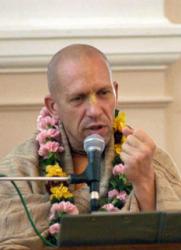
 Date: March 7, 2008
Verse: Srimad-Bhagavatam 3.13.14-16
Speaker: HH Bhaktivaibhava Swami
By Ananda Tirtha (das) PVS (Mayapur – IN)
You can download the audio file from here
or start the player below to listen
_______________________
maitreya uvaca
paramesthi tv apam madhye tatha sannam aveksya gam
katham enam samunnesya iti dadhyau dhiya ciram
TRANSLATION: Sri Maitreya said: Thus, seeing the earth merged in the water, Brahma gave his attention for a long time to how it could be lifted.
PURPORT: According to Jiva Gosvami, the topics delineated here are of different millenniums. The present topics are of the Sveta-varaha millennium, and topics regarding the Caksusa millennium will also be discussed in this chapter.
(invocatory prayers)
Bhaktivaibhava Swami: So I was told to read verse fourteen and fifteen also.
Text 14: “Sri Manu said: O all-powerful lord, O killer of all sins, I shall abide by your order. Now please let me know my place and that of the living entities born of me.”
Text 15: “O master of the demigods, please attempt to lift the earth, which is merged in the great water, because it is the dwelling place for all the living entities. It can be done by your endeavor and by the mercy of the Lord.”
.
So we have again this morning the darshan of the Manu subject matter. It was discussed yesterday morning I remember, I think the question being raised was the difference between Manu and manvantara. Manvantara is a sandhi, a combination of manu and antara, manu-antara, manvantara. Antara has different meanings, one meaning is within, another meaning is creation; another translation I noticed in Srila Prabhupada’s synonyms is duration of life, lifespan also. Then it comes to meaning the lifespan or duration of the Manus. That is manvantara. It is a little confusing because sometimes just the name of the Manus are given, like Iksvaku Manu, for instance, and there you only have the word Manu. But sometimes you also read Iskvaku-manvantara. It’s a little confusing. But it actually means the Manu in that period.
Another point is the topics of the pastimes of the various lila-avataras, incarnations of the Supreme Lord, they may refer to different millenniums. Again millennium also means reign of a Manu, or period of a Manu. Beginning with the Svayambhuva-manvantara and at the end the Caksusa.
Just like the Matysa-avatara incarnation of the Lord, he appeared at the beginning of Svayambhuva-manvantara in order to save the Vedas. And again at the end of the Caksusa-manvantara, again the Matysa-avatara appears in order to favour Satyavrata, King Satyavrata. So here we see the same lila-avatara, the same incarnation but at different times for slightly different purposes. The same thing will also be explained relating to Varahadeva. There are also two incarnations of Varahadeva slightly differing in complexion and also in some aspects of the lilas.
Then we can just recall in one day in Brahma’s life, fourteen Manus appear. We can imagine what a long period that is. Within that period of fourteen Manus, twenty-five lila-avataras appear, that means in one month 420 Manus appear, and then in one year 5040 Manus, and then 100 years means 504,000 Manus. So there are a lot of Manus appearing in the lifespan of Lord Brahma.
Presently we are existing in the Vaivasvata-manu, manvantara period. Brahma’s present day, that has also beeen explained in the purport by Srila Prabhupada, is known as sveta-varaha kalpa. So Varahadeva’s pastimes are very close to us. We have been blessed and favoured Varahadeva, because if Varahadeva would not have lifted the earth from the Garbhodaka Ocean, where would we be? We are very indebted to Lord Varaha.
In one purport Srila Prabhupada explains that one Manu appears after the other Manu, and all the various Manus are empowered by the Supreme Personality of Godhead. In that purport Srila Prabhupada explains that these various Manus are being empowered the Lord to impart the cult of Krsna consciousness. Here we already have a sort of disciplic succession, one Manu after the other, they all impart and transmit Krsna consciousness in various ways. In that particular purport Srila Prabhupada refers to that Bhagavad-gita verse:
imam vivasvate yogam proktavan aham avyayam
Srila Prabhupada concluded that the cult of Krsna consciousness, or the Krsna conscious movement, cannot be stopped by any means, it is not possible, because it refers to the glorification of the Supreme Personality of Godhead.
mattah parataram nanyat kincid asit dhananjaya
Nobody can stop the glorification of the Supreme Personality of Godhead. There will always be somebody somewhere in the universe to spread the glories of the Supreme Lord. Nobody can stop it. In one letter Srila Prabhupada wrote that, referring to one disciple, that “If you simply have faith in the disciplic succession you will never be defeated. You will never be defeated in your attempts to spread Krsna consciousness.” It will never become stopped.
Again, just to recall, Lord Brahma’s lifetime lasts 311 trillion, 40 billion years, a very, very long time, and yet it is explained that in the Causal Ocean there are millions of Brahma’s taking birth, just when the Lord exhales or when he inhales. Just like the bubbles in the Atlantic Ocean. We cannot imagine how many bubbles appear, that many Brahma’s appear just when the Lord exhales. We can chant this Brahma-samhita verse together:
yasyaika-nisvasita-kalam athavalambya
jivanti loma-vilaja jagad-anda-nathah
visnur mahan sa iha yasya kala-viseso
govindam adi-purusam tam aham bhajami
In that verse it is explained that in just one breath of Maha Visnu so many Brahma’s appear and again they disappear. That is the greatness of God. It is a common phrase that “God is great.” That everybody accepts, but how great, this is what Srila Prabhupada challenged sometimes, “Yes, God is great, accepted, but precisely how great is he?”
This is a perfect description about the majesty of the Supreme Personality of Godhead, the greatness of the Supreme Lord. When he exhales, just like when we take a bath you can see at the pores of the hairs so many small air bubbles are there. Just like that, out of the pores of the hairs, out of the mouth, innumerable universes come out. That is the greatness. He is so great:
anor aniyan mahato mahiyan
The Kathopanisad verse, that verse explains that he is the greatest of the greatest. He is so great that we cannot comprehend, we cannot conceive, he is so great. Imagine how vast, how great Maha-Visnu’s transcendental body is. The universe come out of the pores of the hairs, how great, we cannot perceive. And then again, anor aniyam, he is smaller than the smallest. Again we cannot see. In that particular verse it refers to the living entities, the jivatma, soul, the ten thousandth part of the tip of a hair. Again so small, we cannot see the soul, we cannot see Maha-Visnu. Greater than the greatest, smaller than the smallest.
That is the majesty of the Supreme Personality of Godhead. Again it is not possible to just directly approach him. Even in this world it is very, very difficult to come close to, to approach a big person. That is not necessarily a glorious qualification, but just as a crude general example, to someone important you cannot just walk up, “Hey, I want to talk to you.” You have to meet the secretary, you have to make arrangements days in advance, then you might see the president of a particular country or whatever great person. So what to speak of the greatest person. We cannot just approach directly. Therefore the parampara system is being stressed again and again in Srila Prabhupada’s purports, in his classes, in so many different ways. What is that nice verse?
tvad-bhrtya-bhrtya-paricaraka-bhrtya-bhrtya-
bhrtyasya bhrtya iti mam smara loka-natha
King Kulashekhar prays to the Lord like this, “Let me become the servant of the servant of the servant of the servant of the servant of your servant.”
Srila Prabhupada alluded to that verse, emphasizing the importance of the attitude of a Vaisnava, the humility of a Vaisnava. He does not want directly, he rather desires to become the servant of the servant of the servant of the Lord, one thousand times removed, Srila Prabhupada explains. That is humility.
Specifically in the last years I was personally contemplating very much on this point of humility. We have heard it so many times, we have to be humble, yes. But it is really a challenge. The false ego takes on practically unlimited facets, and shades and varieties, again and again tricking the conditioned soul to fall back into the clutches of the illusory energy of the Lord. Thinking in various ways, “Yes, I am the controller, I am the enjoyer.”
It is a challenge, how to practice humility becauseMahaprabhu stresses this point in Siksastakam that that’s the only qualification. No qualifications are required to chant Hare Krsna, surrender to Krsna, whatever our material situation or condition might be it doesn’t matter. The Lord is so merciful.
Srila Bhaktivinoda Thakur explains in his Namastaka the vacya and vacaka. There are two different transcendental forms of the Supreme Lord. One is vacya, that refers to the transcendental body of the Supreme Lord, and vacaka which refers to the holy name. Out of these two, of course the transcendental body of the Lord is full of all transcendental qualities, always emanating the mercy of the Supreme Lord, but still the holy name, vacaka, that is even more merciful. It might happen that we might offend the vigraha of the Lord when we perform our various worships, it might happen we commit some offences.
Unfortunately in our GBC meetings we had our Deity Worship Ministry make a sad report that we had to receive that the Deity worship has been neglected in many, many places, different parts of the world. It is very serious. That might happen. Of course we should not try to justify, we must change, we have to change immediately, but still my point is it might happen. But Srila Bhaktivinoda Thakur explains somehow when we take full shelter, when we are under the shelter of the holy name of the Lord constantly chanting:
Hare Krsna Hare Krsna Krsna Krsna Hare Hare
Hare Rama Hare Rama Rama Rama Hare Hare
Then eventually by the mercy of the holy name we will be protected from the reactions of offending the transcendental body of the Supreme Lord. Therefore Bhaktivinoda Thakur begs to be able to constantly take shelter of the holy name of the Lord. There is a very nice verse by Rupa Goswami, Dravida Prabhu, maybe you can help out:
tunde tandavini ratim vitanute tundavali-labdhaye
karna-kroda-kadambini ghatayate karnarbudebhyah sprham
cetah-prangana-sangini vijayate sarvendriyanam krtim
no jane janita kiyadbhir amrtaih krsneti varna-dvayi
A beautiful verse. In that verse, Rupa Goswami explains, “I do not know how much nectar the holy names have produced. I cannot imagine. When the holy name has been chanted it appears to dance within the mouth therefore we desire many, many, many mouths. When that name enters the holes of the ears we desire many millions of ears. And when that holy name dances in the courtyard of the heart it conquers the activities of the mind and all the senses become inert, finished.
That is attraction, that’s the glory of the holy name. We might also sometimes desire this, I might also sometimes to desire like this to have many mouths, just to finish my rounds quickly [laughter]. I also want to have millions of mouths so it just takes one second to chant my rounds, “Hare hare hare,” finished. That is a different level of desiring. We should rather desire, it refers to taste, there is so much taste for the holy name.
Therefore durdaivam idrsam ihajani nanuragah, anuraga means attachment, na-anuragah, no attachment. Although the holy name is so glorious, giving unlimited benedictions. Again, Skanda Purana and different Puranas explain that if you take all the pious reactions from performing various sacrifices, all the holy places, all the holy rivers, whatever seems to be pious in this world, if you take it all together, it is being channeled into the holy name. It is so beneficial, so glorious. Api means although, despite, despite being so beneficial, so glorious, nanuragah, no taste, no attachment. Why? Durdaiva, durdaiva means offences, not properly chanting.
The first offence against the holy name is to blaspheme, criticize, trying to find some faults especially in those sadhus, sadhu-ninda, in those devotees who have dedicated their lives to spreading the holy name of the Lord. That is the first offence. Of course we know the other offences as well. Unfortunately when offences are being committed then this is exactly what happens, lack of taste. We discover again and again why devotees have so many problems in their practice of Krsna consciousness, why? Lack of taste. Sometimes we say, “Oh, I have to chant my rounds.” Why? It’s a pleasure, a benediction to chant, not “I have to, I have to chant my rounds.”
We have to want to chant our rounds, then there’s progress and hope. This durdaiva is so important, dur is something bad. When we really come to the point of stopping these offences as much as possible, then the taste, not just for the holy name, the holy name is the basis for all our devotional activities, but anything else, the kirtan, prasadam, the association of devotees, studying the sastra, all the nine activities of devotional service will become pleasurable because the taste is there. Why so many going here and there and restless? No taste.
Mahaprabhu knew the apathy of the conditioned souls to chanting the holy name. This is why he is stressing so much, durdaivam should not do. Let us try rather to be simple devotees, as humble as possible. If there is some conflict, what is the difficulty? Let me work out, OK, let’s do like this. “I want to open the window,” “I want to close.” Why fighting? “OK, then let’s half open,” some compromise, what is the difficulty? Why so much fighting, fighting, fighting?
And when there are no offences then the pure name is being chanted and that will result in more and more humility, that will manifest. “Let me serve.” If I want to serve someone, what is the difficulty. But if I want to exploit, then there’s conflict.
I just want to read the verse one more time, oh I closed the book [repeats verse and translation]Srimad-Bhagavatam ki jai! Srila Prabhupada ki jai! Gaura premanande. Hare Krsna. [applause]
I think I will just take one, one and a half questions and then we can honour prasada. Is there just one really, yes?
Ekalavya Das: Maharaja, you were talking about vacya and vacaka and that the holy name is so merciful because it vanquishes the offences in Deity worship. My question is that is there some danger that we may get some polluted consciousness in chanting, similar to the seventh offence, committing sinful activities on the strength of chanting the holy name. I can be negligent in my Deity worship, because I am chanting my offences will be vanquished.
Bhaktivaibhava Swami: That is not good, that is another offence against the holy name. No, but the point is that this is the last chance, the last chance, we have to have some chance. The last chance is to somehow completely surrender to the holy name. That’s the last emergency break. When we are already on our way down on the train of our unfortunate practice of the Krsna consciousness, that is the last emergency brake to somehow take full shelter of the holy name. That’s the last chance. That should be the first and the last and the middle chance [laughs]–we should always take shelter of the holy name. Srimad-Bhagavatam ki jai! Hare Krsna.