
By Sita Pati Das
To help strengthen our mrdanga playing culture, I have produced a book with 50 bonafide mrdanga beats in it. These beats are all notated using a “tablature-style” notation, like the one below:
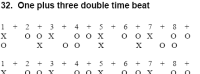
These beats are taken from standard ISKCON kirtan beats and beats used by mrdanga players in the Vrndavana 24-hour kirtan.
You can download the book from the following link:
The Art and Science of Harinam Sankirtan Yajña
By learning and teaching to play the mrdanga properly we can preserve and strengthen our Vaisnava culture and heritage, as we simultaneously adopt and adapt new innovations and assimilate existing elements in the cultural space that we are expanding into. Staying connected to our core allows us to deal with new elements in a healthy, non-fanatical way.
There is ongoing controversy surrounding the use of djembe drums in ISKCON Vaisnava kirtan. Recently we had the mercy of Bada Hari das, who came to our annual Vaisnava Retreat for preaching staff in Brisbane. After one kirtan there featuring a djembe drum he shared a saying, apparently common around New Rama Reti, Alachua: “When a djembe plays a gandharva falls from the sky”. After that we shelved the djembe for the rest of the retreat. Generally we use mrdangas, and sometimes use the djembe to fortify the bottom end in big kirtans.
I’m agnostic on the djembe. Some devotees object to the materials used to make it, but of course you can get djembes made from synthetic materials, similar to our Balaram mrdangas. Personally I prefer and play the mrdanga, and if I were to use another drum in kirtan I prefer the darbuka, or Egyptian tabla. I think that there are two reasons why djembes are rising in popularity in ISKCON kirtan. One reason is that they are relatively easy to play, or begin to play, compared to a mrdanga. To play the mrdanga effectively in kirtan takes a longer time and a greater amount of practice. Another reason is that djembes are easier to obtain than mrdangas. They are sold in most drum shops in modern cities, and can be supported with spare parts, maintenance, and professional tuning, easily and widely.
One of the drawbacks of the easier entry level of djembes is that djembe players inexperienced in playing mrdanga beats sometimes play the drum in such a way that it does not reinforce the mrdanga beat, but clashes with or overrides it.
A stronger culture of mrdanga playing and proficiency in ISKCON, combined with more local production of mrdangas using locally available technologies, materials, and designs, will have the effect of reducing the influx of djembes, and will also assist to make the integration of the djembe and other drums more organic. This way the djembe will not replace the mrdanga or compete with it, but rather in instances where it is present it will complement it.
So I hope that devotees will take advantage of this book to strengthen the culture of mrdanga playing in ISKCON.
I’ve just started reading this book, and one piece of advice raised a vivid memory in my mind. Sita-pati suggests that we tune mrdangas by gently tapping the heads on the ground to raise the pitch. I saw a wonderful kirtaniya do just that in Honolulu in 1974, and Srila Prabhupada stopped him cold and, in front of everyone, admonished him never to do that. Perhaps others have experienced the same thing.
Thanks for the feedback Babhru prabhu.
It’s difficult to extrapolate a policy based on just this one incident. Definitely you should not tune the mrdanga this way if you don’t know what you are doing, especially if it’s not your mrdanga.
When I studied tabla with Dr Talochan Singh he would tune his tablas with a small hammer, and would tune my khol the same way. He also added wooden rollers under the leather straps on my khol to make it more easily tunable.
These two things – inserting wooden rollers and using a small hammer to tune the mrdanga – are better to use than bumping it on the floor.
My feeling is that Srila Prabhupada’s instruction was more a practical one designed to stop a sudden trend of slap happy devotees weakening and breaking mrdangas by over-enthusiastically “tuning” them on the floor, rather than based on an esoteric consideration.
If, on the other hand, it is based on an esoteric consideration, then this is all the more reason why mrdanga prabhu should never be placed on the floor, but should also be offered an asana. This is a very common seva aparadha in ISKCON temples and centers – placing the mrdanga on the floor.
I will add a note incorporating this in the next edition.
If you mean some universal policy, fine. But it was clear that he stopped this very expert musician from “tuning” the mridanga on the floor because it was disrespectful. He said later that using a mallet or placing the head near the fire on the stove was fine, but not the floor. I like your idea of heating a cloth to put on the head, but I’d guess that’s not always practical.
Thank you for the clarification Babhru prabhu. I will modify the book according to your direction.
Dr Singh explained to me that using a cloth that is heated from the stove allows you to control the application of the heat more safely. Placing the mrdanga near the stove has the potential to damage the head through overheating and drying it out.
If tuning the mrdanga on the floor is disrespectful, it indicates that putting him down on the ground is also.
My personal realization is that the mrdanga does not mind being tuned on the floor if you have a personal relationship with him. If you consistently place him on an asana, and then during a kirtan you gently bump him on the ground to tune him, he’s ok with that service. You will also have a sensitivity to know what feels good to Him, and what is unfavorable to his pleasure. This is probably not something that should be imitated prematurely, and we should first learn to respect him as a manifestation of the Supreme Personality of Godhead.
Not tuning him on the ground because it is disrespectful, but at the same time putting him down directly on the floor without a second thought, as is the norm in every ISKCON temple I’ve visited so far, appears inconsistent. The idea behind not tuning him on the ground should extend to not placing him on the ground at all.
The best idea is to develop an initial aisvarya-tinged relationship with Lord Balarama in his form as the mrdanga. The mrdangas in ISKCON temple are constantly in a bad state of repair because devotees often do not realize that this is the Supreme Personality of Servitorship to Godhead, and should be honored as such. Books, japa beads, deity worship paraphenalia, and other sacred items are never placed on the floor. Lord Balarama in his form as the mrdanga should also never be placed on the floor.
I think if you follow the pathway I have set out in the book, that of worshiping the mrdanga with flowers and incense, and constantly placing him on an asana, you will develop to the point of being able to gently bump him on the floor. When you feel reflexive physical dis-ease at the sight on Lord Balarama on the floor you will have the sensitivity to serve him by bumping him on the floor.
However, I will take that recommendation out of the book, because I would not like to see people justify bumping him on the floor based on my book, when they do not consistently worship him as the incarnation of the Supreme based on the same.
Haribol Sita Pati Prabhu,
Thank you for this book. Having played mrdanga for 30 some years I am always interested in learning more. I have a humble request. It would be very helpful to people like me who have no formal training in mrdanga but who just learned by doing it and watching others if you could put out a mp3 of the sound of the beats when played properly. I know for myself it is much easier to hear something and try to play it than it is to try to decipher it in written form. Even a 20 second sample of each beat would be very helpful to a technically illiterate person such as myself. If you are willing I would be very grateful.
Your servant,
Makhanchor das
Hey, Makhanchor, is that you? My old traveling Sankirtan buddy from the frigid Canadian prairies?
I can hardly tell from the picture. We have been “changing bodies” these last 30 or so years, I am sure you would not recognize me, either. But it does kind of look like you.
Please drop me a line if you find the time. My email is:
bernsteinlaw@earthlink.net
As you wish Makhanchor prabhu.
I’ll do small video podcasts of each of the mantras and make an online version of the book. This will take a little while to complete. In the meantime I have put up one podcast with accompanying mantras, here: Daadra taal mrdanga lesson.
I’ll get everything together and then let you know when it is ready.
Thank you very much Sita Pati prabhu. Yes the daadra taal mrdanga lesson is great!! It gives a good idea of how the beats are used, especially with the kartals and when you sing along for a bit. Very nice. A couple of those beats I have my own versions of, so it will be nice to know how they are actually supposed to be played. : )
This is very nice service to aspiring mrdanga players everywhere. Thank you.
The secret of the sweet sound of a mrdunga is the traditional clay shell, combined with the high tension of the heads with the added mass of the gob. I have been producing fiberglass shells with traditional leather heads for the past 18 years, but have never been able to make my drums sound like the clay shell drums. My drums are tunable with a key, so learning to tighten them by pulling straps isn’t necessary. The practice of tuning the mrdunga by tapping the rim of the drum on the ground is disrespectful. The mrdunga should never touch the ground, and in fact should also be wrapped with a cloth. Srila Prabhupada himself demonstrated this in San Francisco when the first shipment of drums arrived there. In India, there is a cushion made for the drum where the drum is placed after being played. The drum should not be set down on the large head, as is usually done in the West. The cushion is necessary because the belly of the drum shell is very fragile. While I was in Mayapur learning to make drums, the local mrdunga mistry would make sure that we understood how sacred these drums are. Mrdunga making is essentially working with dead animal skin, which on the surface makes it muci, or unclean. However, he would come freshly bathed, with clean lungi, and pay obeisances to the drum before working on it. He used to say that while working on the drum, we must use the feet (for tightening, etc.) but when we are done, we put our head to it (as obeisances). He would not allow any of us to actually make a drum. He wanted to be sure we understood that offences to a mrdunga was very serious. Using the mallet to make final adjustments to tune the drum is the proper way. First, the straps must be tightened, using a technique we learned from the teacher. Heating the head is all right, but must be done carefully. I have found a special dessicant that will absorb excess moisture from the atmosphere, which if kept in a sealed container along with the mrdunga, will tighten the mrdunga overnight. Another hint is that the loops that are generally used to attach the drum to shoulder straps isn’t meant for that purpose. Those loops are used for carrying the drum. If they break (and they often do), the drum will fall down. We used to use coated wire to attach a shoulder strap to the drum, lacing it under the mrdunga straps near the heads. If the drum heads are too tight, you can use a little water on your finger to moisten the leather, but not the gob.
Pavamana prabhu, thank you very much for sharing your experience and realization. Are your drums available to purchase?
I am very interested to see how you put a leather head on in a key-tunable fashion. I am also interested to learn about the gob. Could you possibly contact me via email? My address is sitapati at worldsankirtan.net
My drum project is currently suspended. I have pressing family issues, and it’s on the back burner. Sita-pati prabhu, I tried your email address as sitapati@worldsankirtan.net, but it didn’t work. Please email me at pmc033@earthlink.net. I wrote you a lengthly reply, but it bounced. It’s too long to paste here. Your servant, Pavamana dasa
Dear Prabhus,
I am not by any means an expert in music or the playing of mridangas. However, I enjoyed your discussion. Several years ago I purchased one traditional clay mridanga from a small stall where they were being made in Calcutta. I observed how they apply the gob. They take very fine iron filings and mix it with white rice that has been cooked very soft and mashed into a paste. The iron filings and rice paste mixed with water forms a black paste. They apply that to the heads of the mridanga and press it in circular motions onto the heads with a smooth rounded stone. They work it into place and let it dry and place layer over layer until they are contented. The use the same mixture to repair the gob when it becomes pitted or loses some of the gob. That is my limited experience. I would be interested to hear the comments of Pavamana prabhu. I have several Balaram Mridangas, and they sound very sweet. They are tunable and wonderful. When I pick one of them up, I feel that they are very special, and practically they are the astra (weapons) of Sri Chaitanya Mahaprabhu in the Sankirtan Movement in this Kali Yuga. It has been wonderful to see how the devotees have so much expertise to dovetail their talents in the service of Sri Sri Guru Gauranga. I hope this finds you all in good health and happy in Krishna consciousness. Sincerely, Pusta Krishna das
Dear Prabhus:
Unfortunately, this forum doesn’t allow me to post my lengthly reply to Sita-Pati Prabhu. I’ve spent a lot of time studying mrdunga making, and experimenting with various designs and shells. Making the gob is not as easy as it appears. Pusta Krishna is correct that some gobs are made with iron filings. They go to metal smiths and collect the filings from the grinding operations there. Iron filings are used in making gob for tabla heads, which are usually made from goat skins. Not surprisingly, a lot of tablas are made in the shops in Calcutta, nearby the local Kali temples where goats are regularly sacrificed to Kali. The place is called “Kali Ghat”. In Nabadvipa, there is not so much use of iron filings, and the mistry I learned from didn’t use it. It just adds more mass to the gob. Usually, it is a mixture of pottery dust and rice paste. I’ve seen it made many times, but when I’ve tried to duplicate the process here at home, it hasn’t worked well. Perhaps it’s the kind of rice which they use that’s the difference. I don’t know. Some gob attempts I’ve done have lasted a very long time, and others fell off immediately. I do know that sifting the pottery dust is an important step. The ground dust from broken mrdunga shells is sifted through a fine cloth and captured in a jug by shaking a cloth bag containing the dust inside. This fine, talcum powder-like dust is used to make the gob. It’s an all-day affair, spreading the putty-like gob mixture little by little on the surface, letting it dry, and putting tiny cracks in the gob after each layer. This is usually done with the heel of the palm by hitting the gob all over. On the small head, sometimes the elbow is used because of the smaller area. At the end, a very hard, polished stone is used to burnish the gob to seal it and make it smooth. Often a final coat of wood ash is applied to make it black. It’s been many years since I’ve watched them do this, so I have probably missed a few things.
There’s no substitute for a nice clay mrdunga with it’s clear bell-like sound. Mrdunga making is a special art, and unfortunately are almost exclusively made in Bengal. In the coming years, there will be a need for devotees to produce them locally. And that’s why Srila Prabhupada wanted devotees to learn how to make and repair them. The Balaram drum is very nice, but in the long term, local production would be best.
Your servant, Pavamana dasa