
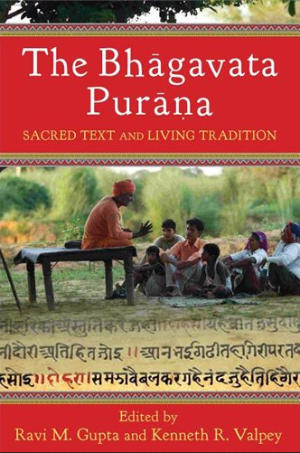
Edited by Ravi M Gupta and Kenneth R. Valpey
The editors of “The Bhagavata Purana: Sacred Text and Living Tradition” (published by Columbia University Press) both teach at Bhaktivedanta College. Ravi M. Gupta (Radhika Ramana Dasa) is also an associate professor of religious studies at The College of William and Mary. Kenneth R. Valpey (Krsna Ksetra Dasa) is the Dean of Studies at Bhaktivedanta College and a regular visiting scholar at Chinese University of Hong Kong. They both earned their doctorates at Oxford.
Last year, Lillian Stevens wrote about this new book and its editors. The following paragraphs are adapted from her article.
Ravi M. Gupta is working on an abridged English translation of the Bhagavata Purana. Fluent in Hindi, English, and Sanskrit, Gupta grew up in Boise, Idaho. He is a major figure in the U.S. Hindu community; in 2008, he was selected to meet with Pope Benedict XVI as a representative of American Hindus. The author of “The Caitanya Vaisnava Vedanta of Jiva Gosvami: When Knowledge Meets Devotion”, he is working with Kenneth R. Valpey, a colleague from the Oxford Center for Hindu Studies and the author of “Attending Krishna’s Image”.
Their translation will come out in 2014 and will accompany a new volume of scholarly articles examining the Bhagavata Purana, just published by Columbia University Press. It is entitled “The Bhagavata Purana: Sacred Text and Living Tradition.” Introducing the Bhagavata Purana’s key themes while also examining its extensive influence on Hindu thought and practice, this new collection of essays conducts the first multidimensional reading of the text’s entire twelve volumes.

Ravi M. Gupta
“The Bhagavata Purana stands out as an important piece of world literature, with some of the most beautiful poetry youâll find in any language,â says Gupta. âItâs an excellent literary piece in terms of poetic ornamentation, alliteration, and all kinds of innovative Sanskrit verse meters. And it stands out aesthetically in terms of the imagery and stories that are used. There will be an abridged translation covering approximately ten percent of the Bhagavata Puranaâs text. The accompanying volume of articles written by different scholars is edited by us, and some of those articles were written by us and other devotee scholars.â

Kenneth Valpey
âKenneth Valpey and I envision a consortium of scholars from around the world who will take up different commentaries from different periods of history and work with them, maybe not to translate all of the commentaries, but to study important areas,â he explains.
Over time, Gupta hopes to undertake an historical analysis of these various periods of Indian history and study how the Bhagavata Purana has interacted with other texts and other cultures as it has migrated to different parts of the world.
From the back cover
A vibrant example of living literature, the Bhagavata Purana is a versatile Hindu sacred text containing more than 14,000 Sanskrit verses. Finding its present form around the tenth century C.E., the work inspired several major north Indian devotional (bhakti) traditions as well as schools of dance and drama, and continues to permeate popular Hindu art and ritual in both India and the diaspora. Introducing the Bhagavata Purana’s key themes while also examining its extensive influence on Hindu thought and practice, this collection conducts the first multidimensional reading of the text’s entire twelve volumes.
The Bhagavata Purana is a hard-to-classify embodiment of classical Indian cultural, religious, and philosophical thought. Its language and poetic expression are on a par with the best of Sanskrit poetry (kavya), while its narrative structure holds together tightly as a literary work. Its theological message centers on devotion to Krishna and Vishnu, while its philosophical content is grounded solidly in the classical traditions of Vedanta and Samkhya. Each essay in this volume focuses on a key theme of the Bhagavata Purana and its subsequent presence in Hindu dance, music, ritual recitation, and commentary. The authors consider the relationship between the sacred text and the divine image, the text’s metaphysical and cosmological underpinnings, its shaping of Indian culture, and its ongoing relevance to contemporary Indian concerns.
 “The Bhagavata Purana gathers a superb group of contemporary scholars who bring a new dimension of appreciation for this religious masterpiece of Vaisnava Hinduism. Their essays plumb the breadth and depth of the influence of one of the world’s religious masterpieces with its unique devotional intensity and metaphysical subtlety. The vast narratives of the Bhagavata Purana reveal a luxuriant universe in which the divine and created worlds interpenetrate and in which Krishna is portrayed as a God truly to be loved with ‘whole heart, mind, soul, and strength.’ The Bhagavata Purana’s special genius heightens devotional intensity to Krishna while presenting profound theological discourse. No wonder Hinduism in all its varieties cannot be understood without first understanding The Bhagavata Purana. Ravi M. Gupta and Kenneth R. Valpey are to be thanked for gathering these important contributions to its scholarship.” — Daniel P. Sheridan, Saint Joseph’s College of Maine
 “This book brings together some of the most highly regarded scholars on this subject and cohesively provides an entry into the main themes of The Bhagavata Purana. Moreover, it does so in an interdisciplinary fashion by drawing on materials from the areas of comparative religion, theology, history, anthropology, and ethnomusicology.” — Cynthia Ann Humes, Claremont McKenna College
I look forward to reading the book. It is thrilling to see devotees in Srila Prabhupada’s line who are able to communicate in the academic world so nicely. The Hare Krishna movement is truly branching out into all different communities and sectors of society.
It is encouraging to see the Srimad Bhagavatam as the center of thought. I am especially looking forward to the study of how SB has interacted with other texts and cultures. I hope these books help certain kinds of people feel the legitimacy of SB and help them take to devotion to krsna.
But, honestly, there is something about the “From the back cover” that bugs me.
I’ve learned from Bhaktivinoda Thakura that a swanlike person is not interested in quarrel and that if the modern scholars have good reason to think SB, in its present form, was written in the tenth century, well, ok, who cares because the advancement of vaisnavism does not depend on whether you believe that, or believe what the scriptures themselves say about their date and author.
I really don’t care about the 14,000 verses either, because, what does it really matter (or is my memory failing and there aren’t 18,000 verses??)
But that word “hindu” really rubs me the wrong way. Is that absolutely necessary? When Ms. Stevens uses it, that is understandable. But on the back cover of the book? Bhaktivinoda’s book summarizing the SB says that if you give sanatana dharma a sectarian name, then other sects will oppose it. A “versatile Hindu text” is not the SB I know. I get it that they’re trying to make it…somehow more acceptable (??) or understandable (??) by being called Hindu and connect it with hinduism. But prabhupada in talks with pusta krsna in 1976 strongly points out that sanatana dharma is not hindu dharma. This hindu dharma is the wrong conception, he says. So why word it that way on the cover…and inside??
I’d also say that Prabhupada’s translation and “reading” is more truly “multidimensional,” if you take the literal meaning of the word, and so this is not the First multidimensional reading.
All that said, it’s nice someone is pulling people into a reality where SB exists.
When I worked on my MA in South Asian Studies (Sanskrit, Hindi, Medieval Hindi, and Indian History), I was exposed to historians’ views of the chronology of Indian history and literature. It differs from our Vaishnava understanding of the chronology. Srila Prabhupad was not ignorant of these alternate conceptions. But, His Divine Grace took things on faith, with faith being invested in our Parampara. He never broke with that, even when he entertained alternate ideas. And, very importantly, he took things very literally. Once while taking a walk on the roof of the original Mayapur building he said (and I quote):
“Vyasadeva is not writing stories for children. When he describes Bakasura, he is literally describing this large duck demon. He is the greatest philosopher. He will not waste our time with children’s stories. The chain is only as strong as its links. If one link is weak, the whole thing is placed into question.”
Try to understand this communication of Srila Prabhupad. We also must have faith in this understanding. Afterall, who with their material speculation could ever speculate that God is an ever-youthful dark blue Person? While He appears like a human, He is fully spiritual. Human beings, their forms, like all material form is simply made up of the material elements. God is not human…and we spirit souls are also not human. We are spiritual persons with spiritual forms, not human forms. The spirit soul is not composed of muscle, bone, water, and the spirit soul is effulgent amazing and eternal. We may view examples of bhaktas in the Srimad Bhagavatam, they may appear human but they are all spiritual. Consider Bhisma enlightening others on a bed of arrows!
Bhagavat dharma is not mundane religiosity! Sanatan dharma is not human dharma, but the dharma of the eternal nonmaterial soul. While varnashrama dharma, created by Krishna, is created by Krishna, that is not the endpoint of the eternal serving soul. Rather, it is a means for forming a God-centric society.
Best wishes in your preaching work and your new book…..Pusta Krishna das